Tag: healthy aging

  • 7 Strength Habits That Matter More After 60

    7 Strength Habits That Matter More After 60

    What strength habits matter most after 60?

    Short answer: Most strength after 60 is built or lost outside the gym. Practice getting up from a chair without your hands, carry things on purpose, walk every day and take the stairs, eat some protein at every meal, practice balance, keep your grip strong, and protect your sleep.

    Getting stronger after 60 is absolutely possible. But here is something I wish more people talked about: most of your strength is not built or lost in the gym. It is built or lost in the other 23 hours of the day.

    I’m in my 60s, and I work out to feel like a healthier me as I age. Workouts matter, and I wrote a whole guide on how to build muscle after 60 without getting hurt. This post is about the everyday habits that make those workouts pay off and keep you capable in real life: getting out of a chair, carrying groceries, climbing stairs, traveling, working around the house.

    The 7 habits at a glance

    1. Get up from a chair without using your hands
    2. Carry things on purpose
    3. Walk every day, and take the stairs when you can
    4. Eat some protein at every meal
    5. Practice your balance while you do something else
    6. Keep your grip strong
    7. Protect your sleep and your recovery

    1. Get up from a chair without using your hands

    Standing up from a chair is one of the most important strength moves you will ever do, and you do it all day. Next time you get up, cross your arms or keep your hands off the armrests and stand using your legs. Sit back down slowly instead of dropping.

    Want to make it a habit? Do five slow sit-to-stands every time a commercial comes on, or before each meal. If it is hard right now, use a higher chair or a cushion and work your way down.

    2. Carry things on purpose

    Carrying works your grip, shoulders, core and legs all at once, and it is exactly what life asks of you. Carry the grocery bags in instead of using the cart all the way to the door. Carry the laundry basket up the stairs. Split heavy loads evenly in both hands, stand tall and walk steadily.

    Keep it to a weight you can carry without hunching or holding your breath. The goal is to make everyday carrying feel easier, not to strain.

    3. Walk every day, and take the stairs when you can

    Walking keeps your legs used to working, and stairs add a little strength training without calling it a workout. Park farther away, take one flight instead of the elevator, walk after dinner. The CDC recommends older adults get at least 150 minutes of moderate activity a week, and brisk walking counts. If you want to know how much is enough at your age, I break it down in how many steps or minutes of exercise you need in your 50s, 60s and 70s.

    4. Eat some protein at every meal

    Muscle needs raw material. A lot of us eat a light breakfast, a light lunch and most of our protein at dinner. Spreading it out gives your body a steadier supply through the day.

    Simple ways to do it: eggs or Greek yogurt at breakfast, chicken, tuna, beans or cottage cheese at lunch, and fish, meat, tofu or lentils at dinner. Protein needs vary from person to person, so if you have kidney problems or another health condition, ask your doctor what is right for you.

    5. Practice your balance while you do something else

    Strong legs help you balance, and good balance helps you use that strength safely. The CDC includes balance activities in its guidelines for older adults for a reason.

    The easiest habit I know: stand on one foot while you brush your teeth, then switch at the halfway point. Stay next to the counter so you can grab it if you need to. Once that feels easy, try it while you wait for the coffee to brew.

    6. Keep your grip strong

    Your grip is what opens jars, carries bags and catches a railing when you slip. Researchers often use grip strength as a simple measure of overall strength as we age. You do not need special equipment. Carrying (habit 2) helps a lot, and so does squeezing a tennis ball for a few seconds at a time while you watch TV.

    7. Protect your sleep and your recovery

    Your workout and your daily habits are the stimulus. Sleep is when your body does the repair work. Try to keep a regular bedtime and wake time, and do not stack hard days on top of each other. If you are constantly worn out, more effort is not automatically the answer. Sometimes better rest is. I wrote more about that in sleep and longevity after 50.

    A simple daily strength checklist

    Print this or keep it on your phone. You do not need all of it every day. Checking off four or five is a good day.

    • ☐ 10 hands-free sit-to-stands
    • ☐ Carried something heavy-ish (groceries, laundry, a bag)
    • ☐ A walk, or at least one flight of stairs
    • ☐ Protein at breakfast, lunch and dinner
    • ☐ One-foot balance while brushing teeth
    • ☐ In bed at a regular time
    • ☐ Strength workout (2 days a week)

    For another perspective on strength and movement after 50, Journey to Fifty Plus shares fitness, wellness, and personal experiences focused on staying strong and active.

    Common Questions

    Can you get stronger after 60 without a gym?
    Yes. Everyday habits like sit-to-stands, carrying, stairs and balance practice all build useful strength at home. Adding two short strength workouts a week makes them work even better.

    What is the most important strength habit after 60?
    If I had to pick one, it is getting up from a chair without your hands. It trains the legs you rely on for almost everything else.

    How much exercise do older adults need?
    The CDC recommends at least 150 minutes of moderate activity a week, at least 2 days of muscle-strengthening activities, and activities that improve balance.

    Does protein really matter for strength after 60?
    Your muscles need protein to repair and grow. Spreading it across your meals is an easy way to make sure you are getting enough. Talk to your doctor if you have kidney disease or a condition that affects your diet.

    How do I make these habits stick?
    Tie each one to something you already do: balance while brushing teeth, sit-to-stands before meals, a walk after dinner. Habits attached to routines last.

    A gentle health note: Start at a level appropriate for your fitness and experience. If you have significant pain, balance problems, or a medical condition that affects exercise, consider talking with a healthcare professional before starting a new routine.

    My take after 60

    I still want my workouts to challenge me. But I have come to believe the small things, how you get out of a chair, whether you carry the bags, what you eat at breakfast, add up to more than any single workout. Strength after 60 is a long game, and these habits are how you play it every day.

    Getting older changes some of the rules. It does not mean you stop getting stronger.

    Your turn: Which of these seven do you already do, and which one are you going to start this week? Tell me in the comments.

    This article is general fitness information, not medical advice. If you have an injury, medical condition, or significant pain, talk with a qualified healthcare professional about exercise that is appropriate for you.

    Strong After Sixty book cover

    Strong After Sixty: The Complete Strength and Fitness Guide for Men Over 60

    by Dr Robert Dalton (Author)

    Check here: https://amzn.to/47yDK8t

    Affiliate Disclosure: Some links in this post may be affiliate links. If you purchase something through one of these links, Sturdy Years may earn a small commission at no extra cost to you. This helps support the site and allows us to continue creating helpful content.

    Written by Tom Green, creator of Sturdy Years

    Tom Green writes Sturdy Years. He was born in Pell City, Alabama, in 1962, and he’s a country boy and a true Southerner through and through. He’s just a regular, laid-back 64-year-old who keeps things simple. He shares what he learns about skincare, fitness and getting older, and what’s working for him. He’s also the author of A Practical Guide to Getting Older Without Giving Up on Yourself. Tom isn’t a doctor. He reads up on the research and passes along what’s useful, plain and simple.

    I’ve also mapped out some great tools on my new Tech for Independent Living After 50 page.

  • How to Build Muscle After 60 Without Getting Hurt

    How to Build Muscle After 60 Without Getting Hurt

    Can you still build muscle after 60 without getting hurt?

    Short answer: Yes. Lift twice a week with a rest day between, warm up for 5 to 10 minutes first, and pick a weight you can lift with smooth form while finishing each set with about two good reps left in the tank. Add weight only in small steps, and let recovery, sleep and protein do their part.

    Building muscle after 60 is possible, but I do not think the smartest approach is pretending you are 25. The goal is to challenge your muscles enough to adapt while giving the rest of your body, your joints, tendons and back, time to keep up.

    I’m in my 60s, and I work out to feel like a healthier me as I age. The fastest way to lose progress at this age is not skipping a workout. It is getting hurt and missing six weeks. So this guide is about one thing: how to start, or start again, in a way that keeps you training for years.

    The short version

    • Train at least 2 days a week. That is what the CDC recommends for older adults, and it is plenty to get started.
    • Start lighter than you think. End every set with about two good reps left in the tank.
    • Add a little at a time. One more rep or a small bump in weight, not big jumps.
    • Rest a day between hard sessions. Muscle is built while you recover.
    • Sharp pain means stop. Effort is fine. Pain in a joint is not.

    Why it is worth doing now

    We slowly lose muscle as we age, and that loss shows up in everyday life: getting out of a low chair, carrying groceries, climbing stairs, catching yourself when you trip. The good news is that muscle still responds to training at 60, 70 and beyond. If you want to understand what you are up against, I wrote about it in why muscle isn’t the only thing you lose with age.

    The “two reps in the tank” rule

    The right starting weight is not the heaviest weight you can move once. It is a weight you can lift with smooth, controlled form for your target reps, and when you finish the set you feel like you could have done about two more good ones.

    That one rule handles most of the safety problem. If you have to swing, jerk or twist to finish the set, the weight is asking more from your joints than from the muscle you are trying to train. Drop it a little and own every rep.

    Warm up for 5 to 10 minutes first

    Cold joints do not like heavy work. A few minutes on a bike or treadmill, then one light “practice” set of your first exercise, gets blood moving and lets you check how everything feels that day. Some days you will feel great. Some days you will want to go a little lighter, and that is fine.

    A simple 2-day starter plan

    Do this twice a week with at least one rest day in between, for example Monday and Thursday. Start with 2 sets of 10 to 12 reps for each exercise, using the two-reps-in-the-tank rule.

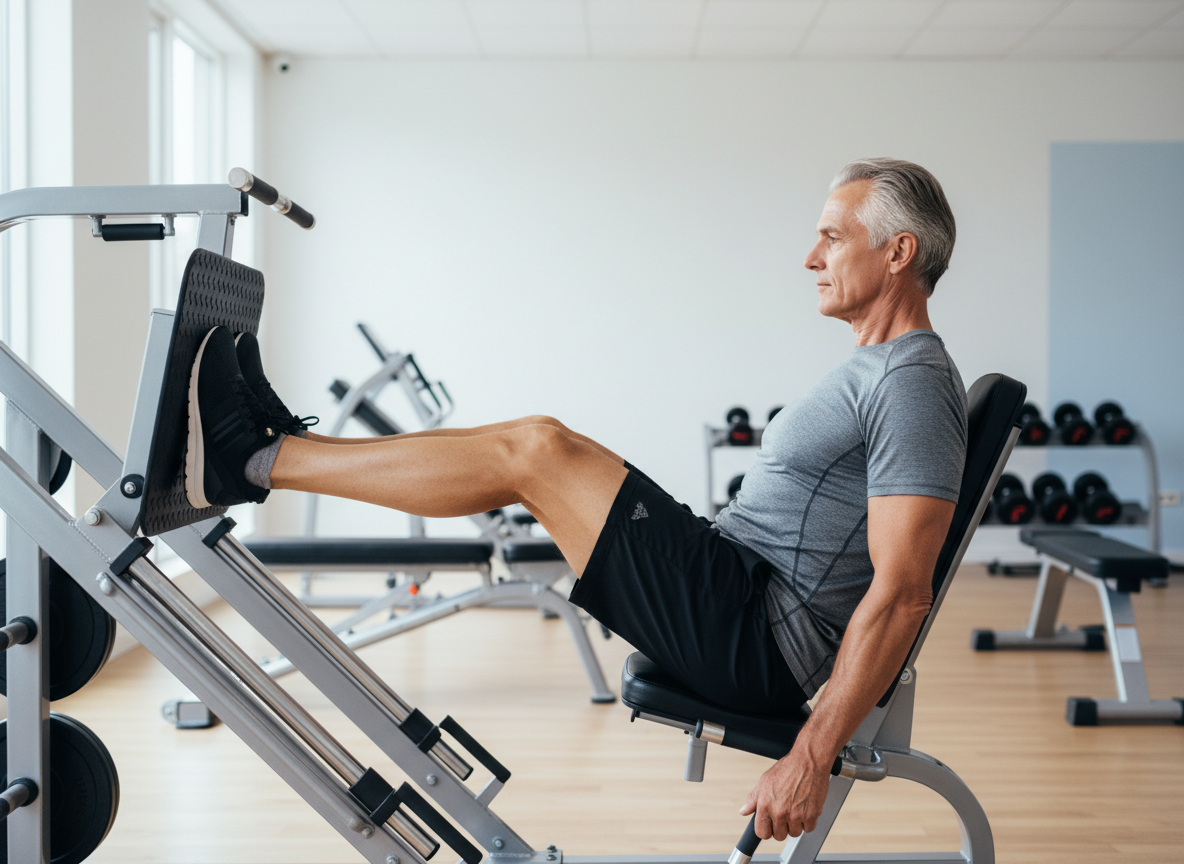
    1. Legs: leg press, or sit-to-stands from a sturdy chair if you are training at home.
    2. Push: machine chest press, or wall push-ups at home.
    3. Pull: seated cable row or a resistance band row.
    4. Back of the body: glute bridges, or a back extension machine.
    5. Upper back: lat pulldown, or a band pulldown anchored over a door.
    6. Core: a short plank against a counter or bench, or a slow dead bug on the floor.

    That is a full-body workout in about 30 to 40 minutes. You can add arm work or calves later. For the first couple of months, these six cover what matters most.

    Your first 8 weeks

    • Weeks 1 and 2: Learn the movements. Keep it light and focus on form. You should leave feeling like you could have done more.
    • Weeks 3 and 4: Add a third set to the exercises that feel good.
    • Weeks 5 to 8: When you can do all your reps with good form and still have two in the tank, add the smallest weight increase the machine allows.

    Write down each exercise, the weight and the reps. A simple notebook works. After a few weeks those notes show you progress your memory will miss, and they keep you from jumping the weight too fast.

    Joint-friendly swaps

    If an exercise bothers a joint, you usually do not have to skip that muscle. You just need a different way to train it.

    • Cranky knees: use a shorter, comfortable range on the leg press, or squat down to a box or chair instead of going deep.
    • Touchy shoulders: use a machine press or a palms-facing (neutral) grip instead of a straight barbell, and skip pressing behind the head.
    • Sensitive lower back: choose machines that support your back over heavy barbell lifts, and keep bridges and back extensions slow and controlled.

    Machines can be a very good tool

    I like machines for some exercises because they provide stability and let me concentrate on producing force with the intended muscles. Free weights can also work well. The best tool is the one that lets you train consistently and appropriately.

    Warning signs to respect

    Training safely does not mean training timidly. It means knowing the difference between hard work and a warning. Normal: muscles that feel worked, some mild soreness for a day or two. Stop and rethink if you notice:

    • Sharp or stabbing pain during a rep
    • Joint pain that is still there or worse the next day
    • Dizziness, chest pain or unusual shortness of breath
    • Soreness that never clears before your next workout

    Recovery is part of muscle building

    The workout is the stimulus. Recovery is when your body has an opportunity to respond. Sleep, enough food, enough protein and rest between hard sessions all matter. More workouts are not automatically more muscle. If performance keeps falling and soreness never clears, look at recovery before adding more training.

    What you do on the other five days of the week matters too. I put those everyday habits, protein, walking, carrying, balance and sleep, in a separate post: 7 Strength Habits That Matter More After 60.

    For another perspective on staying active and building healthy habits later in life, Journey to Fifty Plus shares personal experiences and ideas around fitness and wellness after 50.

    Common Questions

    Can you still build muscle after 60?
    Yes. Adults can build strength and muscle after 60 with consistent resistance training, adequate recovery and good nutrition.

    How often should you strength train after 60?
    The CDC recommends muscle-strengthening activities at least 2 days a week for older adults, with rest between challenging sessions.

    How heavy should you lift after 60?
    Heavy enough that the last couple of reps feel challenging, but light enough that you finish with about two good reps left and never lose your form.

    What exercises are best for building muscle after 60?
    Start with the big movements: a leg exercise, a push, a pull, a hip or back exercise, and some core work. Machines are a great way to learn them safely.

    How quickly should you increase weights after 60?
    Only when you can complete all your reps with good form and still have a couple left in the tank. Then make the smallest increase available.

    Is it normal to be sore after strength training after 60?
    Mild muscle soreness for a day or two is normal, especially when you start. Sharp pain or joint pain that lingers is not, and is a reason to back off.

    A gentle health note: If you’re new to strength training, have significant joint or muscle pain, dizziness, balance problems, or a medical condition that affects exercise, consider talking with a healthcare professional before starting or substantially increasing your workouts. Stop an exercise that causes sharp or unusual pain.

    My bottom line

    After 60, I still want challenging workouts. I just want those workouts to move me forward instead of keeping me injured. Start lighter than your ego wants, add a little at a time, recover, and keep showing up. Two days a week, done well, beats five days that leave you hurting.

    Your turn: Are you just getting started, or getting back into it? Tell me in the comments which exercise gives you the most trouble and I’ll try to help.

    Exercise should be adapted to your health, injuries and abilities. This is general fitness information, not individualized medical advice.

    About Tom Green

    Tom Green writes Sturdy Years. He was born in Pell City, Alabama, in 1962, and he’s a country boy and a true Southerner through and through. He’s just a regular, laid-back 64-year-old who keeps things simple. He shares what he learns about skincare, fitness and getting older, and what’s working for him. He’s also the author of A Practical Guide to Getting Older Without Giving Up on Yourself. Tom isn’t a doctor. He reads up on the research and passes along what’s useful, plain and simple.

    Keep Reading

    I’ve also mapped out some great tools on my new Tech for Independent Living After 50 page.

  • What Does an Attractive 50-Year-Old Woman Really Look Like? The Answer Might Surprise You

    What Does an Attractive 50-Year-Old Woman Really Look Like? The Answer Might Surprise You

    What does an attractive 50-year-old woman really look like?

    Short answer: An attractive 50-year-old woman doesn’t have to look 35. Confidence and strength show more than trying to look younger, and a little gray hair or a few wrinkles don’t change that. Being fit and feeling good in your own skin matters more than being thin.

    Forget the “looks 35” nonsense for a minute.

    What does an attractive 50-year-old woman actually look like?

    That’s a surprisingly complicated question.

    And before somebody gets mad at me, I’m not talking about whether women should care about their appearance. Of course they can. Looking good can feel good. Taking care of your skin, hair, body and clothes isn’t vanity.

    But somewhere along the way, we’ve gotten the idea that an attractive woman over 50 has to look like she just escaped from a time machine.

    Why?

    Why can’t a beautiful 50-year-old woman actually look 50?

    She might have a few wrinkles. Her hair might have some gray in it. Her body might not look like it did at 25. Her face may have changed.

    And she might still turn heads when she walks into a room.

    Maybe attractiveness changes as we get older

    One thing that keeps coming up in conversations about aging is confidence.

    Women talking about getting older often mention things like strength training, better skin care, a good haircut, dressing well and—perhaps most importantly—not caring quite so much about what everybody else thinks.

    That last one might be the most attractive thing of all.

    Because confidence looks different from trying desperately to prove you’re still 30.

    A woman who walks into a room comfortable in her own skin can be incredibly attractive.

    Let’s talk about the elephant in the bathroom mirror

    At 50, you may start noticing things you didn’t notice before.

    Fine lines. Changes in your skin. Hair getting thinner. A different shape around your waist.

    Maybe your face doesn’t look exactly like it did ten years ago.

    And suddenly your bathroom mirror has apparently decided to become your enemy.

    😂

    You lean toward it. You lean back. You change the lighting.

    Then you turn the bathroom light off and decide you’re perfectly happy with yourself.

    Problem solved.

    Until tomorrow morning.

    But here’s the thing: taking care of yourself and accepting that you’re aging aren’t opposites.

    You can use good skin care. You can exercise. You can eat better. You can get a great haircut. You can wear clothes that make you feel good.

    You can even choose cosmetic treatments if that’s what you want.

    “I’m not trying to become 30 again. I’m trying to look like the best version of me at 50.”

    That’s a very different goal.

    And strength is attractive too

    Something else gets overlooked when we talk about attractiveness.

    How you carry yourself.

    Getting stronger can change posture, movement and the way you feel about your body.

    You don’t have to become a bodybuilder. You don’t even have to love the gym.

    But there is something pretty damn good about being 50, 60 or 70 and realizing:

    “I’m stronger than I thought I would be at this age.”

    That confidence tends to show.

    Questions We All Wonder About

    Let’s get real for a minute. These are some of the questions people quietly wonder about but don’t always ask out loud.

    Does a woman have to look younger than 50 to be considered attractive?

    Why is “you look 40!” automatically treated as the ultimate compliment?

    What if someone simply said: “You look great for 50.”

    Would that be enough?

    Or have we been taught that aging itself is something we need to hide?

    Are wrinkles actually unattractive?

    Some people want every line softened. Others don’t mind them at all. Plenty of people are somewhere in the middle.

    Where do you stand?

    Do you want to soften the signs of aging, embrace them, or a little of both?

    Is being fit more important than being thin?

    A woman can be a perfectly healthy weight and not look like a fitness model. She can also be strong, active and muscular without being particularly thin.

    So when you picture an attractive woman over 50, does fitness matter more to you than a certain body size?

    Does gray hair make a woman look older—or can it make her look better?

    Some women couldn’t wait to stop coloring their hair. Others will keep coloring it until they’re 90.

    😂

    Neither choice is wrong.

    Silver, blonde, brunette, red—or whatever makes her feel good?

    What about makeup?

    Does makeup make someone more attractive after 50? Or does less makeup sometimes look better?

    And is there such a thing as too much makeup?

    That’s probably a conversation all by itself.

    Does confidence really make someone more attractive?

    Imagine two women. One looks younger but constantly worries about how she looks. The other has a few more lines but walks into the room smiling, laughing and completely comfortable being herself.

    Which qualities matter more to you?

    Can personality actually make someone physically more attractive?

    Most of us have probably experienced this.

    Someone who didn’t initially catch your eye becomes incredibly attractive after you get to know them.

    Then the opposite can happen too.

    Someone can be gorgeous—and then open their mouth.

    😂

    Suddenly you’re looking for the nearest exit.

    So how much does personality change your perception of someone’s attractiveness?

    So what does an attractive 50-year-old woman look like?

    Honestly?

    She can look like a lot of different things.

    Short. Tall. Curvy. Slim. Gray-haired. Blonde. Natural. Glamorous. Wrinkled. Athletic. Soft. Dressed up. Wearing jeans and sneakers.

    There isn’t one face or body that qualifies.

    And maybe that’s the point.

    At 50, attractiveness doesn’t have to mean looking younger.

    It can mean looking alive. Looking healthy. Looking confident. Having a sense of humor. Taking care of yourself. Knowing who you are.

    And maybe having reached the age where you finally realize you don’t have to impress everybody.

    That might be one of the best things about getting older.

    Now I want to hear from you

    Here’s where I really want to know what you think.

    Women 50+: What makes a woman attractive to you now that might not have mattered as much when you were 25?

    A) Confidence
    B) Fitness/strength
    C) Hair, skin and style
    D) Personality and humor
    E) The way she carries herself
    F) Something completely different

    And men, you’re welcome to answer this one too.

    Just be respectful. 😉

    What do you think makes someone genuinely attractive after 50?

    And be honest…

    Has your definition of “attractive” changed as you’ve gotten older?

    Keep Reading

    How to Look and Feel Better as You Age After 50

    The Simple Morning Routine That Can Make You Look and Feel Better After 50

    7 Strength Habits That Matter More After 60


    About the Author

    Tom Green writes Sturdy Years. He was born in Pell City, Alabama, in 1962, and he’s a country boy and a true Southerner through and through. He’s just a regular, laid-back 64-year-old who keeps things simple. He shares what he learns about skincare, fitness and getting older, and what’s working for him. He’s also the author of A Practical Guide to Getting Older Without Giving Up on Yourself.

    Tom isn’t a doctor. He reads up on the research and passes along what’s useful, plain and simple.

    Affiliate Disclosure: Some links in this post may be affiliate links. If you purchase something through one of these links, Sturdy Years may earn a small commission at no extra cost to you. This helps support the site and allows us to continue creating helpful content.

    I’ve also mapped out some great tools on my new Tech for Independent Living After 50 page.

  • Life After 50 With a Dog: The Joys, the Benefits—and the Reality

    Life After 50 With a Dog: The Joys, the Benefits—and the Reality

    Is getting a dog good for you after 50?

    Short answer: A dog can make life after 50 better. Dogs get you moving every day, make ordinary days more interesting, help you meet people, and don’t care how old you look. Just be honest about the time, money and energy a dog needs before you bring one home.

    Life after 50 can bring more freedom, but it can also bring quieter days, new routines, and a body that does not always want to move the way it once did. A dog has a way of pulling your attention back to the present: the leash waiting by the door, the happy greeting, the ridiculous thing they just did, and the simple fact that someone is counting on you. A dog is not a miracle cure for loneliness or a substitute for human connection. But for the right person, a dog can add movement, affection, structure, and a little everyday comedy to life. Those small things deserve more credit than they often get. Dogs do not care about your birthday. They care about whether you are ready for a walk, whether there is something interesting happening in the kitchen, and whether you have time for them.

    Dogs Keep You Moving

    One of the simplest benefits of having a dog is that they give you a reason to get up and move. A walk around the neighborhood may not feel like a workout, but regular movement adds up. There are also all the little movements that come with caring for a dog—feeding them, letting them outside, playing, cleaning up and getting down on the floor when they decide that is where they want you.

    They Make Ordinary Days More Interesting

    After 50, routines can become comfortable. That is not necessarily a bad thing, but a dog can interrupt the routine in ways that are usually good for you. A funny expression, an unexpected burst of energy or the simple excitement of seeing you walk through the door can make an ordinary day feel different.

    Dogs Can Keep You Connected

    Walking a dog can also create opportunities for casual conversations with neighbors and other dog owners. Sometimes a simple hello is enough to make a day feel a little less isolated.

    They Do Not Care How Old You Look

    This may be one of my favorite things. Your dog is not looking at your wrinkles, gray hair or whether you look tired today. You are simply their person.

    Getting Older Does Not Mean Stopping

    Having a dog does not magically make every day easy. Older dogs may need more care, and your own abilities may change over time. But there is something valuable about continuing to have reasons to move, laugh and get outside. For me, a dog is a good reminder that getting older is not the same thing as checking out of life.

    What Research Says About Dogs and Healthy Aging

    There is research behind some of these everyday benefits, although it is important not to promise more than the evidence can show. The Centers for Disease Control and Prevention (CDC) notes that pets can create opportunities to exercise, get outside, and socialize, and that companionship may help some people manage loneliness. The CDC also points out that pets can carry germs, so good hygiene and appropriate veterinary care matter. A 2022 systematic review published in Social Psychiatry and Psychiatric Epidemiology examined 24 studies on pet ownership, loneliness, and social isolation. The findings were mixed: some studies found associations with less isolation or loneliness, while others did not. The honest takeaway is that a pet may be a meaningful source of companionship, but it will not make everyone feel less lonely. You can read the full review on PubMed Central. There is also a measurable connection between dog walking and activity. In a 2017 study published in Innovation in Aging, researchers followed 86 adults ages 65 to 81 and used activity monitors. The dog owners averaged about 31 minutes a day walking at a moderate pace, compared with 11 minutes among the adults without dogs; they also took more steps on average. The study was relatively small, so it does not prove that a dog will make every owner more active. But it is a useful reminder that a daily walk can become a habit when another living creature is counting on you. Read the study summary at PubMed Central.

    Small Ways to Make Dog Ownership Work Better After 50

    • Make the walk fit your body. Two short, comfortable walks may work better than one long outing. If balance, joint pain, breathing, or stamina is a concern, ask a healthcare professional what level of activity is appropriate.
    • Let the dog sniff. A walk does not have to be a race or a step-count competition. Safe sniffing time gives your dog enrichment and gives you a reason to slow down and notice the neighborhood.
    • Build a rainy-day routine. A few minutes of gentle indoor play, simple training, or hide-and-seek with a toy can keep you connected when weather or mobility makes a walk difficult.
    • Make the home safer for both of you. Keep leashes and toys out of walkways, use good lighting, and consider whether a dog that pulls hard on the leash could throw you off balance. Training and a well-fitted harness may help.
    • Plan for care before you need it. Identify a backup walker, pet sitter, or trusted person who can help if you are sick, traveling, or recovering from an injury.
    • Protect your budget. Food, routine veterinary visits, dental care, medications, grooming, and unexpected emergencies can add up. A realistic pet budget is part of responsible ownership, not a lack of love.

    The Part People Do Not Always Mention: Dogs Need Care, Too

    It is easy to talk about what a dog brings into our lives and forget the work involved. Some dogs need more exercise than their owners can comfortably provide. Older dogs may need medication, help with stairs, or more frequent veterinary visits. Puppies can be exhausting, and a strong dog that pulls on a leash can be a genuine fall risk. If you are thinking about adopting a dog after 50, choose for temperament, size, energy level, and care needs—not just a cute face. An adult dog with a known personality may be a better fit than a high-energy puppy for some households. A shelter or rescue can help you ask the right questions. And if a dog is not a realistic fit right now, helping a neighbor walk their dog, pet-sitting occasionally, or volunteering with an animal organization may offer some of the connection without the full-time responsibility.

    A Simple Reminder: You Do Not Need a Perfect Day

    Some days the walk will be short. Some days you will be tired. Some days your dog will stop to investigate one patch of grass as if it contains the secrets of the universe. That is part of the charm. Healthy aging is not about turning every moment into a performance. It is about finding manageable reasons to move, connect, laugh, and take part in the day. If a dog gives you one more reason to step outside, speak to a neighbor, keep a routine, or smile at something silly, that is worthwhile—even if it never shows up on a fitness tracker.

    Sources and Further Reading

    Before You Bring a Dog Home, Ask These Five Questions

    There is something wonderful about being greeted at the door by a dog who thinks you’re the best thing in the world. But I wouldn’t want anyone to adopt on a lonely afternoon without thinking about the next ten years.

    1. Can I comfortably handle this dog’s size and energy? A calm adult dog may be a better fit than a large, excitable puppy.
    2. Can I afford routine and unexpected vet care? Include food, medication, preventive care, and emergencies—not just the adoption fee.
    3. Who helps if I get sick? Have a backup person or local boarding plan before you need one.
    4. What does this individual dog actually need? Temperament, training, grooming, and exercise differ more than advertisements suggest.
    5. Am I ready for the commitment? If not, fostering, volunteering, or visiting a friend’s dog can still add joy.

    The American Veterinary Medical Association’s pet-selection advice makes the responsibility clear: choose thoughtfully and plan for a dog’s social, physical, and veterinary needs. You aren’t just choosing a companion; you’re agreeing to care for a living animal.

    What the Research Actually Says About Loneliness

    It’s easy to see why pet stories are popular. But a dog isn’t a guaranteed treatment for loneliness. A systematic review of 24 studies found mixed results: some studies linked pet ownership with less isolation, while evidence on loneliness was inconsistent. I think that’s a more useful message than telling someone a pet will fix everything.

    The National Institute on Aging stresses the importance of human connection, too. A dog can be a wonderful part of a life that also includes friends, neighbors, family, or community.

    Make the First Month Easier

    Keep the dog’s routine simple: regular meals, short walks or play suited to its needs, quiet rest, and a vet appointment. Put a leash by the door, keep fresh water available, and resist the urge to expect perfect behavior in a week. Like the rest of us, a new companion needs time to settle in.

    Common Questions

    Can having a dog help you stay active after 50? A dog can encourage regular walking and everyday movement, although the amount of activity depends on the dog and your own abilities. Can dogs help with loneliness after 50? Pets can provide companionship and routine, and walking a dog can create opportunities for social interaction. Do dogs care about your age? Not in the way people do. Dogs generally respond to the relationship, attention, routine, and care you provide. Is having a dog good for your mental well-being? Companionship, routine, physical activity, and the simple responsibility of caring for another living thing can be meaningful parts of daily life. What if you are not able to walk a dog very far? Dogs and people have different needs. Short walks, play, time outside, and other forms of interaction can still provide activity and companionship. Can a dog give you more purpose after 50? Caring for a pet can add structure and responsibility to the day, which some people find meaningful. What is one of the best things about having a dog after 50? A dog can give you a reason to get up, move around, laugh, and pay attention to the present moment. Practical takeaway: Getting older does not mean life has to become smaller. A dog can be one simple reason to keep moving, stay connected, and enjoy ordinary days. A gentle well-being note: Pets are a personal choice, and caring for one should fit your health, living situation, finances, and ability to provide appropriate care.

    Keep Reading

    Written by Tom Green, creator of Sturdy Years Tom Green writes Sturdy Years. He was born in Pell City, Alabama, in 1962, and he’s a country boy and a true Southerner through and through. He’s just a regular, laid-back 64-year-old who keeps things simple. He shares what he learns about skincare, fitness and getting older, and what’s working for him. He’s also the author of A Practical Guide to Getting Older Without Giving Up on Yourself. Tom isn’t a doctor. He reads up on the research and passes along what’s useful, plain and simple.

    I’ve also mapped out some great tools on my new Tech for Independent Living After 50 page.

  • Getting Older and Watching Your Hormones Change

    Getting Older and Watching Your Hormones Change

    How do your hormones change as you get older?

    Short answer: Hormones do change as you age, but not every symptom is a hormone problem. Testing can help when a doctor looks at it in context. Don’t let the internet sell you a hormone shortcut, because sleep, movement, good food and regular checkups still matter most.

    Hormones are one of those subjects that can make getting older sound much more mysterious than it really is. One article says everything is caused by a hormone being “low.” Another promises that a supplement, cream or treatment will restore the person you were at 30. Real life is more complicated—and that is actually useful to understand. Hormone levels change with age, but so do sleep, activity, body composition, nutrition, stress, medications and many other parts of health. A change in how you feel does not automatically tell you which hormone is responsible.

    What Can Change as We Get Older?

    People may notice changes in energy, sleep, body composition, muscle and recovery, sexual function, temperature regulation or mood. Some of these changes can involve hormones. Others have nothing to do with hormones. For women, menopause brings major changes in ovarian hormone production. For men, testosterone levels generally decline gradually rather than switching off at a particular age. Either way, the individual picture matters.

    Symptoms Don’t Come With a Hormone Label Attached

    This is where online checklists can get misleading. Feeling tired can have many causes. So can gaining weight, sleeping poorly, losing strength, having less interest in sex or feeling different emotionally. A symptom may deserve attention without proving what caused it. That is why I think it is better to tell a healthcare professional what changed, when it changed and what else was happening at the time than to walk in convinced that one particular hormone is the answer.

    Testing Can Help, But Context Matters

    When hormone testing is appropriate, a lab result is only one piece of the picture. Timing, the specific test, medications, symptoms and the person’s overall health can affect how results are interpreted. A single number pulled out of context can create more confusion than clarity. Your clinician can decide whether testing makes sense and what the results mean for you.

    Don’t Let the Internet Sell You a Hormone Shortcut

    There is a huge market built around the idea of reversing aging. Some products use words such as “balance,” “reset,” “boost” or “restore” without giving you a clear explanation of what problem they are actually treating. That doesn’t mean every hormone treatment is inappropriate. Some treatments have legitimate medical uses. It means the reason for using one should be clear, and the risks and benefits should be discussed with a qualified professional.

    The Basics Still Matter

    Before turning every change into a hormone problem, I would pay attention to the basics:
    • Sleep: Give it enough time and take persistent problems seriously.
    • Strength training: Resistance exercise can help maintain muscle and physical function.
    • Regular movement: Walking and other activity count.
    • Nutrition: Eat enough protein and a varied diet rather than chasing miracle foods.
    • Stress: Find realistic ways to reduce the load when you can.
    • Routine care: Keep appropriate checkups and discuss persistent changes.

    There Is No Single “Normal” Way to Get Older

    Two people the same age can feel completely different. Their medical histories, medications, sleep, activity, genetics, diet and life circumstances can all be different. That is why I don’t think aging should be treated like a scorecard. Notice what has changed, take reasonable care of yourself and get help when something doesn’t seem right.

    What I Think Is Worth Paying Attention To

    I’m much more interested in whether I can stay active, keep building or maintaining strength, sleep reasonably well, enjoy my life and deal with health changes intelligently than I am in trying to make every number look like it did decades ago. Aging is not a failure of your body. It is a process. The goal is to understand what is changing without letting every change scare you into buying something. For a midlife-focused perspective on changing routines and wellbeing after menopause, Forward After the Pause writes about life after menopause, everyday wellness, and moving into a new chapter. For symptoms that concern you, a qualified clinician is still the right person to help interpret what your own hormone changes may mean.

    Common Questions

    What happens to your hormones as you get older? Hormone levels and patterns can change with age. The changes differ between men and women and can affect things such as sleep, energy, muscle, mood, and sexual health. Do hormones change after 50? Yes. Hormonal changes are a normal part of aging, although the timing and degree vary from person to person. Why do hormones change as you age? Hormone production and regulation naturally change over time as part of the aging process. Can changing hormones affect your energy after 50? They can. Changes in hormones may be one factor affecting energy, but sleep, nutrition, physical activity, medications, stress, and health conditions can also play important roles. Can hormone changes affect muscle after 50? Yes. Age-related hormonal changes can contribute to changes in muscle mass and strength, which is one reason regular resistance exercise and adequate nutrition become important. Can hormone changes affect sleep after 50? They can. Hormonal changes may contribute to sleep changes, although many other factors can also affect sleep as you get older. Do men and women experience hormonal changes differently? Yes. The specific hormones involved, timing, and symptoms can differ significantly between men and women. Does feeling tired always mean your hormones are changing? No. Fatigue has many possible causes. Persistent or unusual tiredness shouldn’t automatically be blamed on aging or hormones. Can lifestyle habits help you manage changes that come with aging? Regular exercise, nutritious food, adequate sleep, stress management, and maintaining healthy habits can support overall health as hormone patterns change. When should you talk with a doctor about hormone changes? If you have persistent or concerning symptoms such as major changes in energy, mood, sleep, sexual function, or other unexplained changes, discuss them with a healthcare professional. Practical takeaway: Hormone changes are part of getting older, but they aren’t the whole story. Focus on the things you can control—exercise, nutrition, sleep, stress, and regular healthcare. This article is general information and reflects my personal perspective. Hormone-related symptoms and treatments are individual medical questions; talk with a qualified healthcare professional about your situation. Written by Tom Green, creator of Sturdy Years Tom Green writes Sturdy Years. He was born in Pell City, Alabama, in 1962, and he’s a country boy and a true Southerner through and through. He’s just a regular, laid-back 64-year-old who keeps things simple. He shares what he learns about skincare, fitness and getting older, and what’s working for him. He’s also the author of A Practical Guide to Getting Older Without Giving Up on Yourself. Tom isn’t a doctor. He reads up on the research and passes along what’s useful, plain and simple.

    Keep Reading

    I’ve also mapped out some great tools on my new Tech for Independent Living After 50 page.
  • Memory Getting Slippery After 50? Citicoline Explained

    Memory Getting Slippery After 50? Citicoline Explained

    Does citicoline help memory after 50?

    Short answer: Citicoline is a supplement your body turns into compounds the brain uses. In one 12-week study of 100 healthy adults ages 50 to 85 with age-related memory slips, those who took 500 mg a day improved more on memory tests than those on a dummy pill. But the European Food Safety Authority found it hasn’t been proven to improve memory, so don’t expect a miracle.

    Ever walk into a room and forget why you went there? Or know a person’s name perfectly well—until the exact moment you need it? Those little memory lapses can become more noticeable after 50+, and they can make you wonder whether there is anything simple you can do to support your brain. That’s one reason citicoline, also called CDP-choline, has been getting attention. But does citicoline actually help memory? The answer is more interesting than a simple yes or no.

    What Is Citicoline?

    Citicoline is a naturally occurring compound involved in the body’s production of phospholipids and the neurotransmitter acetylcholine. After it is taken, it provides choline and cytidine, which are used in several pathways important to brain-cell membranes and brain chemistry. That sounds impressive, but here’s the important distinction: a supplement having a plausible biological role does not automatically mean it will noticeably improve memory in everyday life.

    So, Can Citicoline Help Memory After 50+?

    There is some human research worth paying attention to. One randomized, double-blind, placebo-controlled trial included 100 healthy adults ages 50 to 85 who had age-associated memory impairment. Participants received either placebo or 500 mg of citicoline daily for 12 weeks. At the end of the study, the citicoline group showed greater improvement on measures of episodic memory and overall composite memory than the placebo group. That’s encouraging—but it was one relatively small 12-week study, not proof that citicoline will improve memory for everyone.

    What Makes Citicoline Interesting?

    Citicoline supplies choline, which the body uses to make acetylcholine. Acetylcholine is a neurotransmitter involved in attention and memory. Citicoline also contributes building blocks used in cell-membrane metabolism. Researchers have therefore been interested in whether supporting these pathways might help the aging brain function more efficiently. In other words, there is a reasonable biological explanation for studying citicoline. But mechanism is not the same thing as proof of a real-world benefit.

    What the Research Does—and Doesn’t—Prove

    This is where I think readers 50+ should be careful. The positive clinical trial is useful because it actually tested people rather than simply looking at laboratory mechanisms. But broader evidence is not strong enough to say that citicoline is a proven treatment for age-related memory loss. A later scientific assessment by the European Food Safety Authority concluded that a cause-and-effect relationship between citicoline and improved, maintained, or reduced loss of memory had not been established. In other words, the evidence remains promising but incomplete.

    How Much Citicoline Was Studied?

    The most directly relevant memory trial in adults 50+ used 500 mg per day for 12 weeks. That does not mean 500 mg is a recommended dose for everyone, and it doesn’t mean that taking more will work better. Studies of citicoline for other medical conditions have used different amounts, but those results shouldn’t automatically be applied to healthy people simply interested in memory. If you’re considering a supplement, check the label carefully and talk with your healthcare professional or pharmacist if you take medications or have a medical condition.

    Is Citicoline a Nootropic?

    You’ll often see citicoline described online as a nootropic—a substance marketed for cognitive support. That’s a useful search term, but don’t let the label make the evidence sound stronger than it is. The important question isn’t whether something is called a nootropic. It’s whether controlled human studies show a meaningful benefit. With citicoline, there are some encouraging findings, but more research is needed.

    What About Side Effects?

    Citicoline has generally been described as well tolerated in clinical research, but “natural” or “well tolerated” doesn’t mean risk-free. Reported unwanted effects in some research have included headache, digestive discomfort and sleep-related complaints. If a supplement seems to make you feel worse, disrupts your sleep or causes a new symptom, that’s a good reason to stop and discuss it with a healthcare professional.

    What I Would Take Away From the Research

    If you’re interested in memory after 50+, citicoline is worth knowing about—but not worth treating like a miracle supplement.
    • There is a human trial in adults 50–85 showing improvement in certain memory measures.
    • The study used 500 mg daily for 12 weeks.
    • The overall evidence is still limited.
    • Citicoline has a plausible role in brain-cell and neurotransmitter metabolism.
    • More research is needed before anyone can say it prevents or reverses normal age-related memory decline.

    Common Questions

    Is it normal to have more memory lapses after 50? Occasional forgetfulness can happen with normal aging, but persistent or worsening memory problems deserve attention. What is citicoline? Citicoline is a compound that provides choline and is involved in processes related to cell membranes and brain function. Can citicoline improve memory? Some research has explored citicoline for memory and cognitive function, but the evidence is not strong enough to say it will improve memory for everyone. Is citicoline the same as CDP-choline? Yes. Citicoline and CDP-choline are two names commonly used for the same compound. Is citicoline safe for people 50+? Citicoline appears to be generally well tolerated in studies, but supplements can interact with individual health conditions or medications. It’s smart to discuss regular supplement use with a healthcare professional. When should memory problems be checked by a doctor? If memory changes are frequent, getting worse, interfere with everyday activities, or concern you or someone close to you, bring them up with a healthcare professional.

    And Don’t Forget the Boring Stuff

    Before spending money on another supplement, remember that the basics still matter. Regular physical activity, adequate sleep, a balanced diet, social connection and staying mentally engaged all have a place in healthy aging. Citicoline may eventually prove to have a useful role for some people. For now, the most honest description is interesting, researched and promising—but not proven. Sturdy Years note: This article is for general education, not medical advice. New, sudden or steadily worsening memory problems deserve a conversation with a healthcare professional rather than a supplement experiment.

    Sources

    Citicoline and Memory Function in Healthy Older Adults: Randomized, Double-Blind, Placebo-Controlled Clinical Trial Citicoline Improves Verbal Memory in Aging Citicoline: Pharmacological and Clinical Review, 2022 Update   Practical takeaway: You do not need to overhaul your life to make a useful change. Start with one realistic step, give it time, and build from there. A gentle well-being note: This article is for general information and is not a substitute for professional medical advice. If you have persistent, severe, or worsening symptoms, talk with a qualified healthcare professional.

    Keep Reading

    Written by Tom Green, creator of Sturdy Years Tom Green writes Sturdy Years. He was born in Pell City, Alabama, in 1962, and he’s a country boy and a true Southerner through and through. He’s just a regular, laid-back 64-year-old who keeps things simple. He shares what he learns about skincare, fitness and getting older, and what’s working for him. He’s also the author of A Practical Guide to Getting Older Without Giving Up on Yourself. Tom isn’t a doctor. He reads up on the research and passes along what’s useful, plain and simple.

    I’ve also mapped out some great tools on my new Tech for Independent Living After 50 page.

  • 50+ Looksmaxxing: Simple Ways to Look Better at Any Age

    50+ Looksmaxxing: Simple Ways to Look Better at Any Age

    How can you look better at any age?

    Short answer: Looking better after 50 isn’t about looking 25. Start with your skin, build some muscle, fix your posture, and pay attention to your hair, teeth, glasses and hands. Clothes that actually fit make a big difference, and fellas, facial hair needs a plan.

    “Looksmaxxing” is one of those internet words that sounds like it was invented by a 20-year-old guy measuring his jawline in the bathroom mirror.

    But strip away the silly name and there’s a useful idea underneath it: getting the most out of what you already have.

    For someone 50+, that doesn’t mean trying to look 25. It means looking healthy, strong, well-groomed, alert and comfortable in your own skin—without spending a fortune or chasing every new anti-aging trick.

    1. Start With Your Skin

    You don’t need a complicated 12-step routine. Gentle cleansing, a good moisturizer and daily sun protection can go a long way. If you have a specific concern, such as dryness or uneven tone, add one targeted product rather than turning your bathroom into a laboratory.

    Sun protection is especially important because UV exposure contributes to visible skin aging. A simple routine you actually use beats an expensive routine that sits untouched in a cabinet.

    2. Muscle Is One of the Best 50+ Beauty Treatments

    Strength training is usually discussed in terms of health, independence and function—and it should be. But there’s an appearance benefit too.

    Building or maintaining muscle can improve how your clothes fit, give your shoulders and arms more shape, support better posture and help you maintain a more athletic-looking body as you age. Regular muscle-strengthening activity is recommended for adults by organizations such as the CDC and ACSM.

    3. Fix Your Posture

    This might be the cheapest appearance upgrade on the list because it costs nothing.

    Stand comfortably upright. Let your shoulders settle back instead of collapsing forward. Keep your head in a natural position. You don’t have to walk around like a soldier.

    Try taking a before-and-after photo from the same angle. The difference can be surprisingly noticeable.

    4. Your Hair Matters More Than You Think

    A good haircut can change your entire appearance. The goal isn’t necessarily to hide gray hair or thinning hair. Work with what you have.

    Gray hair can look great when it is intentional and well maintained. If your hair is thinning, a style that works with it usually looks better than trying to force it into a style you had decades ago.

    5. Don’t Underestimate Your Teeth

    A healthy-looking smile makes a difference. Keep up with brushing, flossing and regular dental care. If whitening is appropriate for you, that can be another option.

    You don’t need an unnaturally bright Hollywood smile. Healthy and natural-looking is the goal.

    6. Glasses Can Become Part of Your Look

    If you wear glasses, stop thinking of them as something you simply have to wear. They are part of your face and can become part of your style.

    If your frames are old or no longer suit your face, try something different. A modern frame can make a surprisingly big difference.

    7. Clothes That Fit Are Practically Cheating

    You don’t need designer clothes. You need clothes that fit.

    Pay attention to the shoulders, sleeves, waist, pant length and jacket length. Clothes that fit your current body usually look more polished than clothes that are either too tight or hanging off you.

    Modern beats juvenile. You can look current without dressing like you’re trying to sneak into a college fraternity.

    8. Take Care of Your Hands

    Your hands are one of the first places people notice age-related changes. Keep your nails neat, use moisturizer when your hands are dry and protect them from excessive sun exposure.

    9. Facial Hair Needs a Strategy

    A beard or mustache can completely change the way the lower half of your face looks. That can be useful—but only if it looks intentional.

    Keep the edges and length maintained. If facial hair is patchy or uneven, a shorter style may look cleaner.

    10. Sleep Is an Appearance Hack Nobody Wants to Hear About

    There is nothing glamorous about getting enough sleep, which is probably why the internet doesn’t sell it as aggressively as expensive creams.

    But being rested can affect how alert and healthy you look. Sleep is also part of the bigger picture of healthy aging, recovery and energy.

    11. Don’t Ignore Your Weight—but Don’t Obsess Over It

    Your appearance is affected by body composition, but the number on the scale is only one piece of the picture.

    Strength training, adequate protein, regular movement and sensible eating can help you maintain muscle and a healthy body composition. The goal isn’t perfection. It’s looking and feeling capable.

    The Secret Weapon: Energy

    There is something about a person who has energy that makes them look better.

    Exercise, good sleep, mobility, nutritious food and staying socially and mentally engaged can all contribute to how you carry yourself. Someone who looks interested in life often looks younger without actually trying to look younger.

    What NOT to Do

    • Don’t obsess over tiny imperfections.
    • Don’t compare yourself with celebrities, influencers or heavily edited photos.
    • Don’t chase every new “anti-aging” trick.
    • Don’t make looking younger your entire identity.

    The point is presentation, not perfection.

    The 50+ Looksmaxxing Checklist

    • Get a haircut that suits your current hair.
    • Keep facial hair intentional and maintained.
    • Take care of your teeth.
    • Moisturize and protect your skin from the sun.
    • Strength train.
    • Maintain a healthy body composition.
    • Work on posture and mobility.
    • Wear clothes that fit.
    • Update your glasses if your frames are dated.
    • Take care of your hands and nails.
    • Get enough sleep.
    • Keep moving like you still have somewhere to go.
    • Smile.
    • Stop trying to look 25.

    The Real 50+ Looksmaxxing Goal

    You don’t need to look 25.

    You want to look healthy. Strong. Well-groomed. Alert. Confident. Comfortable.

    That’s a much more realistic—and much more useful—version of looksmaxxing for life after 50.

    For another perspective on looking and feeling good in midlife, Felice Shapiro’s Better After 50 shares stories and ideas about style, wellness, and life after 50. Use any trend as inspiration—not a rule—and choose changes that suit your own face, skin, budget, and comfort.

    What does looksmaxxing mean for someone 50+?
    For 50+ adults, looksmaxxing can simply mean making practical improvements that help you look and feel your best without trying to look younger than you are.

    Can you really improve your appearance after 50?
    Absolutely. Small changes to skincare, hair, grooming, clothing, posture, fitness, and sleep can make a noticeable difference in how you look.

    What are the easiest ways to look better after 50?
    Start with the basics: take care of your skin, get a haircut that suits you, keep facial hair groomed, wear clothes that fit well, stay active, and pay attention to posture.

    Does fitness help you look better after 50?
    Yes. Building or maintaining muscle, staying active, and improving posture can change your overall appearance as well as how you carry yourself.

    Do you have to spend a lot of money to improve your appearance?
    No. Many of the most noticeable improvements—better grooming, fitting clothes, regular exercise, good skincare, and better sleep—don’t require a large budget.

    Is it too late to start looksmaxxing at 50+?
    Not at all. You can start making small improvements at any age, and the goal doesn’t have to be perfection. Looking healthier, more confident, and more put-together is a worthwhile goal at any stage of life.

    A Note on the Research

    The recommendations here are based on the basics of healthy aging: sun protection, regular physical activity and strength training, adequate sleep, dental care and simple skincare. The CDC recommends regular physical activity that includes muscle-strengthening activity, while dermatology organizations emphasize protection from UV exposure.

    In other words: the boring stuff works. And at 50+, boring can be pretty damn effective.

    Keep Reading

    Written by Tom Green, creator of Sturdy Years

    Tom Green writes Sturdy Years. He was born in Pell City, Alabama, in 1962, and he’s a country boy and a true Southerner through and through. He’s just a regular, laid-back 64-year-old who keeps things simple. He shares what he learns about skincare, fitness and getting older, and what’s working for him. He’s also the author of A Practical Guide to Getting Older Without Giving Up on Yourself. Tom isn’t a doctor. He reads up on the research and passes along what’s useful, plain and simple.

    I’ve also mapped out some great tools on my new Tech for Independent Living After 50 page.
  • Retirement and Mental Health: 7 Ways to Build a Life You Actually Enjoy

    Retirement and Mental Health: 7 Ways to Build a Life You Actually Enjoy

    How do you stay happy and mentally healthy in retirement?

    Short answer: Retirement can feel strange because it takes away your routine, coworkers and daily reasons to get out the door. Replace your routine before you miss it, put people on your calendar, find a reason to be needed, keep learning and keep moving. If you feel down for weeks, reach out for help.

    Retirement is supposed to feel freeing. So why can it sometimes feel surprisingly strange?

    Leaving a job can mean more time, but it can also remove routines, coworkers, goals and daily reasons to get out the door. That transition can affect your mood and sense of purpose.

    1. Replace the routine before you miss it

    You don’t need to recreate your working life. But having a reason to get up, get dressed and go somewhere can make a big difference. Build a loose morning and weekly rhythm that gives your days some shape.

    2. Put people on your calendar

    Don’t wait until you feel lonely to call somebody. Schedule coffee, walks, lunch, game nights, volunteer work or regular phone calls. Social connection is an important part of healthy aging.

    3. Find a reason to be needed

    Purpose doesn’t have to mean a new career. Helping a neighbor, mentoring someone, caring for a garden, volunteering or contributing to a community can give your week meaning.

    4. Give yourself something to learn

    Take a class. Learn photography. Try a language. Learn to cook something you’ve never made. Pick up an instrument. Your retirement years don’t have to be a period of standing still.

    5. Keep moving

    Physical activity can support mood, sleep, physical function and overall quality of life. It can also become a social activity when you walk with a friend or join a group.

    6. Watch for the signs that you need help

    Feeling unsettled during a major life change is normal. But persistent sadness, loss of interest, isolation or other troubling changes deserve attention. Talking with a doctor or mental-health professional can be a useful next step.

    7. Don’t make retirement smaller than your working life

    This may be the first time in decades when you have more freedom to decide what belongs in your life. You can change your schedule, meet different people, explore new places and finally make room for things you postponed.

    Your retirement reset

    • One thing that gets you moving.
    • One person you make time for.
    • One activity that challenges your brain.
    • One thing you do simply because you enjoy it.

    Retirement doesn’t have to be an empty space where work used to be. It can become a life with a different rhythm—and one that feels more like your own.

    Common Questions

    Can retirement affect your mental health?
    Yes. Retirement can bring more freedom, but it can also change your daily routine, social connections, sense of purpose, and identity.

    How can I stay mentally healthy after retiring?
    Keeping a regular routine, staying physically active, maintaining relationships, learning new things, and having activities you look forward to can all support well-being.

    Why can retirement feel lonely?
    Leaving the workplace can reduce everyday social interaction. Building new connections through hobbies, volunteering, clubs, classes, or community activities can help.

    Do you need a purpose after retirement?
    Having things that give your days meaning can make retirement more satisfying. Purpose can come from family, hobbies, volunteering, learning, work, creativity, or simply pursuing interests you’ve put off.

    How can I enjoy retirement if I don’t know what I want to do?
    Start small. Try different activities without expecting yourself to find one perfect passion immediately. Pay attention to what leaves you feeling interested, useful, or energized.

    When should I ask for help with my mental health?
    If sadness, anxiety, loneliness, loss of interest, or other emotional difficulties persist or interfere with everyday life, consider talking with a healthcare professional or mental-health professional.

    Question for you: What did retirement give you that you didn’t expect?

    Tom Green writes Sturdy Years. He was born in Pell City, Alabama, in 1962, and he’s a country boy and a true Southerner through and through. He’s just a regular, laid-back 64-year-old who keeps things simple. He shares what he learns about skincare, fitness and getting older, and what’s working for him. He’s also the author of A Practical Guide to Getting Older Without Giving Up on Yourself. Tom isn’t a doctor. He reads up on the research and passes along what’s useful, plain and simple.

    I’ve also mapped out some great tools on my new Tech for Independent Living After 50 page.

  • Hormone Changes After 50: What’s Normal, What Can Change, and When to Ask Questions

    Hormone Changes After 50: What’s Normal, What Can Change, and When to Ask Questions

    What hormone changes are normal after 50?

    Short answer: Hormone changes around menopause can bring hot flashes, sleep changes, mood changes and shifts in weight. After menopause, women become more prone to osteoporosis and heart disease, so bone health, activity, good food and regular checkups matter more. Don’t assume every symptom is just menopause, and talk to your doctor about whether hormone therapy fits you.

    Hormone changes after 50 can make your body feel unfamiliar. Sleep may change. Your weight may shift. You may notice hot flashes, changes in your periods, mood changes, or a difference in how your body stores fat.

    For women, many of these changes are connected with the menopausal transition. But not every new symptom should automatically be blamed on hormones.

    What happens to hormones around menopause?

    During the menopausal transition, production of estrogen and progesterone declines substantially. The transition commonly begins between ages 45 and 55, although timing varies. Menopause itself is confirmed after 12 months without a menstrual period.

    Changes you may notice

    • Hot flashes or night sweats
    • Changes in sleep
    • Irregular periods during the transition
    • Changes in body shape or fat distribution
    • Changes in bone density and physical function
    • Vaginal or sexual changes

    What can actually help?

    Start with the basics that support health at any age: regular physical activity, nutritious food, adequate sleep, and staying socially connected. Exercise that includes muscle strengthening is especially useful for maintaining strength and physical function.

    Don’t assume every symptom is “just menopause.”

    Some symptoms overlap with other health conditions, medications, or normal changes that are not directly caused by menopause. If something is new, severe, persistent, or worrying you, bring it up with your healthcare professional.

    One important change after menopause

    After menopause, women become more vulnerable to conditions including osteoporosis and cardiovascular disease. That makes this a good time to pay attention to bone health, physical activity, nutrition, and regular medical care rather than focusing only on hot flashes.

    What about hormone therapy?

    Hormone therapy is a medical decision, not a one-size-fits-all solution. The benefits and risks depend on your health history, symptoms, age, and other factors. If symptoms are interfering with your life, discuss your options with a qualified healthcare professional.

    Hormone changes can be frustrating—but understanding what is happening can make the next step much less confusing.

    Question: What change surprised you most after 50?

    For more perspectives on menopause and navigating midlife changes, you can also explore Forward After the Pause, which focuses on menopause and midlife well-being.

    Common Questions

    Do hormone levels normally change after 50?
    Yes. Hormone production changes naturally with age, although the timing and degree of change vary from person to person.

    What hormone changes are common after 50?
    Changes in estrogen, progesterone, testosterone, thyroid hormones, and other hormones can occur with aging. The specific changes depend on factors such as sex, health, medications, and life stage.

    What symptoms can hormone changes cause?
    Depending on the hormone involved, people may notice changes in sleep, energy, mood, body composition, sexual function, temperature regulation, or other aspects of health. These symptoms can also have many causes besides hormones.

    Does feeling tired after 50 always mean your hormones are changing?
    No. Fatigue can have many possible causes, including poor sleep, stress, medications, nutritional issues, and medical conditions. Persistent or unexplained fatigue is worth discussing with a healthcare professional.

    Should everyone have their hormones tested after 50?
    Not necessarily. Hormone testing is generally most useful when there are symptoms or other reasons for a healthcare professional to investigate a possible hormone-related problem.

    When should I ask a doctor about hormone changes?
    If symptoms are persistent, bothersome, sudden, or affecting your daily life, bring them up with your healthcare professional. They can help determine whether hormones—or something else—could be contributing.

    Written by Tom Green, creator of Sturdy Years

    Practical takeaway: You do not need to overhaul your life to make a useful change. Start with one realistic step, give it time, and build from there.

    A gentle well-being note: This article is for general information and is not a substitute for professional medical advice. If you have persistent, severe, or worsening symptoms, talk with a qualified healthcare professional.

    Keep Reading

    Written by Tom Green, creator of Sturdy Years

    Tom Green writes Sturdy Years. He was born in Pell City, Alabama, in 1962, and he’s a country boy and a true Southerner through and through. He’s just a regular, laid-back 64-year-old who keeps things simple. He shares what he learns about skincare, fitness and getting older, and what’s working for him. He’s also the author of A Practical Guide to Getting Older Without Giving Up on Yourself. Tom isn’t a doctor. He reads up on the research and passes along what’s useful, plain and simple.

    I’ve also mapped out some great tools on my new Tech for Independent Living After 50 page.
  • How to Reinvent Yourself After 50: 9 Ways to Start a New Chapter

    How to Reinvent Yourself After 50: 9 Ways to Start a New Chapter

    How do you reinvent yourself after 50?

    Short answer: You can start a new chapter after 50 in five minutes. Write down one thing you’ve been curious about for years, pick one tiny step toward it this week, like signing up, calling someone or buying the book, and put it on your calendar. Stop waiting for permission and use what you already know.

    Who says you have to keep being the person you were at 30, 40 or even 49?

    Life after 50 can be a surprisingly good time to rethink what you want. Maybe the kids are grown. Maybe retirement is getting closer, or already here. Maybe you have more free time than you know what to do with. Or maybe you simply woke up one morning and realized you want something different.

    I’m 64, and I can tell you this: reinventing yourself doesn’t mean blowing up your life. It usually starts with one small change you actually follow through on. Then another. Below you’ll find nine ways to start, a simple 30-day plan so it doesn’t stay a “someday” idea, and a little bit of my own story.

    Start here if you only have 5 minutes

    1. Write down one thing you have been curious about for years.
    2. Pick one tiny step toward it you can take this week, like signing up, calling someone or buying the book.
    3. Put that step on your calendar with a day and time.

    That’s it. That’s how a new chapter actually starts.

    How I Started My Own New Chapter at 64

    I’ll be honest with you. I didn’t start Sturdy Years because I had it all figured out. I just thought to myself one day, I’ve got a good bit of life experience. Why not do a blog?

    The hardest part wasn’t the computer stuff, though there was plenty of that. It was fighting my own defeatism. That little voice that says you’re too old, nobody’s going to read it, why bother. I had to take the risk anyway. Now’s a better time than never.

    That wasn’t the only change. These days I work out four days a week, I’m eating better, and I’ve started taking some longevity supplements. None of that happened overnight. It started with one decision, then another.

    If you knew my whole story, I reckon you’d find some hope in it, and maybe the push to try a few things you’ve never done before.

    Why a new chapter is worth it after 50

    This is not just about feeling good. In a study of nearly 7,000 adults over 50 published in JAMA Network Open, people with the lowest sense of purpose in life were more than twice as likely to die during the study period as those with the strongest sense of purpose (Live Science summary). A study like this can’t prove purpose is the cause, but it is a good reminder that having something to get up for matters.

    Reinvention is really about that: finding things that make you feel useful, curious and connected again.

    1. Stop waiting for permission

    A lot of us spent decades doing what was expected of us: by a boss, a spouse, the kids, the neighbors. After 50, you are allowed to want something just because you want it. You don’t need everyone around you to understand your next chapter.

    Try this: Finish this sentence on paper: “If nobody would judge me, I would…” Don’t edit it. Whatever you write first is worth paying attention to.

    2. Try something before deciding who you are

    “I’m not that kind of person” is one of the most limiting things we tell ourselves. You don’t find out who you are next by thinking about it. You find out by trying things. Take the class. Join the group. Try the hobby. Visit the place. You may discover a version of yourself you didn’t know was there.

    Try this: Say yes to one thing this month you would normally turn down. If you need ideas, here are 10 hobbies after 50 that make life more interesting, most of them low-cost.

    3. Use what you already know

    Reinvention doesn’t mean throwing away your past. After 50 you have something younger people don’t: decades of experience, skills, mistakes you learned from and people you know. That is valuable raw material for whatever comes next.

    A retired teacher might tutor or mentor. Someone who managed a household budget for 30 years might help others do it. A lifelong fixer might teach a repair class or help neighbors.

    Try this: Ask two friends, “What do people always come to me for?” Their answers often point straight at your next chapter.

    4. Make your world a little bigger

    As we get older, our circles tend to shrink without us noticing. New experiences create new connections, and new connections create new opportunities. Join a local group. Take a trip. Volunteer. Go to an event alone if you have to. It gets easier every time.

    Try this: Look up one local group this week: a walking club, library class, volunteer group, church group or community center program. Go once before deciding if it’s for you.

    5. Learn something that makes you feel like a beginner

    Being new at something is uncomfortable, and that’s the point. It keeps your brain working, keeps your curiosity alive and gives you something to look forward to. A language, an instrument, painting, woodworking, dancing, a computer skill. It doesn’t matter what, as long as you are learning.

    Try this: Give a new skill 15 minutes a day for two weeks. Free videos and your local library are a great place to start.

    6. Take your health with you

    A new chapter is a lot easier to enjoy when your body can keep up. I work out four days a week now and I’m eating better, because I want to be able to say yes to the trip, the hike and whatever comes next. I’ve also started on some longevity supplements, but that’s a conversation to have with your own doctor first, since supplements can interfere with medications. Walking, strength training, good food and enough sleep aren’t glamorous, but they give you more options.

    Try this: Start with the basics in 7 strength habits that matter more after 60, or a simple gym plan in how to build muscle after 60 without getting hurt.

    7. Let your appearance evolve too

    A haircut, a new color, different clothes or a simple skincare routine can be a fun way to mark a fresh chapter. The goal isn’t to look younger. It’s to look like yourself now, and to feel good when you catch your reflection.

    Try this: Change one thing about how you look this month that you’ve been thinking about for a while. If it’s been hard to accept the face in the mirror, I wrote about that in when you don’t recognize yourself anymore.

    8. Make a “not someday” list

    “Someday” is where good ideas go to die. Grab a piece of paper and fill in one answer for each line:

    • ☐ Something I want to learn: ________
    • ☐ Somewhere I want to go: ________
    • ☐ Someone I want to reconnect with: ________
    • ☐ Something I want to stop doing: ________
    • ☐ Something I want to do just for fun: ________

    Now circle the one that excites you most. That’s your first experiment.

    9. Give yourself a 30-day experiment

    Don’t demand a complete life transformation. That’s too much pressure, and it’s why most big plans fizzle. Instead, pick one change and try it for 30 days. You are just collecting evidence about what makes you feel more alive, curious and connected.

    • Week 1: Take the first small step. Sign up, show up, or buy what you need.
    • Week 2: Do it at least twice. Notice how you feel before and after.
    • Week 3: Tell someone about it, or invite a friend along.
    • Week 4: Decide: keep going, change it, or try the next thing on your list. All three are wins.

    What usually holds us back (and what to tell yourself)

    • “I’m too old.” You are younger today than you will ever be again. Plenty of people start businesses, degrees, hobbies and friendships in their 60s and 70s.
    • “What will people think?” Most people are too busy with their own lives to judge yours. The ones who matter will be glad to see you happy.
    • “I can’t afford it.” Many good changes cost little or nothing: walking groups, library classes, volunteering, reconnecting with old friends.
    • “I don’t know what I want.” That’s fine. Nobody does at first. That’s what the 30-day experiment is for.

    Sometimes a new chapter also means letting go of things that drain you. If you’re ready to stop saying yes to everyone, read a simpler life after 50: how to stop pleasing everyone and find your peace.

    Starting a new chapter can mean learning from other people’s experiences, too. In “After All, You’re Never Too Old for a First Time,” Larry Potter of Last Best Bite reflects on continuing to learn, explore, and grow later in life.

    Common Questions About Reinventing Yourself After 50

    Is 50 too late to start over?

    Not at all. Starting over after 50 can mean a small change or a big one: trying something new, changing direction at work, finding a new hobby, moving, or simply deciding how you want to spend your time from here.

    How do I start reinventing myself after 50?

    Start with one thing you are curious about rather than trying to redesign your whole life. Take one small step this week, give it 30 days, see how it feels, and build from there.

    What if I don’t know what I want next?

    Experimenting is more useful than waiting for a perfect answer. Fill in the “not someday” list above and try the item that excites you most. You’ll learn more from one month of doing than a year of thinking.

    How do I reinvent myself after retirement?

    Retirement takes away structure and a sense of purpose that work often provided. Replace both on purpose: give your week a few fixed activities, like a class, a volunteer shift or a workout, and look for ways to use the skills you built during your career.

    Can I reinvent myself without spending a lot of money?

    Yes. Some of the most meaningful changes are free: volunteering, walking groups, library programs, reconnecting with people, learning from free online videos, and getting healthier.

    My take

    Getting older doesn’t mean your best chapters are behind you. It means you finally have the experience to know what matters. I’m living proof that you can still do things you never did before to better yourself, even if you have to fight your own doubts to get started. Reinvention after 50 isn’t about becoming somebody else. It’s about becoming more of who you really are, one small step at a time.

    What would you try?

    If you could start one completely new thing this year, what would it be? Leave your answer in the comments. Someone else may be waiting for the same idea, and you might inspire them to finally start.

    Written by Tom Green, creator of Sturdy Years

    Tom Green writes Sturdy Years. He was born in Pell City, Alabama, in 1962, and he’s a country boy and a true Southerner through and through. He’s just a regular, laid-back 64-year-old who keeps things simple. He shares what he learns about skincare, fitness and getting older, and what’s working for him. He’s also the author of A Practical Guide to Getting Older Without Giving Up on Yourself. Tom isn’t a doctor. He reads up on the research and passes along what’s useful, plain and simple.

    I’ve also mapped out some great tools on my new Tech for Independent Living After 50 page.