Tag: fall prevention

  • Does Walking Prevent Falls After 65? What Actually Cuts Falls by 25%

    Does Walking Prevent Falls After 65? What Actually Cuts Falls by 25%

    Does walking prevent falls after 65?

    Short answer: Walking alone doesn’t cut falls much. In one Australian trial of 386 inactive people 65 and older, a 48-week walking program didn’t lower falls in any way that mattered. What works is balance exercise. A big review of 108 trials found balance and everyday-movement exercise cut falls by about 24 percent, and about 34 percent when strength work was added.

    Does walking prevent falls after 65? Not on its own, it doesn’t. I wish somebody had sat me down and told me that plain years ago.

    Now don’t get me wrong, I walk every day and I’m not about to quit. It’s good for my heart and my blood pressure and my mood, and it gets me out the door. But walking doesn’t teach your body how to catch itself when your toe snags a rug, or how to stay steady when you spin around too quick in the kitchen. That takes a different kind of work, and the good news is it’s simple, it’s free and you can do it holding onto your own counter.

    So I went digging through what the research actually says. Here’s what I found and what I’m doing about it.

    The big study that surprised a lot of folks

    This September a big Cochrane review came out on tailored fall-prevention plans. That’s the kind where a professional checks all your risks and builds a plan just for you. It pulled together 110 studies and close to 49,000 older people living in their own homes.

    Here’s what caught me off guard. Those fancy personalized plans did no better than plain good fall-prevention advice, the kind you’d get in a leaflet. Matter of fact, compared with just getting the advice, people on the tailored plans probably had a few more falls, not fewer.

    That doesn’t mean fall prevention doesn’t work. It means the complicated stuff isn’t the magic answer. Dr. Cynthia Swarnalatha at the University of Exeter, one of the lead researchers, put it pretty simple: give people good advice and get them exercising. Those simpler things looked like they help the most.

    So what does work? Balance work

    It’s the boring-sounding answer, but it’s the one that holds up.

    Back in 2019, Professor Cathie Sherrington and her team in Sydney rounded up 108 exercise trials with more than 23,000 people, average age 76. Exercise overall cut the rate of falls by about 23 percent. Balance and functional exercise, the kind that challenges your balance on purpose and works the moves you do every day, cut falls by about 24 percent. That was high-certainty evidence, the strongest kind they’ve got.

    Put some strength work together with that balance work and the drop looked even bigger, around 34 percent fewer falls. Tai Chi helped too, about 19 percent fewer.

    And walking all by itself? The evidence was uncertain. Not proven to stop falls and not proven not to. In one Australian trial, 386 inactive people 65 and older followed a walking program for 48 weeks. They walked more, sure enough, but their falls didn’t go down in any way that mattered.

    Dr. Peter Attia, who wrote the bestseller Outlive, says he treats stability as just as important as cardio and strength. I reckon he’s onto something. You can have a strong heart and still go down hard if your balance is shot.

    So keep walking. Just don’t count on walking alone to keep you on your feet.

    If Tai Chi sounds like more your speed, an easy way to get started at home is Tai Chi Walking for Weight Loss. It’s a beginner 28-day plan with 10 minutes a day, it comes in large print, and it mixes slow Tai Chi moves into your walk, so you’re working your balance while you’re out there anyway. It’s a how-to book, not a study, so think of it as a friendly guide to the kind of moves the research backs.

    As an Amazon Associate I earn from qualifying purchases. It doesn’t cost you a penny more.

    The 10-minute routine your doctor might hand you

    Here’s a newer one I really liked. It’s called the eSTEPS trial, led by Nancy Latham and her team at Mass General Brigham, and it came out in JAMA Network Open this October. They followed 11,945 people 65 and older who were at risk of falling, across 22 regular doctor’s offices.

    Doctors in half the offices got a tool that helped them hand patients a simple home exercise plan that fit their balance level, plus handouts or an app to follow along. Those offices ended up with about 9 percent fewer falls showing up in patients’ medical records.

    Nine percent might not sound like a lot, but think about this. Only about 1 in 5 of those patients actually got the exercise plan. Imagine what could happen if more of us got it and stuck with it. It’s not some fringe idea either. The US Preventive Services Task Force tells doctors to recommend exercise to folks 65 and up who are at higher risk of falling. So if your doctor hasn’t brought it up, you bring it up.

    A lot of these home routines come from the Otago Exercise Programme, which was built in New Zealand. Done properly with a physio, about 30 minutes three times a week, it cut falls and fall injuries by about 35 percent, and folks over 80 got the most out of it.

    A starter routine for your kitchen counter

    Here’s a simple version you can start with at home. Stand at the kitchen counter so you’ve got something to grab.

    • Chair rise. Stand up from a sturdy chair and sit back down, 10 to 15 times. Use your hands only if you need to.
    • One-leg stand. Hold the counter, lift one foot, hold for 5 to 10 seconds, then switch. Build up over the weeks.
    • Heel-to-toe walk. Walk a straight line along the counter with your heel right in front of your toes, holding on at first.
    • Toe stands. Rise up on your toes, hold a second, then lower down slow, 10 to 15 times.

    Do it three times a week and push it a little each week. Hold a second longer, use one less finger on the counter, stand a little further from the wall. Give it at least 12 weeks and then keep right on going. The World Falls Guidelines say the same thing: balance and strength work that gets a little harder over time, and that you keep doing. This isn’t a 12-week fix, it’s a habit.

    If you want to see where your balance stands right now, try the 10-second one-leg test from Dr. Claudio Gil Araújo’s research. I wrote about it in The Floor Test That May Predict Longevity. And if you’re working on the strength side too, my post on getting back the muscle you lose after 50 is a good place to start.

    If you already feel unsteady or dizzy, or you’ve had a fall, talk to your doctor first and ask about seeing a physical therapist. Don’t try to push through pain or dizziness on your own.

    It’s not just exercise

    Two more things in the research are worth knowing.

    Your home. Occupational therapist Lindy Clemson and her team looked at 22 trials with 8,463 people in 2023. Fixing trip hazards like loose rugs, cluttered walkways, poor lighting and missing grab bars cut falls by about 26 percent overall, and about 38 percent in people at higher risk, like folks who’d already had a fall or just come home from the hospital. That 38 percent number was the strongest kind of evidence there is. It didn’t do much for people who weren’t at much risk to begin with, and just reading about it without fixing anything didn’t help much either. So go walk your house tonight and look at it like a stranger would.

    Your medicines. Some medicines are strongly tied to falls, especially certain antidepressants, antipsychotics and sleeping pills. That doesn’t mean stop taking them, and never stop a medicine on your own. It means ask your doctor or pharmacist for a medicine review, and speak up if you feel dizzy, sleepy or wobbly after starting something new.

    Getting your eyes checked matters for plenty of reasons, but in the trials, just fixing vision didn’t clearly cut falls on its own. Still get them checked.

    My take from the porch

    I’m still walking every day, and I hope you are too.

    But I’m adding the balance work three times a week, ten minutes at my kitchen counter. The way I see it, walking keeps you moving and balance work keeps you upright. Men and women both, it doesn’t matter, our balance slips as we get older if we don’t use it, and it comes back when we do.

    Start with the good advice like the researchers said, clear out the trip hazards, and then do the exercise. That’s the part that can cut falls by about a quarter, and it’s never too late to start.

    This is general information only, not medical advice, and it’s no substitute for your own doctor who knows your history. If you’ve fallen, feel unsteady or have a condition that affects your balance, talk to your doctor before starting a new exercise routine.

    — Tom, Sturdy Years

    Sources

    Join the Conversation

  • AI Tools for Seniors Living Alone: Free and Cheap Ways to Stay Independent at Home

    AI Tools for Seniors Living Alone: Free and Cheap Ways to Stay Independent at Home

    What AI tools help seniors who live alone stay independent?

    Short answer: Most of the tech that helps you keep living on your own is free, already on your phone, or cheaper than you’d think. Start with Medical ID on your phone, which is free and takes 5 minutes, so an EMT can see your medicines in an emergency. Then look at Alexa+, free with Amazon Prime, and Be My Eyes, a free app that reads things for you.

    You don’t need a robot or a big budget. Most of the tech that helps folks keep living in their own homes is free, already on your phone, or cheaper than you’d think.

    Living on your own after 50 mostly comes down to a handful of worries. Falling with nobody around. Missing a pill, or taking it twice. A scam call that sounds just like family. And the house getting awful quiet some evenings.

    The good news is that AI got a lot better at those exact jobs this year, and plenty of folks our age have noticed. AARP’s latest tech survey of more than 3,000 people found that AI use among adults 50 and older jumped from 18% in 2024 to 30% in 2025.

    If you want to learn to talk with a chatbot like ChatGPT, I covered that in Best Free AI for Seniors. This one’s different. These are the tools that help you stay safe and independent at home, starting with the free ones. For each one I’ll tell you what it does, what it costs and where it falls short. Fellas and ladies both, there’s something here for you.

    The quick list

    • Medical ID on your phone: free, takes 5 minutes
    • The new Alexa+: free with Amazon Prime, or about $140 to $200 for an Echo Show 8
    • Be My Eyes, for reading labels and mail: free
    • A family safe word against AI scam calls: free
    • Medicine reminders: free, or a smart dispenser from about $40 a month
    • Fall detection on a watch: Apple Watch SE 3 from $249
    • An AI companion: ElliQ, free in some states, otherwise a lease
    • Borrowing gadgets before you buy: free through your state

    1. Set up Medical ID on your phone (free, 5 minutes)

    I’m starting with this one because it costs nothing and most folks have never touched it. If you’re ever found on the floor or in a wreck, an EMT can pull up your medicines, allergies and emergency contacts right from your lock screen, no passcode needed.

    • iPhone: open the Health app, tap your picture, then Medical ID. Fill it in and turn on “Show When Locked.”
    • Android: open Settings, then look for “Safety & emergency” and “Medical information.” The menu names vary a little by phone brand.

    While you’re in there, add at least two emergency contacts. Everything else in this article works better once that’s done.

    2. The new Alexa+ (free with Prime)

    This is the big change this year. Amazon rebuilt Alexa with the same kind of AI that runs the chatbots, and since February it’s been free for every Prime member in the U.S. Without Prime, it’s $19.99 a month, which isn’t worth it when Prime costs less.

    The difference is you can talk to it like a person now. Instead of memorizing exact commands, you can say something like “remind me to take my blood pressure pill after breakfast every day” or “call a ride to my doctor’s appointment Thursday.” If you already have an Echo, just say “Alexa, upgrade to Alexa+.”

    If you’d like a device to go with it, the Amazon Echo Show 8 is the one senior tech guides keep coming back to. It’s a speaker with a screen, so you can see faces on video calls from across the room and read your reminders in big letters. With your OK, family can “Drop In” for a video check-in without you having to answer anything. The regular price runs about $180 to $200, but it goes on sale a lot, and deal sites have caught it around $140. With Black Friday coming, I’d hold off and wait for a sale.

    Where it falls short: It’s new, and TechRadar reports some early users have had slow answers, broken routines and wrong information. For now you can switch back to the old Alexa if it gives you fits. It’s also not an emergency device. Amazon sells a paid add-on called Emergency Assist that connects you to a live agent, but nothing works if the power or internet goes out, so keep your phone handy too.

    3. Be My Eyes: a free app that reads things for you

    You point your phone’s camera at something, like a medicine label, the tiny print on a bill, the microwave display or a thermostat. Then either the app’s AI tells you what it says, or a real volunteer comes on a video call and helps you out.

    It’s built for people who are blind or have low vision, but anybody whose eyes aren’t what they used to be can use it. It’s free on iPhone and Android, and there are millions of volunteers signed up around the world, so somebody’s usually awake to help no matter what time it is.

    Where it falls short: AI can get things wrong. For something important, like a medication dose, double-check with your pharmacist. And don’t point it at your bank statements unless you’re comfortable with a stranger seeing them.

    4. A family safe word: free protection from AI scam calls

    Now for the ugly side of AI. Scammers can copy a voice from a few seconds of video posted online, then call you sounding just like your grandson, your niece or your brother, crying and begging for money.

    It’s working, too. The Federal Trade Commission reports that adults 60 and older reported more than $3 billion in fraud losses in 2025, up from about $600 million in 2020.

    The best protection doesn’t cost a dime. The FBI recommends a family safe word, something only y’all would know. No word, no money. Hang up and call that person back on the number you already have. (I also showed how a free AI helper can sniff out scam texts in Best Free AI for Seniors.)

    And with Medicare open enrollment running until December 7, watch out for fake “Medicare” calls. Medicare isn’t going to call you out of the blue asking for your Medicare number. If you’re not sure, hang up and call 1-800-MEDICARE (1-800-633-4227) yourself.

    5. Medicine reminders that won’t let you forget

    Before you spend money on a fancy pill machine, try the free stuff. Your phone or Alexa can remind you at the same time every day. Many pharmacies will also pack your pills in little sealed packets labeled by day and time, so you can see at a glance whether you took them. Just ask at the counter.

    If you take five or more medicines a day, a smart dispenser like Hero might be worth a look. You pour each pill type in once, and at pill time it chimes and gives you just that dose. It stays locked the rest of the time so you can’t double up by accident, and it can text family if you miss one. On Hero’s own site it runs about $40 to $60 a month, depending on the plan. If you’re on Medicare and managing an ongoing health condition, ask about their Medicare remote care program. It can bring the cost way down, sometimes to nothing, though co-pays may apply.

    Where it falls short: You rent it, you don’t own it, and you’ll likely want a family member to help you set it up the first time. For one or two pills a day, a $5 pill box does the job.

    6. A watch that calls for help after a fall (from $249)

    Falls are the thing most of us worry about when we think about living alone. The Apple Watch SE 3 is Apple’s cheapest current watch, and it’s the one senior tech guides keep ranking first for fall detection.

    The part I like best: if you’re 55 or older, Apple turns fall detection on by itself once you put in your age. If it feels a hard fall and you don’t move for about a minute, it calls for help on its own and sends your location to your emergency contacts. And it just looks like a regular watch, so folks actually wear it instead of leaving it in a drawer.

    Prices start at $249. Get the cellular version, which costs more, so it works even when your phone is in the other room.

    Where it falls short: Apple says plainly that the watch can’t detect every fall. A slow slide out of a chair might not set it off. It needs an iPhone, and you’ll have to charge it every day. A dead watch can’t help anybody.

    7. An AI companion that checks on you (free in some states)

    ElliQ is a little tabletop robot that looks something like a desk lamp with a screen. Unlike Alexa, it starts the conversation. It says good morning, asks how you slept, reminds you to drink water or take a walk, plays games and helps you video call family.

    Now, the budget part most folks miss. Some states give it to qualifying older adults for free through their aging offices. New York just renewed its program in October 2026, and as of this past summer, Washington, Florida, Nevada, Wisconsin and New Jersey had programs too. Call your local Office for the Aging and ask. If you don’t qualify, it’s a lease: $249 to start, then $39 to $59 a month depending on how long you sign up for.

    Where it falls short: New York reports that most users feel less lonely, but those numbers come from users rating themselves, with no comparison group. ElliQ is not an emergency device, so keep a phone or alert button close by. No machine takes the place of a real friend, but it might help fill the quiet hours.

    8. Borrow it before you buy it (free)

    Hardly anybody knows about this one. Every state has an assistive technology program, paid for by a federal law called the Assistive Technology Act. Many of them will let you try out gadgets, borrow them for a few weeks, or get gently used equipment for little or nothing.

    That means you can test a magnifier, an easy phone or a medical alert before you spend a penny. To find yours, search for your state’s name plus “assistive technology program,” or start at the national directory at AT3Center.net.

    AI for Seniors: A Friendly Beginner’s Guide to ChatGPT, Smart Tools, and Everyday Tasks by Wes Coburn https://link.amazon/B03Q1vQSR

    Bonus: help paying for your phone or internet

    None of this works without a phone or internet. If you get SSI, Medicaid, SNAP, federal housing help or a veterans pension, you may qualify for the federal Lifeline program, which takes money off your monthly phone or internet bill. The bigger ACP internet discount ended in 2024, but Lifeline is still going. Apply through the official site, not some website promising a “free iPhone.”

    Your weekend checklist ($0)

    Print this out or stick it on the fridge. You can do every one of these by Sunday without spending a dime.

    1. Fill in Medical ID on your phone and add two emergency contacts.
    2. Pick a family safe word and share it with the people you love.
    3. Set one daily reminder, for pills, water or a walk.
    4. Download Be My Eyes and try it on a can label.
    5. If you have Prime and an Echo, say “Alexa, upgrade to Alexa+.”
    6. Look up your state’s assistive technology program before buying anything.

    Then, if you’ve got some money set aside, a fall-detection watch or an Echo Show 8 on sale is where I’d look next. Like the old saying goes, an ounce of prevention is worth a pound of cure.

    Other Voices Worth Following

    • Laurie Orlov of Aging and Health Technology Watch has spent years tracking the tech built for older adults. Read her if you want the big picture without the sales pitch.
    • Kim Komando, the longtime tech radio host and columnist, has written about how scammers use AI to copy voices. Her plain-talk tips are easy to follow.
    • Joseph Coughlin, founder of the MIT AgeLab and author of The Longevity Economy, has been asking for years why technology isn’t built better for people our age. He’s worth a listen.

    Common Questions

    What are the best free AI tools for seniors living alone?

    Medical ID on your phone, the voice assistant already on your phone, Alexa+ if you have Prime, the Be My Eyes app for reading labels and mail, and your phone’s reminder app. A family safe word isn’t an app, but it’s free and one of the best defenses against AI voice scams.

    Is Alexa+ free?

    Yes, if you have Amazon Prime in the U.S. Without Prime it costs $19.99 a month, and there’s a limited free text version on Alexa.com.

    What technology helps seniors living alone?

    Fall detection, like the Apple Watch, which turns it on automatically at 55 and up. A voice assistant or smart display for hands-free calls and reminders. And daily check-ins, like ElliQ or a simple phone call routine with family.

    Can seniors get ElliQ for free?

    In some states, yes. New York, Washington, Florida, Nevada, Wisconsin and New Jersey have offered it free to qualifying older adults through aging programs. Call your local Office for the Aging to ask.

    How do I protect myself from AI voice scams?

    Set up a family safe word, never send money on an urgent call, and hang up and call the person back on a number you already know.

    A Final Thought

    Staying independent isn’t about having the fanciest gadget. It’s about having a little help in the right spots, so you can keep living in your own home, on your own terms. I reckon most of us can start with what’s already in our pocket.

    Your turn: Which of these would help you most, or is there one you already use? Tell me in the comments. Somebody reading might need your tip.

    — Tom

    Keep Reading

    Find more on my Tech for Independent Living After 50 page.

    About the Author

    Tom Green writes Sturdy Years. He was born in Pell City, Alabama, in 1962, and he’s a country boy and a true Southerner through and through. At 64, he shares practical research and everyday experience about staying active, living well and making the most of life after 50.

    Prices and programs change often. Figures here were checked in early November 2026, so check the seller or program before you buy or apply. Tom isn’t paid by any company mentioned here. This article is general information, not medical, legal or financial advice.

  • Why Fall Might Be the Best Season to Get Serious About Fitness After 50

    Why Fall Might Be the Best Season to Get Serious About Fitness After 50

    Is fall a good time to start getting fit?

    Short answer: Fall is a great time to start, because the weather’s easier and you won’t be starting with the January crowd. Keep it simple this week: take a 10-minute walk on a nice day, and do one short strength session, standing up from a sturdy chair 5 to 10 times and doing a few wall push-ups.

    Fall has a way of making a fresh start feel possible. The sweltering days ease, the leaves change, and walking outside can become enjoyable again. If you’ve been telling yourself you need to get moving, why wait for January?

    After 50, getting fit isn’t about proving you can exercise like you’re 25. It’s about walking without getting winded, carrying groceries, climbing stairs, staying steady and having energy left for the people and activities you love.

    If you only do three things this week

    • Take a 10-minute walk on a day when the weather is nice. That’s it. Don’t make it a big production.
    • Do one short strength session: stand up from a sturdy chair 5 to 10 times, then do a few wall push-ups.
    • Put your next two walks on the calendar. A plan you’ve written down is much harder to skip.

    If that’s all you do, you’re already ahead of where you were last week.

    Why I’d start now instead of waiting for January

    Here’s the way I look at it. January is when everybody starts at once, the weather is cold and gray, and most of us are coming off the holidays feeling a little heavier and a lot less motivated. Fall gives you a head start. The weather is on your side, the days are still reasonably long, and you have a couple of months to build a habit before the holiday season gets busy.

    I’m in my 60s, and I work out to feel like a healthier me as I age. What I care about is being able to keep doing the everyday things without thinking twice. That’s the goal of everything in this post: simple, safe and repeatable.

    Cooler weather can remove one big excuse

    If you’ve ever tried walking through a Southern summer, you know heat and humidity can sap your enthusiasm quickly. Autumn often makes outdoor exercise more comfortable. The season itself isn’t a fitness shortcut: the benefit comes when pleasant conditions help you move consistently. Getting started now also gives you time to establish a habit before the busy holiday season.

    Stop thinking only about the scale

    Weight isn’t the only measurement that matters. Strength helps you rise from a chair and carry bags. Cardio builds endurance. Balance helps you move with confidence. The CDC’s older-adult activity guidance recommends that people 65 and older work toward at least 150 minutes of moderate aerobic activity weekly, muscle strengthening at least twice, and balance activities. Adults in their 50s and early 60s also benefit from cardio and strength work. Build gradually if you are returning after a break.

    If you want a simple way to check where your strength stands right now, try the floor test I wrote about in Can You Get Up From the Floor? What a Simple Test Reveals About Strength After 50. It’s a good “before” picture you can compare against in a couple of months.

    Make your next walk more interesting

    Walking doesn’t need an expensive app or a complicated plan. Matthew Solan offers practical ideas in Harvard Health’s “Step up your walking routine.” Rather than walking at the same pace every time, try three or four minutes at your comfortable pace followed by 30 seconds a little faster. You can also mark the faster stretches using mailboxes or telephone poles.

    Keep it safe: aim for an effort where you breathe more noticeably but can still speak. If you’re unsteady or have painful joints, stay on level ground and keep a comfortable pace. Progress isn’t a contest.

    Don’t let walking become your entire fitness plan

    Walking can strengthen your endurance, but it doesn’t cover every physical need. Erica Sweeney explains why in AARP’s “4 Types of Exercise You Need as You Age.” Strength, cardio, balance and flexibility serve different purposes. Relying exclusively on one can leave important gaps.

    Consider two short strength sessions a week, choosing movements suitable for your abilities: supported chair sit-to-stands, calf raises, resistance-band rows, wall push-ups or controlled exercises on gym machines. Start with manageable resistance and avoid exercises that aggravate an injury. The point is to become more capable, not to leave yourself too sore to move the next day.

    For more on which strength habits are worth your time, see 7 Strength Habits That Matter More After 60.

    Enjoy autumn scenery, but watch your footing

    Those beautiful fallen leaves can hide roots, potholes and slick pavement. Earlier sunsets can leave your favorite walking route poorly lit. In Harvard Health’s “Protect yourself from falls outside the home,” Heidi Godman shares physical therapist Barbara Ranucci’s advice about supportive, nonslip shoes, uneven terrain, weather and building leg and core strength for balance.

    Choose a familiar route with firm, even ground. Wear shoes with good grip, carry your phone, and walk in daylight when possible. If you have balance problems, seek guidance rather than testing yourself alone on a slippery path.

    A first week that won’t wear you out

    You don’t need to overhaul your entire life on Monday. Here’s a flexible starting point if you’re returning to activity:

    • Monday: Walk 10–15 minutes at a comfortable pace.
    • Tuesday: Do a short, gentle strength session.
    • Wednesday: Walk again; try brief faster intervals only if comfortable.
    • Thursday: Rest or stretch gently.
    • Friday: Complete a second strength session.
    • Saturday: Enjoy a park or another active outing.
    • Sunday: Recover and plan your next week.

    These are examples, not requirements. Five minutes may be the right starting point for some people. Increase gradually and speak with a qualified clinician about exercise restrictions if you have significant health conditions or injuries.

    What to do on the days you don’t feel like it

    There will be days when it’s chilly, it’s getting dark early, and the couch looks a lot better than a walk. That’s normal. On those days, don’t skip it completely. Just shrink it. Walk to the end of the street and back. Do five chair stands while the coffee brews. A small win keeps the habit alive, and the habit is what matters.

    Make movement the easy choice

    Motivation comes and goes, so don’t count on it. Put your walking shoes where you’ll see them, keep comfortable workout clothes ready, and leave any home equipment where you’ll actually use it. Then treat your walks and strength sessions like appointments: pick the day and time ahead of time.

    It also helps to make it enjoyable. Walk somewhere with changing leaves, listen to music or a podcast, take the dog, or meet a friend for a walk instead of another meal. If an activity feels good, you’re far more likely to keep doing it.

    And if you spend a lot of the day sitting, break it up. Stand up, walk around the house, or step outside for a few minutes. Small movement breaks add up.

    Consistency beats punishment

    One of the easiest ways to give up is to exercise so hard on day one that you dread day two. You don’t need to prove anything with painful soreness. A repeatable routine is more valuable than one heroic workout. Stop for sharp pain, dizziness, chest discomfort or unusual shortness of breath and seek appropriate care.

    Here’s the best thing about beginning in fall: when January finally rolls around, you might already have a habit rather than another resolution. Start with a walk. Add some strength. Practice safe balance work. Make it something you actually enjoy. That’s real progress after 50.

    Common Questions

    Is fall a good time to start exercising after 50?
    Yes. Cooler weather often makes walking and outdoor activity more comfortable, and starting in fall gives you a couple of months to build a habit before the holidays and winter.

    How much exercise do I need after 50?
    The CDC suggests older adults work toward about 150 minutes of moderate activity a week, plus muscle strengthening at least two days a week and balance activities. If you’re starting from scratch, begin with much less and build up gradually.

    Is walking enough exercise after 50?
    Walking is a great foundation, but it doesn’t do everything. Adding simple strength work, like chair stands and wall push-ups, helps you keep the muscle you need for everyday tasks.

    What’s the easiest way to start if I haven’t exercised in years?
    Start small: a 10-minute walk and a few chair stands. Do that consistently for two weeks before adding more. If you have health conditions or injuries, check with your healthcare professional first.

    How do I stay safe walking outside in the fall?
    Wear shoes with good grip, stick to familiar routes with even ground, walk in daylight when you can, and watch for wet leaves, roots and potholes. Carry your phone.

    How do I stay motivated when the days get shorter?
    Schedule your walks like appointments, walk earlier in the day, and on low-energy days do a shorter version instead of skipping. Small, regular wins keep the habit going.

    Keep Reading

    About the author

    Tom Green writes Sturdy Years. He was born in Pell City, Alabama, in 1962, and he’s a country boy and a true Southerner through and through. He’s just a regular, laid-back 64-year-old who keeps things simple. He shares what he learns about skincare, fitness and getting older, and what’s working for him. He’s also the author of A Practical Guide to Getting Older Without Giving Up on Yourself. Tom isn’t a doctor. He reads up on the research and passes along what’s useful, plain and simple.

    I’m not a doctor—I’m a man in my 60s sharing research and practical experience. This article is for general education, not individual medical advice.

    I’ve also mapped out some great tools on my new Tech for Independent Living After 50 page.

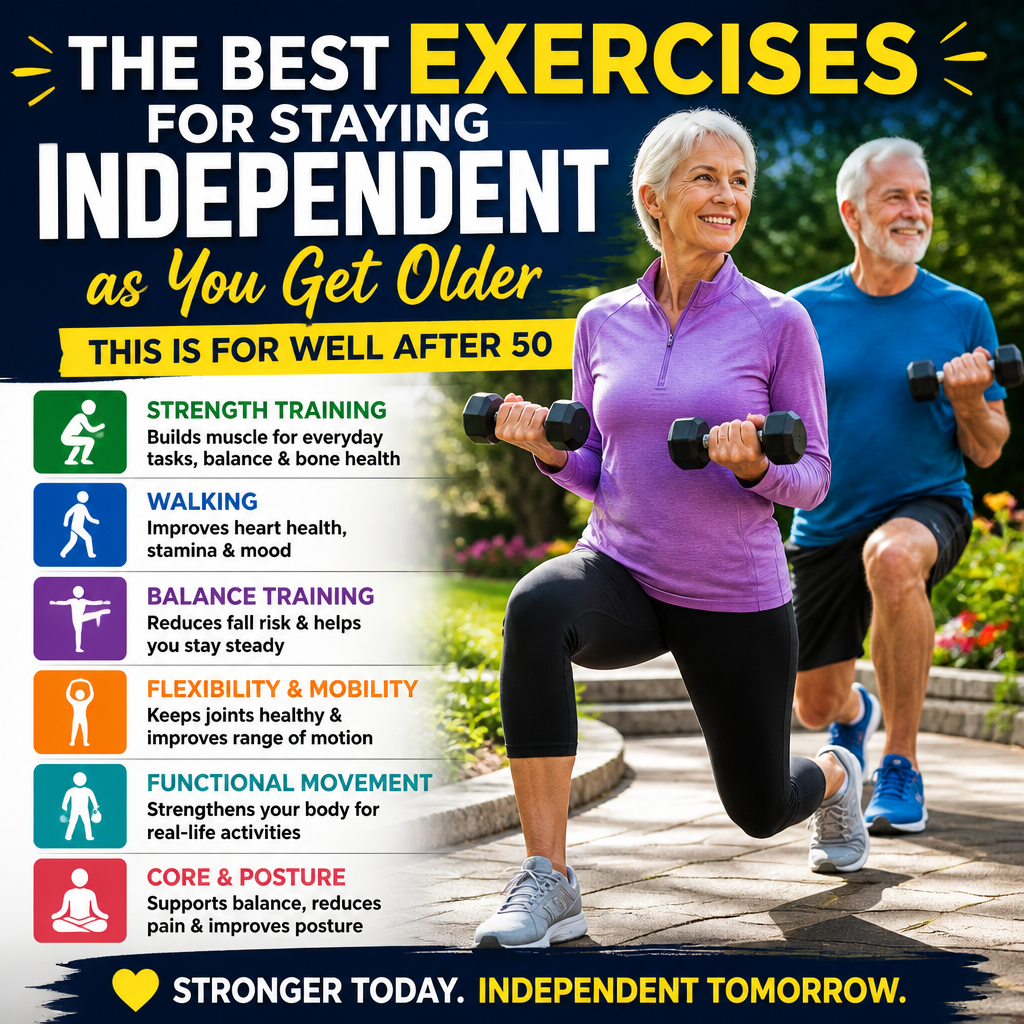
  • The Best Exercises for Staying Independent as You Get Older

    The Best Exercises for Staying Independent as You Get Older

    What are the best exercises for staying independent as you get older?

    Short answer: The best exercises for staying independent are the ones that train everyday life: strength training first, then practicing getting up and sitting down, walking, and balance work. Together they help you get up from the floor, climb stairs and carry your own groceries for years to come.

    There is a difference between getting older and feeling like your world is getting smaller.

    Maybe you have already noticed it in little ways. A flight of stairs feels different. Getting up from a low chair takes more effort. Carrying groceries from the car is not quite as easy as it used to be. You may not think of these things as fitness problems. They are really independence problems.

    That is why the best exercise after 50 is not necessarily the exercise that burns the most calories or makes you sweat the hardest.

    The best exercise is the kind that helps you keep doing your own life.

    Think about the life you want your body to handle

    Instead of asking, “What exercise should I do to look better?” try asking:

    • Can I get up from the floor if I need to?
    • Can I climb stairs without feeling defeated?
    • Can I carry my groceries?
    • Can I walk through an airport, museum or shopping center?
    • Can I get out of a chair without using my hands?
    • Can I keep traveling, working around the house and doing the things I enjoy?

    Those are not vanity questions. They are freedom questions.

    1. Strength training may be the most important place to start

    Muscle does not disappear simply because we reach a certain birthday, but muscle and strength can decline with age when we are inactive. The good news is that the body can respond to resistance training well into later life.

    You do not have to become a bodybuilder. Sit-to-stands, resistance bands, machines, dumbbells, wall push-ups and other simple movements can help.

    Think about training the muscles you use to live: legs, hips, back, chest, shoulders and arms.

    2. Practice getting up and sitting down

    This sounds almost too simple to count as exercise. It counts.

    Standing from a chair without pushing off with your arms trains the legs and hips in a movement you actually use. Start with a sturdy chair and use your hands if you need to. Over time, work toward smoother, stronger repetitions.

    3. Walk for the life outside the gym

    Walking is wonderfully unglamorous—and that is part of its strength. It is accessible, easy to repeat and useful for building endurance.

    You can walk around your neighborhood, inside a store, on a treadmill or with a friend. The goal is not to prove anything. The goal is to make movement part of ordinary life.

    4. Do not ignore balance

    Balance deserves attention because a strong body still needs to know where it is in space.

    Simple balance practice might include standing near a counter and briefly standing on one leg, walking heel-to-toe, or practicing controlled sit-to-stands. Use support when needed and do not turn balance work into a dare.

    5. Train your ability to push, pull, carry and reach

    Real life is full of awkward little strength tests. Opening a stubborn door. Lifting a bag. Reaching for something on a shelf. Carrying laundry. Moving a box.

    Your workout does not need to copy these tasks perfectly, but it should prepare your body for them.

    A simple week can be enough to make a difference

    • 2 days: strength training for the major muscle groups
    • Most days: some walking or other aerobic activity you enjoy
    • Several times a week: brief balance practice
    • Every day: look for opportunities to sit less and move more

    CDC guidance for adults 65+ recommends aerobic activity, muscle-strengthening activity at least two days a week, and balance activities. You do not have to jump straight into the full recommendation. Start from where you are and build gradually.

    The goal is not to become 30 again

    This may be the most important part.

    You are not exercising to erase your age. You are exercising so your age does not unnecessarily erase parts of your life.

    You want to be the person who can say yes when someone suggests a day trip. You want to carry your own bags. You want to get out of a chair without thinking about it. You want enough strength and balance to keep making your own choices.

    That is what fitness after 50 can really be about: keeping your world open.

    Common Questions

    What is the best exercise after 50?

    A combination of strength, aerobic activity and balance is more useful for healthy aging than relying on one type of exercise alone.

    Can I start strength training if I have never lifted weights?

    Yes. Start with manageable resistance, controlled movements and gradual progress. If you have a medical condition or significant physical limitation, ask your health professional what is appropriate.

    Do I have to exercise every day?

    No. Consistency matters more than perfection. Regular movement spread across the week is a practical goal.

    Can walking really help me stay independent?

    Walking can improve endurance and physical activity levels, while strength and balance work address other abilities needed for everyday independence.

    Keep Reading

    For more practical healthy-aging ideas, explore Sturdy Years.

    About Tom Green

    Tom Green writes Sturdy Years. He was born in Pell City, Alabama, in 1962, and he’s a country boy and a true Southerner through and through. He’s just a regular, laid-back 64-year-old who keeps things simple. He shares what he learns about skincare, fitness and getting older, and what’s working for him. He’s also the author of A Practical Guide to Getting Older Without Giving Up on Yourself. Tom isn’t a doctor. He reads up on the research and passes along what’s useful, plain and simple.

    Sources & Proof

    CDC: Older Adult Activity Guidelines
    National Institute on Aging: Health Benefits of Exercise and Physical Activity
    National Institute on Aging: Types of Exercise and Physical Ability

    Safety note: Start at a level appropriate for your current ability. Stop if you develop unusual pain, dizziness, chest pressure, severe shortness of breath or other concerning symptoms, and seek medical advice when appropriate.

    I’ve also mapped out some great tools on my new Tech for Independent Living After 50 page.