Tag: ad

  • Everyone’s Microdosing Weight-Loss Drugs Now — Here’s What the Evidence Actually Says

    Everyone’s Microdosing Weight-Loss Drugs Now — Here’s What the Evidence Actually Says

    Does microdosing weight-loss drugs like Ozempic work?

    Short answer: There’s no good evidence that microdosing weight-loss drugs like Ozempic works. Obesity doctor Amanda Velazquez says low, on-and-off doses haven’t been shown to give meaningful or lasting weight loss or other health benefits. Many microdosers get the drugs from medspas or telehealth companies instead of their own doctor, so talk to your doctor before trying it.

    Sturdy Years · The Long Read

    Tiny doses of Ozempic and tirzepatide are the biggest longevity trend of the year — the benefits without the side effects or the price, if you believe the videos. I went looking for the proof. Here’s what I found, and what it means for those of us over 50.

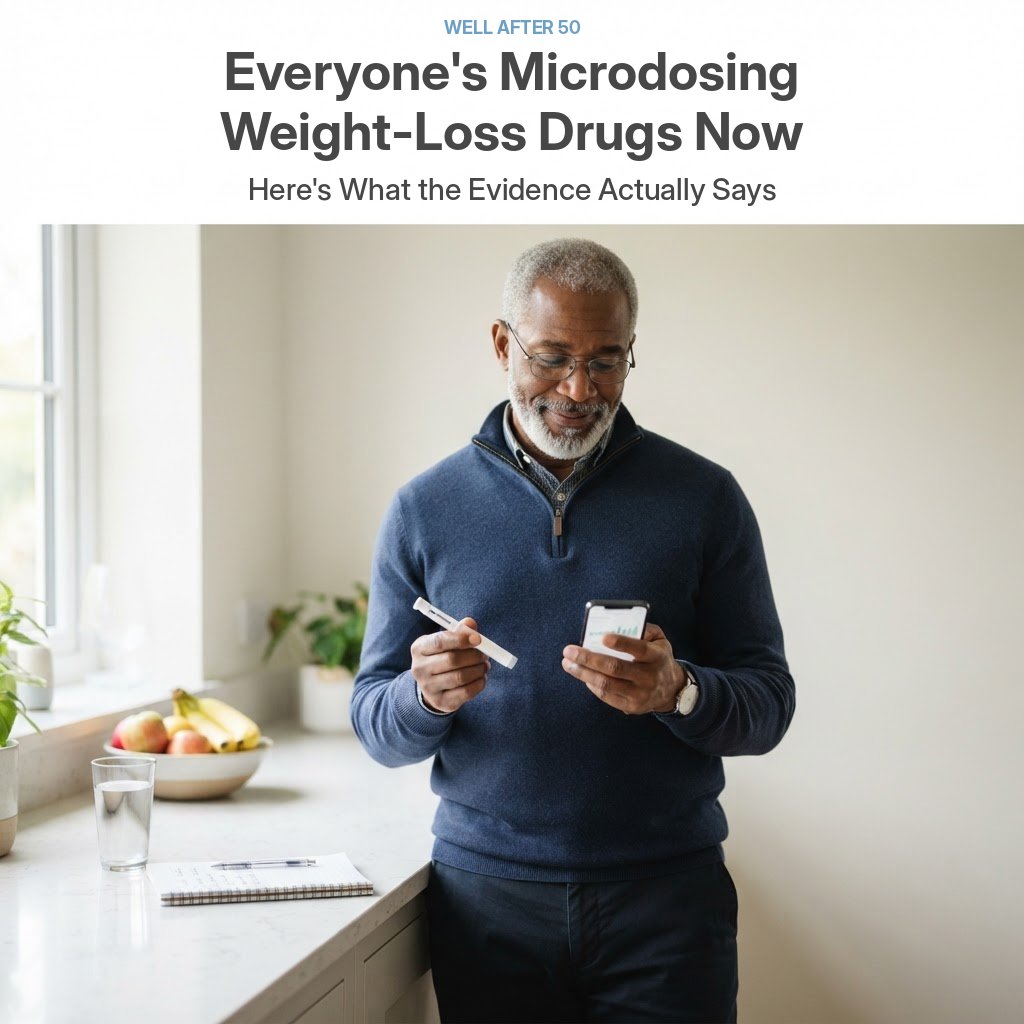
    Man over 50 in his kitchen comparing a GLP-1 injector pen with microdosing research on his phone
    The weekly shot millions of people know. The new trend isn’t a new drug — it’s taking a fraction of this dose, on your own schedule, and hoping the benefits still show up.
    Part 1

    It started, like everything does now, with my phone

    You can’t scroll for five minutes without running into it. Somebody on TikTok holding up an Ozempic pen, explaining how they take just a few clicks of it — a “microdose.” Enough, they say, to quiet the food noise and keep the weight off. Not enough to make you sick. Not enough to cost a fortune. And if the longevity crowd is to be believed, maybe enough to slow down aging itself.

    It sounds like the best of both worlds. That’s exactly why I didn’t trust it.

    So I did what I always do: I went looking for the proof. Not the testimonials, not the before-and-after photos — the actual studies, the actual numbers, from people with no product to sell me. And I looked at it the way those of us over 50 have to look at everything: not “does it work in a headline?” but “what does it do to somebody my age, with my muscle, my stomach, and my wallet?”

    Here’s the honest answer, up front, before we get into any of it.

    The short answer

    The trend is real. The treatment is unproven. About 1 in 7 people on these drugs say they’ve microdosed — but as of November 2026, not one proper trial has ever tested a dose below the approved starting dose of Ozempic-style drugs or tirzepatide. Not for weight. Not for the heart. Not for living longer. There isn’t even an agreed definition of what a “microdose” is.

    What is proven is the full, approved dose — in the right people. And for people over 50, the part nobody in the videos talks about is muscle: a quarter to more than a third of the weight lost on these drugs can be lean tissue, and muscle is the one thing we can’t afford to give away.

    First — “microdosing” isn’t even a medical word

    That isn’t me being picky. That’s a doctor who treats obesity for a living:

    “Microdosing is not a medical term. It’s a term that has been popularized on social media. We don’t have any evidence that low-dose, intermittent use of GLP-1s provides meaningful or sustained weight loss or broader health benefits.”
    — Amanda Velazquez, MD, director of Obesity Medicine at Cedars-Sinai, August 2026 (Cedars-Sinai)

    In practice, microdosing means taking less than the approved dose, or taking it less often — splitting a pen, stretching the shot out to every 10 to 14 days, staying on the starter dose forever, or buying a low-dose vial from a compounding pharmacy. The Cleveland Clinic describes it the same plain way: intentionally taking a reduced amount of the drug.

    Don’t confuse it with what your doctor does. Starting low and adjusting a dose up or down based on how you’re doing is normal medicine — doctors have always done that. Microdosing, the way it’s sold online, is you (or a company) making up the dose as you go, with no tested protocol behind it. Jody Dushay, MD, of Harvard and Beth Israel Deaconess, put it about as bluntly as it can be put in STAT in May:

    “Microdosing GLP-1s is not a thing. There are no legitimate long-term data to support it. In fact, there isn’t even a single definition of microdosing.”
    — Jody Dushay, MD, STAT, May 29, 2026

    The drugs we’re talking about are semaglutide — Ozempic for diabetes, Wegovy for weight — and tirzepatide — Mounjaro and Zepbound. Wegovy’s approved doses climb from 0.25 mg to 2.4 mg a week. Online, a “microdose” of semaglutide is often 0.05 to 0.25 mg — at or below the very first step, the one that was designed to be climbed through in four weeks just so your stomach can get used to the drug. It was never designed to treat anything.

    Why everybody’s doing it anyway

    I get it, I really do. The reasons aren’t vanity — they’re the two problems everybody on these drugs actually has: the nausea and the bill.

    The best count we have is a big survey presented at ISPOR 2026: among 8,486 people currently injecting a GLP-1 drug, 15% said they had microdosed — roughly 1 in 7. Their top reasons were managing side effects (40.8%), cutting cost (31.9%), and trying to hold weight off in maintenance (29.6%). Social media was their most common source of information, and microdosers were more likely to get their medication from a telehealth company, a weight-loss clinic, or a medspa than from their own doctor. (ISPOR 2026 / Evidation Health)

    1 in 7current GLP-1 users in a survey of 8,486 said they’d microdosed
    ~18,000searches a month for “microdosing Ozempic,” surging since late 2024 (BMJ, 2026)
    0randomised trials of any dose below the approved starting dose. Zero.

    And there’s a sales machine behind it. Longevity telehealth companies — most visibly AgelessRx — openly sell “GLP-1 microdoses” for longevity, advertising them as “a powerful new path to promoting long-term wellness.” Secondary reporting this year put their microdosed tirzepatide from about $159 a month and microdosing GLP-1 from about $99 a month, with claims that low doses “may reduce the risk of age-related cognitive decline” and “may trigger molecular pathways that help prevent heart disease, neurodegeneration, and metabolic disorders.” Read those words again: may. Those are marketing claims, not results from any trial. (Science News, March 20, 2026)

    The famous biohacker Bryan Johnson told a podcast audience he microdoses Ozempic and predicted most people eventually will. The BMJ wrote up a former Olympic swimmer whose TikTok video taught followers how to squeeze extra doses out of a pen. Famous people doing something is not evidence. It’s just advertising you don’t have to pay for.

    Now here’s what the full dose actually does — because it’s genuinely impressive

    I don’t want you walking away thinking these drugs are snake oil. They’re not. At full, approved doses, in big proper trials, they’re some of the most effective medicines we’ve ever had for weight:

    For information about clinician-supervised GLP-1 treatment options, see GLP-1 treatment options .

    More dose, more loss — that’s the whole problem with a tiny one

    Average body-weight change in the big trials, drug vs. placebo

    Tirzepatide 15 mg−20.9%
    Tirzepatide 10 mg−19.5%
    Tirzepatide 5 mg−15.0%
    Semaglutide 2.4 mg−14.9%
    Very low dose (~0.35 mg/wk)~−6%
    Placebo (sugar shot)−2.4%

    Average body weight lost · Scale: 0–25%

    Full-dose bars: SURMOUNT-1 (tirzepatide, NEJM 2022) and STEP 1 (semaglutide 2.4 mg, NEJM 2021), all with diet and activity counselling. The amber bar is an early phase-2 dose-ranging study (O’Neil et al., Lancet 2018) at roughly 0.35 mg a week — still above Wegovy’s 0.25 mg starting dose. Below the starting dose, there is no bar to draw. Nobody has run the trial.

    And it isn’t just weight. In SELECT — over 17,600 people, all with existing heart disease and overweight or obesity, none with diabetes — semaglutide 2.4 mg cut major heart events (heart attack, stroke, cardiovascular death) by 20%. In FLOW, it cut major kidney events by 24% in people with type 2 diabetes and kidney disease. That’s real medicine doing real good for real sick people.

    But notice who those trials were in. People with heart disease. People with diabetes and kidney disease. SELECT does not prove the drug prevents a first heart attack in a healthy person, and not one word of it says anything about a tiny dose taken by a healthy 62-year-old who wants to “age slower.” That last claim — the longevity one — has literally never been tested in a human being. The first serious trial of these drugs for healthy aging, called VITAL-H, hasn’t even started enrolling yet. It’s scheduled for 2027. More on that in Part 2.

    The part nobody selling it mentions: your muscle

    Here’s where being over 50 changes the whole conversation.

    In STEP 1, people on semaglutide lost an average of 13.6 kg. Of that, 8.3 kg was fat — and 5.3 kg, about 38%, was lean tissue. In SURMOUNT-1, about a quarter of the weight lost on tirzepatide was lean mass. Muscle is roughly half of lean mass, so figure on something like a fifth of everything you lose being muscle. At 35, you rebuild that without thinking about it. At 65, with muscle already harder to keep and slower to respond to protein, you may not.

    And here’s the cruel part: when the weight comes back — and in the trials, when people stop the drug, most of it does — the fat comes back faster than the muscle does. Lose, regain, lose, regain, and you can end up the same weight you started at but with less muscle holding you up. Less muscle means more falls, more fractures, more help needed with the groceries and the stairs. That’s the trade nobody puts in the TikTok.

    A strong 62-year-old with plenty of muscle might absorb that fine. A frail 76-year-old might not. Which is why the honest question was never “microdose or full dose?” It’s “how much muscle do I have, and what’s my plan to keep it?” — and that plan, per the 2025 joint advisory from four major medical societies, is strength training at least three times a week plus real protein, not a smaller shot. Details and numbers are in Part 2.

    So where does that leave us?

    Part 1 was the story. Part 2 is the proof, and the plan — every major trial with its numbers and its fine print, the FDA’s 2026 crackdown on the compounded stuff microdosing depends on, what these drugs actually cost and what Medicare is doing about it, the hype claims checked one by one, what actually protects your muscle, and the exact list of questions to take to your doctor. If you’re thinking about this — or already doing it — Part 2 is the part to read slowly.

    Part 2

    The proof, the fine print, and the plan

    This is the full report the article above was written from — researched November 9, 2026. Every number carries its source. Where the evidence is strong, I say so. Where it’s thin, secondhand, or missing entirely, I say that too. Nothing here is medical advice for you personally — that’s a conversation for your own doctor, and there’s a list of questions to take to that conversation near the end.

    Considering standard GLP-1 care rather than experimental microdosing? Explore GLP-1 treatment information .

    Every claim, graded

    Claim Verdict
    Microdosing is popular in 2025–2026 Strong — survey, search, and press data
    Microdosing works for weight loss or longevity No evidence — zero trials below the starting dose
    Full-dose GLP-1s cause large weight loss Strong — STEP / SURMOUNT trials
    Full-dose semaglutide protects the heart, in people who already have heart disease Strong — SELECT trial
    Full-dose semaglutide protects kidneys, in type 2 diabetes with kidney disease Strong — FLOW trial
    GLP-1s slow aging or extend life in healthy people Hype / untested — the first real trial hasn’t enrolled anyone yet
    A lower labelled dose can help maintain weight loss Emerging — one trial, SURMOUNT-MAINTAIN (2026)
    Muscle loss is a real risk, especially over 50 Strong — trial body-composition data + 2025 joint advisory

    The big trials, with their fine print

    Every trial below used brand-name drugs at approved doses, plus diet and activity counselling — typically about 500 fewer calories a day and building toward 150 minutes of activity a week. The drug didn’t do it alone, and averages hide wide differences between people.

    Trial Who, what dose, how long What happened
    STEP 1 (2021) 1,961 adults with obesity/overweight, no diabetes; semaglutide 2.4 mg weekly, 68 weeks −14.9% body weight vs −2.4% on placebo; 86% lost at least 5%. Wilding et al., NEJM
    STEP 2 (2021) 1,210 adults with type 2 diabetes; semaglutide 2.4 mg, 68 weeks −9.6% vs −3.4% — the loss is smaller when diabetes is in the picture. Lancet
    STEP 5 (2022) 304 adults, no diabetes; semaglutide 2.4 mg, a full 2 years −15.2% vs −2.6%; loss levelled off around week 60, then held. Nature Medicine
    SURMOUNT-1 (2022) 2,539 adults, no diabetes; tirzepatide 5 / 10 / 15 mg, 72 weeks −15.0% / −19.5% / −20.9% by dose vs −3.1% placebo. Jastreboff et al., NEJM
    SURMOUNT-2 (2023) 938 adults with type 2 diabetes; tirzepatide 10 / 15 mg, 72 weeks −12.8% / −14.7% vs −3.2%. Lancet
    SURMOUNT-5 (2025) 751 adults, no diabetes; tirzepatide vs semaglutide, head to head, 72 weeks Tirzepatide −20.2% vs semaglutide −13.7%. NEJM
    SELECT (2023) 17,604 adults, 45+, BMI 27+, established heart disease, no diabetes; semaglutide 2.4 mg, ~40 months Major heart events 6.5% vs 8.0% — a 20% relative reduction; about 67 people treated for ~3 years to prevent one event. Lincoff et al., NEJM
    FLOW (2024) 3,533 adults, type 2 diabetes + chronic kidney disease; semaglutide 1.0 mg, median 3.4 years Major kidney events −24%; trial stopped early because it was working. Perkovic et al., NEJM
    SURPASS-CVOT (2025) 13,299 adults, type 2 diabetes + cardiovascular disease; tirzepatide vs dulaglutide Non-inferior, not superior — so no SELECT-style heart claim for tirzepatide yet. NEJM
    SURMOUNT-1, 3-year (2025) 1,032 people with prediabetes; tirzepatide up to 176 weeks Weight −12.3% to −19.7% by dose; new type 2 diabetes 1.3% vs 13.3% on placebo. NEJM

    Trial summaries cross-checked across multiple 2026 sources; see the source list at the end. The FDA approved Wegovy in March 2024 to reduce cardiovascular death, heart attack, and stroke in adults with established cardiovascular disease and overweight or obesity. Tirzepatide’s own heart-outcomes trial in people without diabetes (SURMOUNT-MMO) is still running, expected around October 2027.

    And the evidence for microdoses, specifically?

    There isn’t any — from randomised trials, none at all. As of November 2026, no trial has tested semaglutide below 0.25 mg a week or tirzepatide below 2.5 mg a week for weight loss or anything else. A 2026 review in Cureus called microdosing “an emerging pragmatic approach” but said direct evidence is limited and more research is needed — it leaned on observational reports and case studies, which its own authors described as indirect support rather than direct evidence.

    The closest real numbers we have — and notice, none of them is an actual microdose:

    • The lowest dose ever properly tested (phase 2, O’Neil et al., Lancet 2018): semaglutide 0.05 mg daily — about 0.35 mg a week, still above the 0.25 mg starting dose — produced about 6% weight loss over a year, versus about 14% at the highest dose tested. Dose matters. Less drug, less effect.
    • Lowest labelled doses in real-world records (2026, secondary reporting): people who stayed on the lowest approved doses for a year lost 2.2% (semaglutide) to 5.5% (tirzepatide) — against 15–21% at full trial doses. Indicative, not a trial result.
    • SURMOUNT-MAINTAIN (The Lancet, May 2026) — the one real maintenance trial. After 60 weeks at full-dose tirzepatide, 378 people were randomised to stay at full dose, step down to 5 mg — a labelled dose, not a microdose — or switch to placebo. A year later: full dose held −21.9%, the 5 mg group held −16.6%, placebo slid to −9.9%. But a quarter of the step-down group regained at least half their loss and needed rescue, versus 8% on full dose and 67% on placebo. (American College of Cardiology summary) Stepping down to a mid-range labelled dose kept most of the loss. It says nothing about dropping below 2.5 mg.
    • One small bright spot, flagged as preliminary: a small 2025 JAMA Psychiatry report found a low dose of semaglutide might reduce alcohol cravings. Interesting. Not a weight or longevity finding.

    The longevity claim, checked

    VITAL-H is the first real test — and it hasn’t started. In early 2026, the federal ARPA-H agency awarded UT Health San Antonio up to $38 million to lead VITAL-H, a five-year trial that will enrol 726 adults in their 60s and compare semaglutide, rapamycin, and dapagliflozin against placebo, measuring “intrinsic capacity” — physical and mental function — as a marker of healthy aging. Enrolment starts in 2027. Results can’t arrive before 2028–2031. And note: VITAL-H tests semaglutide as a drug for healthy aging at a studied dose — it is not a trial of the microdose regimens sold online. (UT Health San Antonio, March 4, 2026)

    The “biological age” headlines are hype. In October 2026, MIT Technology Review reported that Eli Lilly and Novo Nordisk had presented analyses suggesting their drugs lower “biological age” by about 2–3 years on proteomic clocks. Those results were presented by the companies that sell the drugs, not published in a peer-reviewed journal; the clocks used are unvalidated; the people studied had overweight or diabetes; and the doses were full doses. The Biomarkers of Aging Consortium (Cell, 2023) has said plainly there are no formally validated surrogate biomarkers of aging.

    And the brain claim took a real hit: Novo Nordisk’s EVOKE and EVOKE+ trials of oral semaglutide in early Alzheimer’s disease — 3,808 people, two years — failed. Cognition did not improve, and the programme was discontinued (secondary reporting). A failed treatment trial in Alzheimer’s patients is not evidence for prevention in healthy people — it’s evidence in the other direction.

    SELECT did show lower all-cause mortality as a secondary outcome (HR 0.81) — in a sick, high-risk population, at full dose. Supportive. It is not proof of anti-aging, and it must not be re-sold as “live longer” for healthy 60-year-olds taking a fraction of the dose.

    The risks, honestly — especially after 50

    The everyday side effects are common and usually early: nausea, vomiting, diarrhoea, constipation, bloating, reflux, stomach pain. In STEP 1, on full-dose semaglutide, nausea hit 44% of people, diarrhoea 32%, vomiting 25%. They’re worst in the first months and after dose increases, and they fade for most people. Don’t assume a microdose removes them — the Cleveland Clinic warns that if a low dose wears off faster, the side effects can come back fresh with each new dose, and compounded products add dosing-error risk on top.

    • Stomach paralysis (gastroparesis), ileus, bowel obstruction: real but uncommon reports. These drugs slow stomach emptying by design. The Ozempic label was updated in January 2025 to say it is not recommended for people with severe gastroparesis. Tell your doctor — and any anaesthetist before surgery, because a slow stomach matters under anaesthesia — about severe nausea, vomiting, or being unable to keep fluids down for 24 hours or more.
    • Gallbladder: gallstones and an inflamed gallbladder are on the labels, and rapid weight loss from any method raises gallstone risk. In Wegovy trials: gallstones 1.6% vs 0.7% on placebo; gallbladder inflammation 0.6% vs 0.2%.
    • Pancreatitis: rare, but on every label. Severe stomach pain that may spread to your back, with or without vomiting, means stop and get care. A 2025 meta-analysis of 62 trials (66,232 patients) reported a modest relative risk of 1.44 (secondary reporting).
    • Also on the labels: a boxed warning for thyroid C-cell tumours (based on animal studies; human relevance unproven), kidney injury from dehydration, worsening diabetic eye disease in people with diabetes, hair loss and fatigue. And one update worth knowing: in January 2026 the FDA asked for the suicidal-ideation warning to be removed after finding no causal increase — if you still see the old warning quoted, it’s out of date (secondary reporting).

    Be especially careful — and talk to a clinician first — if you have: a personal or family history of medullary thyroid cancer or MEN2, prior pancreatitis, severe gastroparesis, active gallbladder disease, or type 1 diabetes (off-label), or if you’re pregnant or breastfeeding. That’s a checklist to raise, not a diagnosis.

    Why microdosing usually means compounded drugs — and why that’s the sharpest risk

    Here’s a mechanical fact nobody mentions: brand-name pens only deliver fixed, approved doses. So microdosing usually requires a compounded product — a low-dose vial mixed by a compounding pharmacy. The alternative, counting pen “clicks” to split a dose, is guessing: pens are calibrated for labelled doses, not fractions, and a miscount can double your dose.

    What “compounded” actually means

    • Compounded drugs are not FDA-approved. The FDA does not review them for safety, effectiveness, or quality before they’re sold. They are not generics.
    • The shortage loophole is closed. The FDA declared the tirzepatide shortage resolved on December 19, 2024, and semaglutide’s on February 21, 2025. The enforcement discretion that allowed mass compounding ended in spring 2025. Mass-producing copies is no longer permitted — only narrow, patient-specific compounding remains legal.
    • The FDA acted in 2026. On March 3, 2026, the FDA announced 30 warning letters to telehealth companies for false or misleading claims about compounded GLP-1s — mainly implying the products were the same as FDA-approved drugs, and hiding who actually makes them. (FDA, March 3, 2026)
    • SECONDARY REPORTING — further 2026 actions reported from FDA documents by law and trade press: 25 more warning letters in June 2026 (55 in 2026, after 100+ in 2025); a warning letter to Empower Pharmacy on September 18, 2026; and a revised Import Alert on October 9, 2026, after the FDA evaluated 48 GLP-1 ingredient sites and found 21% out of compliance. As of May 31, 2026, the FDA had received 990 adverse-event reports for compounded semaglutide and 730+ for compounded tirzepatide, including dosing errors that put people in hospital.

    Red flags — walk away if you see: “research use only” or “not for human consumption” peptides sold with dosing instructions anyway; the seller’s own brand name on a compounded drug; claims that it’s “the same as Wegovy/Zepbound” or “FDA-approved”; no named, licenced prescriber or pharmacy; prices far below the manufacturer programmes below.

    What it costs — and the cost trap

    US list prices run about $968–$1,349 a month, but almost nobody paying cash should pay list. The manufacturer direct programmes in 2026: NovoCare offered Wegovy at $499/month, later reported at $349/month for pens (oral Wegovy $149–$299 by dose); LillyDirect offered Zepbound vials at $349 for 2.5 mg, $299 in its Self-Pay Journey Programme, $399 for 5 mg, and $449 for higher doses refilled within 45 days. Savings cards can bring insured copays to about $25/month — but not for Medicare or Medicaid patients. (Prices as reported October 2026 — they changed repeatedly this year; check NovoCare and LillyDirect directly before relying on any figure, including these.)

    Medicare: Part D generally does not cover these drugs for weight loss alone, but it can cover Wegovy for its heart indication if you have documented cardiovascular disease. A temporary Medicare GLP-1 Bridge programme (July 1, 2026 – December 31, 2027) was reported to offer Wegovy, Zepbound, or Foundayo at $50/month for eligible Part D enrollees — BMI 35+, or 30+ with heart failure, uncontrolled blood pressure, or stage 3a+ kidney disease, or 27+ with prediabetes, a prior heart attack or stroke, or peripheral artery disease; people with type 2 diabetes or already getting a GLP-1 through Part D are excluded. Verify your eligibility on Medicare.gov before counting on it. Novo also announced a list-price cut to $675/month from January 1, 2027 (secondary reporting).

    The cost trap, plainly: a compounded “microdose” bought to save money runs $99–$199 a month for a product with no proven benefit. That same money could go toward a labelled dose through a manufacturer programme — or toward the food, protein, and strength training that do have evidence behind them. If it doesn’t work, you’ve spent the money and the time.

    Stopping — and the regain nobody warns you about

    These drugs work while you take them. Obesity is a chronic condition, and the trials treat the drugs as long-term treatment. What happens when people stop is some of the clearest data in this whole report:

    • STEP 1 extension (2022): 327 people who had lost 17.3% of their body weight by week 68 stopped the drug, with no lifestyle programme. One year later they had regained about two-thirds of the loss — and the blood pressure, blood sugar, and cholesterol improvements faded with it.
    • STEP 4 (JAMA, 2021): after 20 weeks on semaglutide, people who continued lost another 7.9%; people switched to placebo gained 6.9% over the next 48 weeks.
    • SURMOUNT-4 (JAMA, 2024): after 36 weeks on tirzepatide, people who continued lost another 5.5%; people switched to placebo gained 14.0% over 52 weeks.

    No taper has ever been proven. No published trial has compared tapering against stopping outright — tapering trials are registered but hadn’t started recruiting as of October 2026. So when a microdose is sold to you as a gentle “taper” off the drug, that use is untested too. The only step-down with trial evidence behind it is SURMOUNT-MAINTAIN’s 5 mg, above.

    For us, this matters twice over: the regain is mostly fat, while the muscle lost on the way down doesn’t fully come back. A stop–start cycle can leave your body composition worse than before you started — same weight, less strength.

    The hype checklist — claims going around, checked

    The claim What the evidence says
    “Microdosing gives you the benefits without the side effects” No trial shows this. A lower dose means less effect and still side effects — plus dosing-error risk.
    “It slows aging and adds years to your life” No human data. The first real trial (VITAL-H) hasn’t enrolled yet. The “biological age” clocks are unpublished and unvalidated.
    “It reduces inflammation, protects the brain, prevents dementia” Full-dose GLP-1s may have anti-inflammatory effects; the Alzheimer’s trials failed. There is no microdose data at all.
    “Celebrities and biohackers do it, so it must work” Anecdote is not evidence. Bryan Johnson’s routine is not a trial.
    “A tiny dose is safer because it’s tiny” Backwards. Measuring tiny doses from pens and vials increases error risk, and compounded concentrations vary.
    “It’s the same drug, so it’s the same as Wegovy/Zepbound” The FDA has warned telehealth companies for making exactly this claim. Compounded ≠ approved ≠ generic.
    “You can stop anytime and keep the weight off on a microdose” Regain after stopping is the rule in the trials. No taper or microdose maintenance protocol has ever been tested.
    “Ozempic face and muscle loss won’t happen on a microdose” No data. Muscle loss tracks with how much weight you lose and whether you train and eat protein — not with the word “micro.”

    What people are searching right now (November 2026): how to split a pen and “click counting”; microdosing for longevity, inflammation, energy, and brain fog; microdosing for perimenopause and menopause — often driven by fear of “Ozempic face,” with the tiny dose sold as the way to avoid looking gaunt; microdosing to dodge nausea or stretch a pen to save money; how to stop without regaining; and “is compounded semaglutide still legal in 2026.” One shift worth noticing: searches for “tirzepatide” (reported at 1.5 million a month in October 2026, up 40% year on year) have overtaken “ozempic” (550,000, down 41%) — people are searching by ingredient name, often to find compounded or research-peptide sellers. Treat those aggregator figures as indicative, but the direction is a safety signal, not just a trend.

    What is not hype: that full-dose GLP-1s genuinely help many people with obesity, diabetes, heart disease, and kidney disease; that cost and nausea are real barriers worth solving with a clinician; and that a lower labelled dose under supervision can be reasonable for some people — for tolerability, or for maintenance.

    What actually protects your muscle

    An older man at home doing a seated resistance-band row on a yoga mat
    This is the unglamorous part with the strongest evidence behind it: resistance work you can do in your living room, a few times a week, every week.

    This comes from the 2025 joint advisory of the American College of Lifestyle Medicine, the American Society for Nutrition, the Obesity Medicine Association, and The Obesity Society (Mozaffarian et al., Obesity 2025) — written specifically for people losing weight on these drugs:

    • Lift something, at least 3 times a week. Full-body strength work — weights, machines, bands, bodyweight, chair stands — progressing gradually. Add at least 150 minutes a week of brisk walking or the equivalent. Protein alone will not preserve muscle without resistance training; this is the single best-supported lever there is.
    • Eat protein first, at every meal. During active weight loss, the advisory range is 1.2–1.6 grams per kilogram of body weight per day — or, simpler, 80–120 grams a day for most adults — spread across meals (roughly 25–40 g a meal for many of us). Avoid sustained intakes at or above 2 g/kg/day. For healthy adults over 65 generally, PROT-AGE and ESPEN suggest at least 1.0–1.2 g/kg/day, and more when losing weight. These are general targets to personalise with your doctor or dietitian — kidney disease changes the maths, and a suppressed appetite makes protein the first thing to slip, so plan it deliberately.
    • Lose slowly if you can. Rapid loss raises gallstone risk and lean-tissue loss. A slower loss with training preserves more muscle than a fast loss without it.
    • Mind bone, sleep, and vitamin D. Bone loss rides along with weight loss, and fall risk climbs if muscle and bone fall together. Ask your doctor where you stand.
    • Weigh function, not just weight. Can you climb the stairs, carry the groceries, get up out of a chair without using your arms? After 50, those are the numbers that matter.

    Questions to take to your doctor

    Copy this list and take it in. It’s the whole point of the article in eight questions.

    For readers comparing options after discussing eligibility with a clinician: GLP-1 treatment information .

    1. “Do I have a medical reason for a GLP-1 at all?” Approved uses are type 2 diabetes and chronic weight management (BMI 30+, or 27+ with a weight-related condition), plus specific heart and kidney indications. Healthy weight, no diabetes, no heart or kidney disease means no approved indication — and no longevity indication exists for anyone.
    2. “What is my muscle and frailty picture?” Ask about grip strength, walking speed, falls, and bone density — and whether weight loss is even the right goal for you, versus strength and function. If you’re already frail or low on muscle, rapid weight loss may do more harm than good.
    3. “If we use one, what dose — and how will we adjust it?” Ask what labelled dose you’d start at, how the steps up work, what happens if the nausea is bad, and what the maintenance plan is — before you start. Ask specifically: “Is there a labelled lower dose we could try under supervision, instead of a compounded microdose?”
    4. “What is my protein and strength plan?” Ask for a protein target in grams per day and a strength programme you can actually do — chair exercises, bands, and walking count. Ask for a dietitian referral if your appetite is low.
    5. “What should I watch for, and when do I call?” Severe stomach pain, vomiting you can’t keep fluids down through, dehydration, gallbladder pain (upper-right belly pain, fever) — and what to tell the team before any surgery or anaesthesia, because these drugs slow stomach emptying.
    6. “What will this cost me, for how long — and what if coverage stops?” Ask about NovoCare and LillyDirect, savings cards, and the Medicare GLP-1 Bridge if you’re on Part D. Don’t start without an exit plan.
    7. “Is this product FDA-approved — and who is the pharmacy?” If anyone offers you a compounded or “research” product, ask for the pharmacy’s name and licence, and why an approved product can’t meet your need. If they can’t answer clearly, walk away.
    8. “Can we review all my medicines together?” Bring everything — diabetes drugs (especially insulin and sulfonylureas, where low blood sugar is a real risk), blood pressure medicines, and anything that affects stomach emptying. Doses often need adjusting as weight and blood sugar change.

    If you’re already microdosing — or about to

    • Don’t adjust a pen by counting clicks, split doses, or stretch a prescription on your own. And tell your prescriber what you’re actually taking. If they think you’re on 1.0 mg and you’re on 0.2 mg, every judgement they make about your health is based on a wrong number.
    • Don’t buy from an unknown online seller. Check the pharmacy’s licence and the FDA’s warning letters. Beware “the same as Wegovy” — the FDA has warned companies for that exact claim.
    • If cost or nausea is the problem, say so. Those are solvable in normal care — a slower climb up the doses, a different labelled dose, anti-nausea strategies, a manufacturer programme — without stepping off-label into untested territory.

    What we couldn’t verify — said plainly

    • Exact microdose schedules and current prices from specific sellers (including AgelessRx’s current pages) were not opened live for this report. The $99–$199/month figures come from secondary 2026 reporting and may have changed. Check a seller’s own site before quoting a price — and treat the checking as part of the point.
    • FDA actions beyond the March 3, 2026 release — the June 2026 warning-letter wave, the Empower Pharmacy letter, the October Import Alert, and the 990 / 730+ adverse-event counts — come from law-firm and trade reporting of FDA documents, not from fda.gov directly in this run. The March release itself was verified live.
    • Medicare Bridge details and manufacturer self-pay prices come from October 2026 secondary price guides, and these programmes changed repeatedly during 2026. Confirm on Medicare.gov, NovoCare, or LillyDirect before acting.
    • Some secondary trial details — SURPASS-CVOT’s mortality figures, a reported Mounjaro cardiovascular indication dated August 28, 2026, and FLOW’s −20% all-cause mortality figure — come from secondary summaries; the core heart and kidney findings are from the NEJM papers as summarised in multiple sources.
    • Search-trend numbers come from the BMJ (≈18,000 searches/month) and an October 2026 trend aggregator — indicative, not raw Google or TikTok data.
    • Some things simply don’t exist yet: there is no data on microdosing safety or effectiveness in adults over 50 specifically, none on microdosing and bone health, and none on microdose outcomes beyond a year. Those are gaps in the science, not just missing citations.
    • VITAL-H’s semaglutide dose and form aren’t stated in the university’s release (secondary reports describe a daily pill). Don’t cite VITAL-H as a microdose trial — it isn’t one.

    Sources

    Verified live on November 9, 2026, unless marked “index” (found via search-result text, cross-checked against other sources).

    • Cedars-Sinai — “Can Microdosing GLP-1s Promote Health and Weight Loss?” (August 5, 2026). cedars-sinai.org
    • Cleveland Clinic — “Can You Microdose Ozempic and Other GLP-1s?” W. Scott Butsch, MD. health.clevelandclinic.org
    • Science News — Jamie Ducharme, “GLP-1 microdosers are chasing longevity” (March 20, 2026). sciencenews.org
    • FDA — “FDA Warns 30 Telehealth Companies Against Illegal Marketing of Compounded GLP-1s” (March 3, 2026). fda.gov
    • UT Health San Antonio — “$38 million national trial testing drugs to extend healthspan” (VITAL-H, March 4, 2026). news.uthscsa.edu
    • ISPOR 2026 — Ramirez et al., Evidation Health, “Emerging Patterns of GLP-1 Microdosing in a Large Real-World Population” (May 2026). ispor.org
    • STAT — Jody Dushay, MD, “GLP-1 microdosing is popular, but there’s little evidence it works” (May 29, 2026) (index). statnews.com
    • BMJ (2026) — Canqi Li, “Weight loss drugs: Does microdosing GLP-1s work?” (index). bmj.com
    • American College of Cardiology — “SURMOUNT-MAINTAIN: Continuing Tirzepatide Maintains Weight Loss,” Horn et al., The Lancet (May 12, 2026) (index). acc.org
    • Trial results (STEP, SURMOUNT, SELECT, FLOW, SURPASS-CVOT) as summarised across 2026 sources (index). treatmentshub.com · jabsandtabs.com · ajmc.com · onedaymd.aestheticsadvisor.com
    • Microdosing evidence roundup, 2026 (index). treatmentshub.com · getheally.com
    • Protein and muscle on GLP-1s — Mozaffarian et al. 2025 joint advisory summary (index). gramproteincalculator.com · saciedad.com · glp1nutrition.org
    • Stopping and weight regain (index). glp-1.app · ecgwaves.com
    • Compounding legality and FDA enforcement (secondary, Oct–Nov 2026) (index). glp-1.reviews · frierlevitt.com
    • Cost and access guides (secondary, October 2026) (index). jabbitapp.com · glp1alpha.com
    • Search trends (secondary) (index). risingtrends.co
    • Longevity context (index). pravida.com

    One last thing. This page is general information, researched on November 9, 2026 — it is not medical advice, and it is not a substitute for your own doctor, who knows your history and your medicines. Don’t start, stop, split, stretch, or change any dose based on anything written here, or in any video, mine included. If this article did its job, the next step isn’t a purchase. It’s a conversation — take the questions above with you.


    Join the Conversation

  • What Is Astaxanthin? The Red Stuff in Salmon Everyone’s Suddenly Talking About

    What Is Astaxanthin? The Red Stuff in Salmon Everyone’s Suddenly Talking About

    It’s the pigment that makes salmon pink, and right now it’s all over TikTok. I went looking for what it actually is, what the human trials really show for skin, eyes, blood sugar and joints — and what it doesn’t do. The honest answer is more interesting than the hype.

    What is astaxanthin, and does it really work?

    Short answer: Astaxanthin is a red antioxidant pigment made by tiny algae. It’s what makes salmon pink. The best evidence in people is for skin: a 2021 review of 11 trials found it improved skin moisture and elasticity compared with a dummy pill. The proof for eyes, joints and the rest is weaker, so don’t expect it to fix everything.

    Older woman holding a supplement bottle and taking a red softgel; headline: What Is Astaxanthin? The Red Stuff in Salmon Everyone's Suddenly Talking About
    What Is Astaxanthin? The Red Stuff in Salmon Everyone’s Suddenly Talking About

    Part 1 — The Story

    The pink fish gave it away

    Astaxanthin is a red antioxidant pigment made by a tiny algae — and it is the reason salmon are pink, shrimp turn orange when you cook them, and flamingos are rosy. I had eaten salmon all my life and never once asked why it was pink. Turns out the answer is a little green algae called Haematococcus pluvialis that lives in freshwater ponds. When the sun gets fierce or the food runs out, that algae turns itself deep red and packs itself with astaxanthin, like a built-in sunscreen it paints itself with to survive.

    The salmon eat the algae, or eat the little creatures that ate the algae, and the red builds up in their flesh. We get the colour on our plate — and we get a little of the pigment too.

    The algae under a microscope: the big deep-red cells are packed with astaxanthin, made when the algae is stressed by strong sunlight — its own built-in sunscreen. The smaller green cells haven’t made the switch yet.

    I first heard the word the way most people do now — on my phone. Somebody on TikTok was calling it “America’s tanning pill.” Somebody else was calling it the strongest antioxidant on earth, 6,000 times stronger than vitamin C. Somebody else was holding up a bottle and saying it would fix their skin, their eyes, their brain, their knees — all of it.

    That is a lot of promises for one red capsule. And I have been around long enough to know that when something promises everything, it usually delivers a little of one or two things, and the rest is noise. So I did what I always do now: I went and looked at the actual studies, the real trials in real people, and asked the simple question — what does this stuff actually do, and is any of it worth anything to someone over 50?

    That 6,000 number — let me clear it up first

    You will see that number everywhere, so let me tell you where it came from before it confuses you the way it confused me. Back in 2007, three scientists working for a company that sells one of the big astaxanthin brands put astaxanthin and vitamin C in a test tube with one particular kind of free radical, called singlet oxygen, and timed how fast each one mopped it up. Astaxanthin was about 6,000 times faster than vitamin C in that one test.

    That is real lab data. It is also one chemical reaction in a glass dish. It does not tell you what a capsule does in your body, how much of it gets into your skin or your eyes, or whether it changes anything you can actually feel. In that same test, in a fully fatty liquid, lycopene — the stuff that makes tomatoes red — beat astaxanthin. Nobody puts that on a bottle.

    So forget the 6,000. What matters is what happened when real people swallowed the stuff and researchers measured what changed. That is a much quieter story, but it is a more honest one — and there is genuinely something in it.

    One more thing worth knowing before we get to the trials. Astaxanthin is fat-soluble, not water-soluble, and its shape lets it stretch right across a cell membrane, so it can protect both the inside and the outside of the membrane at once — most antioxidants work on one side only. It also gets into the brain and the eye, which is why researchers have looked at it for both. And unlike beta-carotene, it does not turn into vitamin A in your body, so there is no vitamin A build-up to worry about.

    Why now?

    A few things came together this year. Market estimates put astaxanthin at about $1.9 billion in 2025, heading for about $4.3 billion by 2033 — though most of that market is fish feed, not supplements, and other estimates put the total much lower, so treat the figures as rough. TikTok is full of it: about 150,000 mentions and roughly 55 million views on astaxanthin posts in the last year, mostly about skin and glow.

    And 2026 brought a run of proper new reviews of all the trials added together: one on exercise recovery covering 24 trials, one on blood sugar covering 9 trials in people with prediabetes or type 2 diabetes, and a couple of brand-new joint trials. Even doctors’ sites published a full review at the end of October asking whether it was a super antioxidant or overhyped. Their answer was the same as mine: neither. Somewhere in the middle — with a few things that are genuinely worth knowing about.

    And that “tanning pill” label, while we’re here: astaxanthin does not stimulate a tan, does not increase melanin, and is not sun protection. Any warm glow is just the pigment itself showing in the skin. It is not a substitute for sunscreen. Not ever.

    Part 2 — The Proof & The Practical

    Skin — the best evidence, and it is still modest

    Read the published research for this section

    If astaxanthin does anything well in people, it is this: skin that holds its moisture and its spring a little better. A review in 2021 pulled together 11 randomised trials and found that astaxanthin significantly improved skin moisture and skin elasticity compared with a dummy pill. That is the strongest finding in the whole pile.

    But here is the part the bottles leave out. That same review found it did not significantly reduce wrinkle depth. Not when all the trials were pooled. So the wrinkle cream in a capsule is not what this is.

    The trials themselves are small. One gave 36 men 6 mg a day for six weeks, and the skin around their eyes got a bit firmer and lost less water. Another gave 65 women 6 or 12 mg a day for sixteen weeks, through the autumn. While the women on the dummy pill saw their wrinkles and moisture get measurably worse over those months, the women on astaxanthin basically held steady.

    Held steady. That is not a facelift — but at our age, holding steady for four months is not nothing either.

    A third trial, 23 people on 4 mg a day for ten weeks, found their skin could take a bit more sun before it reddened. A bit. It is not sunscreen, and I want to be plain about that — nothing you swallow replaces sunscreen on your skin.

    Most of these trials were done in Japan, most were small, and several were run or paid for by the companies that sell astaxanthin. That does not make them false, but it means I keep my expectations measured — and other reviewers pooling different trials have found the evidence for skin ageing and sun damage insufficient, so the experts don’t all agree.

    The fair way to put it: after about twelve weeks, your skin may feel a little more moisturised and a little springier. You probably will not see it in the mirror. And if anyone tells you it erases wrinkles, they are selling you something the pooled trials did not find.

    Eyes — this one matters more after 40

    Read the published research for this section

    I spend more time on screens than I ought to, and my eyes tell me about it by the end of the day. This is the part of the research that caught my attention, because the age split is right where we live.

    A trial in 2023 gave 60 healthy adults 9 mg a day for six weeks while they did computer work. In the people aged 40 and over, their near vision held up better after a day at the screen than the people on the dummy pill. In the people under 40, there was no difference at all.

    That is worth sitting with: the benefit, if it is real, shows up in our age group and not in the young. Older, smaller trials in screen workers found the same kind of thing — 6 mg a day for four weeks, and people’s eyes refocused better from near to far, and they reported less of that heavy-headed, dim-sight feeling at the end of the day.

    It does not prevent macular degeneration or cataracts. Nobody has done a trial that shows that. What it seems to do, modestly, is help tired eyes feel a little less tired after a long day looking at a screen. For someone like me, who reads and writes on a screen all day, that is a real, everyday thing — not a miracle, just a bit more comfort at the end of the day.

    Brain — the biology is beautiful, the proof is thin

    Astaxanthin can cross into the brain. In cells and in animals it looks protective, and that has led to a lot of big talk about memory and dementia. In people, the story is much thinner, and I will not dress it up.

    The best trial gave 96 healthy middle-aged and older adults with a bit of age-related forgetfulness either 6 or 12 mg a day for twelve weeks. Their memory test scores improved — and improved a bit earlier than the dummy pill group — but the authors themselves said the trial was too small to prove a real difference.

    Another small pilot, 21 people with mild cognitive impairment, found faster thinking after twelve weeks, but it mixed astaxanthin with sesamin, so nobody can say which one did what, and it was run by a manufacturer. When researchers pooled 11 trials together in 2024, the effect on thinking accuracy was only just barely significant, and the effect on reaction time was not significant at all.

    So here is where I land: it might help a little with the small stuff — word-finding, processing speed — but nobody has shown it prevents dementia or Alzheimer’s, and anyone who tells you it does is ahead of the evidence by a long way. I am not going to sell you a brain pill that the science has not earned yet.

    Muscle and exercise — recovery, not performance

    Read the published research for this section

    This one surprised me, because the headline in 2026 sounded good: a big review of 24 trials found astaxanthin lowered creatine kinase, a blood marker that goes up when muscle is damaged. That is real.

    But the same review found it did not improve VO2max, did not make anyone faster in a time trial, and did not increase power. An earlier pooling of 11 trials disagreed in part and found some performance benefit — which tells you the effect, if any, is small.

    So it may help you recover a touch better after a hard session, but it will not make you stronger or faster. Strength after 50 still comes from the same place it always has: lifting weights, and eating enough protein. A capsule does not do your squats for you.

    Blood sugar and cholesterol — the most promising new bit

    Read the published research for this section

    Here is where the newest research is most interesting, and I want to be careful with it because it matters to a lot of us. A 2026 review pulled together 9 trials with 403 people who had prediabetes or type 2 diabetes. On astaxanthin, fasting blood sugar came down by about 16 points on average. HbA1c — the three-month blood sugar measure — came down by about a third of a point. Triglycerides came down by about 21, LDL — the bad cholesterol — by about 9, and HDL — the good cholesterol — went up by about 3.

    Those are modest numbers. But they all point the same way, and they are the most consistent set of results in the whole literature.

    But — and this is important — body weight did not change. BMI did not change. Insulin resistance did not change. And nobody has shown it prevents heart attacks or diabetic complications. So it is not a substitute for your medicine, or for the food and the walking. It is a small nudge on the numbers, in people who already have blood sugar trouble — worth knowing about, not worth getting excited about.

    A separate review of higher doses, 6 to 20 mg a day, found the same pattern on cholesterol: HDL up, triglycerides down, LDL and total cholesterol not reliably changed. And pooled analyses find no reliable effect on blood pressure at all. So if your blood pressure is the problem, this is not your answer.

    Joints — two new trials, both worth watching

    Two trials came out in 2025 that I think are worth knowing about, even though both are small and short. One gave 71 adults with knee osteoarthritis 12 mg a day for eight weeks, and pain scores dropped, stiffness eased, and two inflammation markers in the blood came down. The other gave 60 people with rheumatoid arthritis 20 mg a day for eight weeks, and their disease activity scores and disability scores improved — though the pain and CRP differences faded once the numbers were adjusted.

    Eight weeks is not long, and 60 or 70 people is not many. But these are real randomised trials in real people with sore joints, and they both point the same way. I would call this “worth a try alongside moving more” — not a treatment for arthritis, and not a replacement for anything your doctor has given you.

    Immune system — one good old trial

    The main human trial here is from 2010: 42 healthy young women took 2 or 8 mg a day for eight weeks, and their natural killer cell activity — the part of the immune system that deals with virus-infected cells — went up, and markers of DNA damage in their immune cells went down. The 8 mg dose did better than the 2 mg dose.

    That is a real result, but it was in young women, not in people our age, and it does not mean it will shorten a cold or stop you getting ill. At most, it suggests astaxanthin helps keep the immune system steady by taking some of the oxidative load off it. I would not buy it for immunity alone.

    What it does not do

    Let me put this in one place, because it is as important as what it does. Astaxanthin does not reduce wrinkle depth when you pool the trials. It does not help you lose weight — a 2025 review of 9 trials found no effect on BMI or body weight at all. It does not reliably lower blood pressure. It does not make you faster or stronger. It does not prevent dementia, or macular degeneration, or diabetes, or heart disease. It does not give you a tan, and it does not replace sunscreen.

    If a bottle promises you any of those things, put it back on the shelf.

    Dose, safety, and how to take it

    Read the published research for this section

    Most of the human trials used 4 to 12 mg a day, for six to sixteen weeks. Skin trials mostly used 3 to 6 mg. Eye trials used 6 to 9 mg. Brain trials used 6 to 12 mg. There is no proven “best” dose, and higher has not been shown to be better.

    A 12 mg softgel sits at the top of that studied range — Sports Research® Icelandic Astaxanthin 12mg is one at that strength, taken once a day.

    The safety record is reassuring. A review of 87 human studies found no safety concern, including 35 studies at 12 mg a day or more. The European Food Safety Authority set a daily limit of 0.2 mg per kilo of body weight — about 14 mg a day for a 70-kilo adult — and judged 8 mg a day from supplements safe for adults on top of what food gives you. In Europe, supplements are capped at 8 mg a day. In America, 12 mg softgels are common.

    The side effects people report are mild: a reddish tint to the skin or the stool at high intakes — it is a red pigment, so that is to be expected — and a bit of stomach upset, usually if you take it without food.

    There are two cautions worth knowing. One case report described a 69-year-old woman on warfarin who started 16 mg a day — above the recommended dose — and developed big bruises within a day, with her blood-thinning measure shooting up dangerously. One case, at a high dose, is not proof of an interaction, but if you take a blood thinner, talk to your clinician before you start this. [2019 warfarin case report]

    And there is no safety data in pregnancy or breastfeeding, so it is not recommended there. If you have a shellfish allergy, check the source on the label too — algae-derived astaxanthin doesn’t carry seafood allergens, but krill- or shrimp-derived versions can. And this is an adult supplement: at 8 mg a day, children under 14 would meet or exceed the European daily limit for their size.

    Now, the one practical tip that actually matters: take it with food that has some fat in it. Astaxanthin dissolves in fat, not water, and your body needs fat to absorb it. In a small study, people absorbed about two and a half times as much when they took it after a meal as when they took it before one. You do not need a heavy meal — eggs, avocado, a handful of nuts, olive oil on a salad, or a piece of salmon is plenty. Taking it on an empty stomach with a glass of water wastes a good part of the dose. Once a day, with your main meal, is the sensible way.

    Food or supplement?

    A 6-ounce serving of wild sockeye gives you about 3.6 mg of astaxanthin — close to a low-dose capsule — plus the protein and omega-3s that come with the fish.

    Wild sockeye salmon is the richest food: a good 6-ounce serving gives you about 3.6 mg, which is close to a low-dose capsule, plus omega-3s and protein. Farmed Atlantic salmon gives you only about 1 mg in the same serving. Shrimp and crab carry most of their astaxanthin in the shell, which you do not eat, so they give you very little. Krill oil capsules are often sold on their astaxanthin, but one popular one contains about 1/160th of a 4 mg capsule — not worth buying for that reason.

    So can you get a trial dose from food? At the low end, yes — wild sockeye most days gets you about 3 to 4 mg. At 12 mg, no, not practically. A supplement is the only reliable way to take a standard dose every day — that’s where something like Sports Research® Icelandic Astaxanthin 12mg comes in, if you want the same amount each day without eating salmon daily.

    But salmon is still the better food. If you eat wild salmon a couple of times a week, you are already getting some of this stuff the way nature intended, along with everything else that makes fish good for you.

    Buying it — what to look for

    If you do go looking, here is what matters. Buy natural astaxanthin from Haematococcus pluvialis — the label should name the algae. The synthetic kind is made from petrochemicals, is mostly used to colour farmed fish, and is not what the human trials used.

    Look for 4 to 12 mg a day, and read the dose per day, not per softgel — some bottles say 12 mg on the front and mean two softgels. An oil-based softgel helps absorption. Look for a named third-party tester, not just the words “third-party tested” with nobody named. And compare the cost per milligram per day, not the bottle price — buying guides put a good natural product at roughly $25 to $50 for a month at 6 mg a day, which works out to about a dollar or two a day, though quoted prices vary a lot from guide to guide.

    Avoid anything that hides the dose in a “proprietary blend.” Avoid anything that does not name its source. And avoid anything promising wrinkle removal, weight loss, or a tan. The product I’ve linked in this article is Sports Research® Icelandic Astaxanthin 12mg — use that checklist to judge it, and any other bottle, for yourself.

    Is it worth trying?

    Here is my honest answer, after reading all of this. If you try it, the most likely thing you will notice after eight to twelve weeks is skin that feels a little more moisturised and springy, and eyes that feel a little less tired at the end of a screen-heavy day. You probably will not see it in the mirror. You will not feel smarter, you will not lose weight, and your blood pressure will not move.

    That is a small return for a dollar or two a day — worth it to some people, not to others, and entirely your call.

    If you do try it, give it a fair run. Pick one product that meets the label checklist — Sports Research® Icelandic Astaxanthin 12mg is the one linked throughout this article — and take it once a day with your main meal, for twelve weeks. Note how your skin feels and how your eyes feel at the end of the day: at the start, at six weeks, and at twelve weeks. If nothing has changed by week twelve, stop. The trials say that is long enough to know.

    And whatever you decide, remember what it does not replace: sunscreen, strength training, protein, sleep, and any medicine your doctor has prescribed. Astaxanthin sits beside those things. It does not stand in for them.

    The red stuff in the salmon is interesting, and it is worth knowing about — but the boring stuff, the walking and the weights and the sleep, is still doing most of the work.

    Two honest gaps before I finish: nobody has run a big trial in people over 65 specifically, and nobody has tested long-term safety beyond about twelve to sixteen weeks at these doses — the European daily limit is the long-term reference point, not a trial result. If a study fills either gap, I’ll update this.

    — Thomas Green, Sturdy Years

    Research and further reading

    About Tom Green

    Tom Green writes Sturdy Years. He was born in Pell City, Alabama, in 1962, and he’s a country boy and a true Southerner through and through. He’s just a regular, laid-back 64-year-old who keeps things simple. He shares what he learns about skincare, fitness and getting older, and what’s working for him. He’s also the author of A Practical Guide to Getting Older Without Giving Up on Yourself. Tom isn’t a doctor. He reads up on the research and passes along what’s useful, plain and simple.

  • What Is GLP-1 — and How It Helps With Weight Loss After 50

    What Is GLP-1 — and How It Helps With Weight Loss After 50

    What is GLP-1, and how does it help with weight loss?

    Short answer: GLP-1 is a hormone your gut makes after you eat. It tells your brain you’re full, slows how fast food leaves your stomach, and helps keep your blood sugar steady. The weekly GLP-1 shots copy that hormone, which is why they can make weight loss after 50 feel more doable.

    Sturdy Years · Health

    You keep hearing the letters GLP-1. This post keeps it simple: what GLP-1 actually is, what it does in your body, and why it can make weight loss feel more doable after 50 — in plain words, no sales pitch.

    GLP-1 and weight loss after 50; older couple walking in a park
    Losing weight after 50 is not about looking twenty again. It is about moving easier, feeling steadier, and enjoying the years in front of you.

    GLP-1 is a hormone your own body makes. That is the first thing worth knowing, because the name sounds like something invented in a laboratory. It was not. Your gut releases GLP-1 every time you eat, and it is one of the signals that tells your body, “Food has arrived — here is what to do with it.”

    GLP-1 support for weight loss works by copying that natural signal, only stronger and longer-lasting than the brief signal a meal gives you on its own. It comes as a small shot you give yourself at home, just once a week. That is the whole idea — help your body’s own fullness and blood-sugar system do its job more steadily, so eating less stops feeling like a constant fight with yourself.

    What GLP-1 does in your body

    Think of GLP-1 as a messenger with three jobs, and all three matter for weight.

    1. It tells your brain you are full

    After you eat, GLP-1 helps send the “that’s enough” signal to your brain. When that signal is stronger, you feel satisfied on a smaller portion — not stuffed, not deprived, just done. Supper ends naturally instead of drifting into seconds and then something sweet an hour later because you never quite felt finished.

    2. It quiets the food noise

    So many of us over 50 describe the same thing: thinking about food all day long. What is in the fridge, when is lunch, what is that in the cupboard. That constant background chatter is sometimes called “food noise,” and it is exhausting — it is a big reason willpower runs out by evening. When GLP-1 is working, that chatter gets quieter for a lot of people. Food goes back to being food, not a full-time occupation. You eat when you are hungry and then you get on with your day.

    3. It slows your stomach down a little

    GLP-1 slows how quickly food leaves your stomach, so a meal keeps you full for longer. A normal breakfast carries you to lunch instead of wearing off by ten. That simple change — feeling full between meals — is what makes eating less sustainable. You are not white-knuckling your way from one meal to the next. You are just not that hungry yet.

    4. It helps your body handle blood sugar

    GLP-1 also helps your body release insulin when blood sugar rises after a meal, and eases back on the sugar your liver lets out. The result is steadier blood sugar — fewer sharp rises, fewer of the crashes that send you looking for a snack an hour later. Steady suits us. Most of us feel the difference in our energy when the day stops swinging between wired and wiped out.

    Why this matters more after 50

    Weight after 50 is a different game from weight at 30, and it is not because we got lazy. A few honest things change:

    • We lose muscle as we age, and muscle is what burns energy even at rest. Less muscle, slower burn — the same meals that suited us at 40 can quietly be too much at 60.
    • Weight settles around the middle. Belly weight is the stubborn kind, and it is also the kind most tied to blood sugar creeping up over the years.
    • Hunger and fullness signals get less reliable. The “I’m full” message can arrive late, and the “have a little something” message can arrive all day long.
    • We have dieted before — probably more than once. Losing and regaining teaches your body to defend the higher weight, so each fresh start feels harder than the last.

    That is exactly where GLP-1 helps. It does not ask you to win an argument with your own appetite every day. It turns the appetite down, steadies the blood sugar, and lets a smaller amount of food genuinely satisfy you. For a lot of people over 50, that is the first time weight loss has felt calm instead of like a battle — and calm is something you can keep up.

    What losing the weight can give you back

    Nobody over 50 I know is chasing a beach body. What people actually talk about is ordinary, everyday stuff — and it is not small stuff:

    • Getting up from a chair, the floor, or the garden without planning it first.
    • Knees, hips and backs that have an easier job to do all day.
    • Walking further, keeping up with grandkids, and still having something left in the evening.
    • Clothes fitting the way they used to, and feeling like yourself when you catch your reflection.
    • Sleeping more comfortably and waking up clearer.

    That is the real prize here. The number on the scale is just the measure. The point is a body that lets you do more of the life you want to live.

    Protect Your Strength After 50; older man exercising with hand weights
    Keeping your muscle while the weight comes off is the smartest move there is after 50. Light weights, bands, bodyweight — whatever you will actually do a few times a week.

    How the weekly shot fits into real life

    One of the reasons this suits people our age is how ordinary it is to live with. There is no daily routine to remember and no clinic trip every week. It starts with a health questionnaire you fill in online at home — your weight, your health history, the medicines you already take. A licensed clinician reviews what you have written, decides whether GLP-1 is a sensible fit for you, and only then is anything prescribed.

    If it is right for you, the medicine is shipped to your door, with everything you need in the kit. From there it is simply a once-a-week shot you do at home — a small, quick injection, the same day each week, that takes a moment and then you forget about it until the following week. Most people pick a quiet time, a Sunday evening or a Monday morning, and it just becomes part of the week like anything else.

    The amount starts low and builds up gradually over the first weeks, which gives your body time to get used to it. You are not left to figure it out alone, either — there are regular check-ins every few weeks, where you share how you are eating, how you are feeling and how the weight is moving, and the clinician adjusts things with you as you go. Refills are coordinated to arrive before you run out, so there is no scrambling and no gap in the middle of progress.

    That steady, guided rhythm is a big part of why it works for people over 50. You have support when you need it, a plan that adjusts as your body changes, and the rest of the week is just yours to live.

    Help it work: the over-50 basics

    GLP-1 does the appetite part. A few simple habits do the rest, and they matter more at our age than they ever did.

    Protect your muscle with protein

    When weight comes off, you want it to be fat that leaves, not muscle. Eating protein at every meal helps your body hold on to muscle while it lets go of fat. A simple guide: a palm-and-a-half of protein at each meal — eggs, Greek yogurt, chicken, fish, beans, whatever you enjoy — spread across the day rather than loaded into one big sitting.

    Protein and Nutrition After 50; woman enjoying a balanced meal
    Protein at every meal, in food you actually like. That is what feeds the muscle you are keeping.

    Use your muscles a few times a week

    Protein feeds muscle; using muscle keeps it. Strength work a few times a week — dumbbells at home, resistance bands, chair rises, a class at the gym — tells your body the muscle is still needed. Pair that with regular walking and you have the combination that keeps the weight-loss years feeling strong instead of frail.

    Eat slowly and stop at satisfied

    Because the fullness signal now arrives properly, give it time to arrive. Eat slowly, put the fork down now and then, and stop at comfortable rather than full. Smaller meals, eaten calmly, sit better and satisfy more than big ones bolted down.

    Keep the rest of life steady

    Sleep well, keep fluids up, and keep moving on the ordinary days — a walk after supper, the stairs when you can, the garden, the dog. None of this is dramatic, and that is the point. GLP-1 makes the eating part quieter, so these simple things finally get a chance to work.

    A few good questions to have in mind

    If you are curious whether GLP-1 could help you, these are the questions worth having ready when you fill in your health details and the clinician reviews them — and to keep asking at your check-ins as you go:

    • Given my weight, my blood sugar and my health history, would GLP-1 help me?
    • How does the weekly shot work, and how do we build the amount up gradually?
    • What is my plan for protein and strength work while the weight comes off?
    • How often will we check in, and how will I know it is working well for me?
    • What should I do on a day when I do not feel much like eating?

    The bottom line

    GLP-1 is not a gimmick and it is not magic. It is your own gut hormone, given a stronger, steadier voice — delivered as a once-a-week shot you do at home, with a clinician guiding the plan — so hunger quiets down, meals satisfy you sooner, and blood sugar stays on an even keel. After 50, when muscle, metabolism and appetite are all pulling in the wrong direction at once, that help lands exactly where it is needed.

    Add protein, keep your muscles working, walk most days, and let the weight come off at a pace your body can live with. That is how this helps people our age — not just lighter, but stronger, steadier, and more able to enjoy the years ahead.

    — Thomas Green, Sturdy Years

    About Tom Green

    Tom Green writes Sturdy Years. He was born in Pell City, Alabama, in 1962, and he’s a country boy and a true Southerner through and through. He’s just a regular, laid-back 64-year-old who keeps things simple. He shares what he learns about skincare, fitness and getting older, and what’s working for him. He’s also the author of A Practical Guide to Getting Older Without Giving Up on Yourself. Tom isn’t a doctor. He reads up on the research and passes along what’s useful, plain and simple.

  • The Short Phone Dramas Women Are Getting Hooked On — What Is ReelShort?

    The Short Phone Dramas Women Are Getting Hooked On — What Is ReelShort?

    Sturdy Years · Entertainment · Phones & Apps

    ReelShort is a phone app that tells soap-opera stories in one-to-two-minute episodes — and a lot of women over 50 have quietly made it part of their day. This is a friendly guide to what it is, why it is fun, and how to enjoy it well: the stories, the pace, and the small pleasures of watching in short, satisfying pieces.

    Older man and woman watching short films on their phone in the park, with headline Short Films You Can Watch Anywhere After 50

    What is ReelShort, and why are so many women hooked on it?

    Short answer: ReelShort is a short-drama app made for your phone. Every story is told in short vertical episodes of about one to two minutes, filmed to fill your phone screen, and every episode ends on a cliffhanger — which is why “just one more” becomes the natural rhythm of watching. It is free to download from your phone’s app store, and the opening episodes of most series are free, so you can try a story and see whether its characters hold you. From there, viewers choose how to continue: unlock episodes as they go with coins, or use a VIP pass for uninterrupted watching.

    What follows is a guide for older viewers in particular — what the stories are like, why the format suits this stage of life, and a few simple ways to get more enjoyment out of every episode.

    What it is, and what the stories are like

    Think of the soaps many of us grew up loving, made fresh for the phone in your hand. The stories are unapologetic melodrama: romance, revenge, family secrets, and second chances. There are billionaire romances like The Double Life of My Billionaire Husband, werewolf stories like Fated to My Forbidden Alpha and True Luna, and revenge stories like CEO Queen: A Mother’s Revenge, where a woman comes back for everything that was taken from her. Secret babies, fated mates, betrayals, makeovers — the plots move fast and the feelings are big. You can browse the range in the ReelShort catalogue.

    A full series runs about 40 to more than 100 episodes, which adds up to roughly two to three hours of story — about the length of a film, or a short novel, told in small pieces. Each episode gets going in the first few seconds and ends at a turning point. That “just one more” feeling is simply how the format works, and for a lot of viewers it is a big part of the enjoyment.

    ReelShort makes its stories in English, largely with American casts. It launched in August 2022, and the audience has grown steadily since: some 310 million installs on Android phones alone by November 2026, a rating of 4.69 stars from more than half a million ratings, and more than a billion dollars in revenue from these little dramas.

    Why women our age are at the heart of it

    It would be easy to assume this is a young person’s thing, but the numbers tell a different story. Industry figures put women 25 to 55 at the centre of an American audience that reached some 66 million monthly viewers in 2025 — more than double the year before — with the core audience often described as women aged 30 to 60. Viewing research found that women 35 to 44 made up 20.8% of microdrama viewing against 11.5% of viewing overall, and women 45 to 54 made up 15.7% against 7.7% overall. In plain words, women in the second half of life watch these dramas at about double the usual rate.

    The same pattern shows up elsewhere. In China, about 46.5 million people aged 50 and over were watching short dramas every month by February 2026, up about 50% in a year.

    It is not hard to see the appeal at this stage of life. Many of us have spent decades fitting our time around families, jobs, and everybody else’s needs. An episode that asks for two minutes — and gives back a laugh, a gasp, and a reason to watch the next one — fits easily into the day most of us actually live.

    How it fits a day after 50

    Part of the format’s charm is how little it asks of you. There is no need to set aside a whole evening or keep track of a complicated plot for weeks. It fits around ordinary life, in ordinary moments.

    Unwinding at the end of the day. Feet up, tea made, and for a while the only question that matters is whether she will forgive the billionaire. A lot of viewers describe exactly this — the day loosening its grip, one short episode at a time.

    A small pleasure, in small pieces. A few episodes with morning coffee. A few more after lunch. A couple before bed. It becomes a modest daily pleasure rather than a big production, and there is something to be said for pleasures that size.

    Made for spare moments. A waiting room, the garden, a quiet afternoon, the last ten minutes of the evening — one episode is only a minute or two. And because every episode recaps through its cliffhanger, picking the story back up later feels easy, like returning to familiar characters.

    Something to look forward to. A cliffhanger left at lunchtime is still there in the evening. It is a small thing, but having a little enjoyment waiting for you can brighten an ordinary Tuesday.

    Fun to share. For many viewers, half the enjoyment is the conversation afterwards — a text to a friend, a sister, or a granddaughter: did you see what she just did? Swapping theories about a secret husband or laughing about a mother-in-law is its own pleasure, and a shared story gives you something light to talk about together.

    Why it lifts the mood

    Ask regular viewers what they get out of it and the answer is usually simple: it makes them happy, and feeling happy makes the rest of the day feel better. Lighter, somehow. A bit more patient. A bit more like themselves.

    The stories are built for that response. A heroine delivers the perfect comeback and you catch yourself grinning at your phone. A long-kept secret finally comes out and you gasp in your own kitchen. A second-chance romance you have been rooting for finally lands. None of this is grand or complicated — it is the old, familiar pleasure of a story going the way you hoped, delivered in two-minute pieces.

    Most of us know how a flat afternoon can sit on you, and how a good story can change the weather inside a day. A few enjoyable episodes with a coffee, a cliffhanger that gives a quiet evening a little sparkle, ending the day on a smile — these are small things, but small things are most of life. Enjoyment like this is not a medical claim or a cure for anything. It is just a pleasant way to spend part of a day, and pleasant parts of a day matter.

    I open the app, and within two minutes I am somewhere else entirely — rooting for a heroine half my age like she is my own granddaughter. I always come away smiling.

    Speaking for myself

    I am in my sixties, and I did not expect a phone app full of two-minute love stories to become a regular part of my day. It has, and I am not embarrassed about it.

    My days have their own worries, the same as anyone’s. In the evening I make a cup of tea, put my feet up, and let somebody else’s dramatic life take over for a while. For twenty minutes I get to wonder whether she will see through the secret billionaire, instead of running through my own list. By the time I set the phone down, my mind feels like it has had a short holiday.

    It is a small treat, and I treat it that way — a few episodes while the coffee brews, a few more in my chair after lunch. I have noticed I am often in a better mood afterwards, and a better mood tends to make the rest of the day go more kindly. On a heavier day — a difficult phone call, a quiet house — a couple of episodes can be a gentle change of scene. That is not a promise about what it will do for you. It is just why I keep watching, the way a friend might tell you about a show he has been enjoying.

    How it works, in plain words

    For readers who like the practical side, here is how it works. You download ReelShort free from your phone’s app store, open a story that catches your eye, and start watching. The first episodes of most series are free — one check of 766 series on ReelShort’s own pages found a median of 10 free episodes to open a series, and found that 108 of those series — about 14% — are free all the way from the first episode to the last. That opening stretch is usually enough to know whether a story and its characters suit you.

    Past the free episodes, there are two ordinary ways to continue, and it helps to know both before you start. Episodes can be unlocked with coins, at about 60 coins an episode, with coin packs from $4.99 up to $49.99. There is also a VIP pass — about $19.99 for a week of unlimited watching, with monthly and yearly options — which tends to suit viewers who like to watch a whole series through in a few sittings. Neither way is pushed here; it is simply worth knowing how the app is set up, so you can watch in the way that feels comfortable for you.

    There is also a slower, free route that a lot of patient viewers enjoy. Daily check-ins and short adverts inside the app earn coins — viewers report roughly five free episodes a day this way — so a leisurely watch, a few episodes at a time, can carry you a long way through a series. Watching that way turns the cliffhangers into part of the routine: a little more story each day.

    A few ways to enjoy it more

    These are small habits, gathered from my own watching and from what other viewers describe — the kind of thing one friend passes to another:

    • What to watch for when choosing a series: a first episode that makes you care about the heroine quickly, a story question you genuinely want answered, and a tone you enjoy — romance, revenge, fantasy, and second chances each have their own flavour. The free opening episodes are there for exactly this: sampling until a story clicks.
    • Pair it with a moment you already enjoy. Morning coffee, afternoon tea, the evening wind-down — attaching a few episodes to a familiar break turns it into a small, pleasant routine.
    • Watch in sittings. A few episodes, a stretch, a fresh cup of tea, then back to the story. The cliffhanger will still be there, and the pause is part of the anticipation.
    • Keep a next series in mind. When one story ends well, noting a title you would like to try next — a billionaire romance, a mother’s revenge, a second chance at love — keeps the enjoyment going without any hunting around.
    • Share it, if you can. Telling a friend which series you are following, and swapping reactions after a big reveal, adds a social pleasure to a solitary one.

    A last word

    ReelShort is not high art, and it does not pretend to be. It is something simpler and, on the right afternoon, just as welcome: short, warm-hearted, cliffhanger-driven stories that fit into the corners of a day and leave most viewers in a better mood than they found them. For a lot of us over 50, that is a perfectly good reason to watch.

    If it sounds like your kind of thing, a gentle way to find out is to open ReelShort during a quiet moment and watch the free opening episodes of a series like The Double Life of My Billionaire Husband or Fated to My Forbidden Alpha. You will know within a few episodes whether it is for you — and if you find yourself smiling and reaching for the next one, you will be in plenty of company.

    About Tom Green

    Tom Green writes Sturdy Years. He was born in Pell City, Alabama, in 1962, and he’s a country boy and a true Southerner through and through. He’s just a regular, laid-back 64-year-old who keeps things simple. He shares what he learns about skincare, fitness and getting older, and what’s working for him. He’s also the author of A Practical Guide to Getting Older Without Giving Up on Yourself. Tom isn’t a doctor. He reads up on the research and passes along what’s useful, plain and simple.

  • AI Tools for Seniors Living Alone: Free and Cheap Ways to Stay Independent at Home

    AI Tools for Seniors Living Alone: Free and Cheap Ways to Stay Independent at Home

    What AI tools help seniors who live alone stay independent?

    Short answer: Most of the tech that helps you keep living on your own is free, already on your phone, or cheaper than you’d think. Start with Medical ID on your phone, which is free and takes 5 minutes, so an EMT can see your medicines in an emergency. Then look at Alexa+, free with Amazon Prime, and Be My Eyes, a free app that reads things for you.

    You don’t need a robot or a big budget. Most of the tech that helps folks keep living in their own homes is free, already on your phone, or cheaper than you’d think.

    Living on your own after 50 mostly comes down to a handful of worries. Falling with nobody around. Missing a pill, or taking it twice. A scam call that sounds just like family. And the house getting awful quiet some evenings.

    The good news is that AI got a lot better at those exact jobs this year, and plenty of folks our age have noticed. AARP’s latest tech survey of more than 3,000 people found that AI use among adults 50 and older jumped from 18% in 2024 to 30% in 2025.

    If you want to learn to talk with a chatbot like ChatGPT, I covered that in Best Free AI for Seniors. This one’s different. These are the tools that help you stay safe and independent at home, starting with the free ones. For each one I’ll tell you what it does, what it costs and where it falls short. Fellas and ladies both, there’s something here for you.

    The quick list

    • Medical ID on your phone: free, takes 5 minutes
    • The new Alexa+: free with Amazon Prime, or about $140 to $200 for an Echo Show 8
    • Be My Eyes, for reading labels and mail: free
    • A family safe word against AI scam calls: free
    • Medicine reminders: free, or a smart dispenser from about $40 a month
    • Fall detection on a watch: Apple Watch SE 3 from $249
    • An AI companion: ElliQ, free in some states, otherwise a lease
    • Borrowing gadgets before you buy: free through your state

    1. Set up Medical ID on your phone (free, 5 minutes)

    I’m starting with this one because it costs nothing and most folks have never touched it. If you’re ever found on the floor or in a wreck, an EMT can pull up your medicines, allergies and emergency contacts right from your lock screen, no passcode needed.

    • iPhone: open the Health app, tap your picture, then Medical ID. Fill it in and turn on “Show When Locked.”
    • Android: open Settings, then look for “Safety & emergency” and “Medical information.” The menu names vary a little by phone brand.

    While you’re in there, add at least two emergency contacts. Everything else in this article works better once that’s done.

    2. The new Alexa+ (free with Prime)

    This is the big change this year. Amazon rebuilt Alexa with the same kind of AI that runs the chatbots, and since February it’s been free for every Prime member in the U.S. Without Prime, it’s $19.99 a month, which isn’t worth it when Prime costs less.

    The difference is you can talk to it like a person now. Instead of memorizing exact commands, you can say something like “remind me to take my blood pressure pill after breakfast every day” or “call a ride to my doctor’s appointment Thursday.” If you already have an Echo, just say “Alexa, upgrade to Alexa+.”

    If you’d like a device to go with it, the Amazon Echo Show 8 is the one senior tech guides keep coming back to. It’s a speaker with a screen, so you can see faces on video calls from across the room and read your reminders in big letters. With your OK, family can “Drop In” for a video check-in without you having to answer anything. The regular price runs about $180 to $200, but it goes on sale a lot, and deal sites have caught it around $140. With Black Friday coming, I’d hold off and wait for a sale.

    Where it falls short: It’s new, and TechRadar reports some early users have had slow answers, broken routines and wrong information. For now you can switch back to the old Alexa if it gives you fits. It’s also not an emergency device. Amazon sells a paid add-on called Emergency Assist that connects you to a live agent, but nothing works if the power or internet goes out, so keep your phone handy too.

    3. Be My Eyes: a free app that reads things for you

    You point your phone’s camera at something, like a medicine label, the tiny print on a bill, the microwave display or a thermostat. Then either the app’s AI tells you what it says, or a real volunteer comes on a video call and helps you out.

    It’s built for people who are blind or have low vision, but anybody whose eyes aren’t what they used to be can use it. It’s free on iPhone and Android, and there are millions of volunteers signed up around the world, so somebody’s usually awake to help no matter what time it is.

    Where it falls short: AI can get things wrong. For something important, like a medication dose, double-check with your pharmacist. And don’t point it at your bank statements unless you’re comfortable with a stranger seeing them.

    4. A family safe word: free protection from AI scam calls

    Now for the ugly side of AI. Scammers can copy a voice from a few seconds of video posted online, then call you sounding just like your grandson, your niece or your brother, crying and begging for money.

    It’s working, too. The Federal Trade Commission reports that adults 60 and older reported more than $3 billion in fraud losses in 2025, up from about $600 million in 2020.

    The best protection doesn’t cost a dime. The FBI recommends a family safe word, something only y’all would know. No word, no money. Hang up and call that person back on the number you already have. (I also showed how a free AI helper can sniff out scam texts in Best Free AI for Seniors.)

    And with Medicare open enrollment running until December 7, watch out for fake “Medicare” calls. Medicare isn’t going to call you out of the blue asking for your Medicare number. If you’re not sure, hang up and call 1-800-MEDICARE (1-800-633-4227) yourself.

    5. Medicine reminders that won’t let you forget

    Before you spend money on a fancy pill machine, try the free stuff. Your phone or Alexa can remind you at the same time every day. Many pharmacies will also pack your pills in little sealed packets labeled by day and time, so you can see at a glance whether you took them. Just ask at the counter.

    If you take five or more medicines a day, a smart dispenser like Hero might be worth a look. You pour each pill type in once, and at pill time it chimes and gives you just that dose. It stays locked the rest of the time so you can’t double up by accident, and it can text family if you miss one. On Hero’s own site it runs about $40 to $60 a month, depending on the plan. If you’re on Medicare and managing an ongoing health condition, ask about their Medicare remote care program. It can bring the cost way down, sometimes to nothing, though co-pays may apply.

    Where it falls short: You rent it, you don’t own it, and you’ll likely want a family member to help you set it up the first time. For one or two pills a day, a $5 pill box does the job.

    6. A watch that calls for help after a fall (from $249)

    Falls are the thing most of us worry about when we think about living alone. The Apple Watch SE 3 is Apple’s cheapest current watch, and it’s the one senior tech guides keep ranking first for fall detection.

    The part I like best: if you’re 55 or older, Apple turns fall detection on by itself once you put in your age. If it feels a hard fall and you don’t move for about a minute, it calls for help on its own and sends your location to your emergency contacts. And it just looks like a regular watch, so folks actually wear it instead of leaving it in a drawer.

    Prices start at $249. Get the cellular version, which costs more, so it works even when your phone is in the other room.

    Where it falls short: Apple says plainly that the watch can’t detect every fall. A slow slide out of a chair might not set it off. It needs an iPhone, and you’ll have to charge it every day. A dead watch can’t help anybody.

    7. An AI companion that checks on you (free in some states)

    ElliQ is a little tabletop robot that looks something like a desk lamp with a screen. Unlike Alexa, it starts the conversation. It says good morning, asks how you slept, reminds you to drink water or take a walk, plays games and helps you video call family.

    Now, the budget part most folks miss. Some states give it to qualifying older adults for free through their aging offices. New York just renewed its program in October 2026, and as of this past summer, Washington, Florida, Nevada, Wisconsin and New Jersey had programs too. Call your local Office for the Aging and ask. If you don’t qualify, it’s a lease: $249 to start, then $39 to $59 a month depending on how long you sign up for.

    Where it falls short: New York reports that most users feel less lonely, but those numbers come from users rating themselves, with no comparison group. ElliQ is not an emergency device, so keep a phone or alert button close by. No machine takes the place of a real friend, but it might help fill the quiet hours.

    8. Borrow it before you buy it (free)

    Hardly anybody knows about this one. Every state has an assistive technology program, paid for by a federal law called the Assistive Technology Act. Many of them will let you try out gadgets, borrow them for a few weeks, or get gently used equipment for little or nothing.

    That means you can test a magnifier, an easy phone or a medical alert before you spend a penny. To find yours, search for your state’s name plus “assistive technology program,” or start at the national directory at AT3Center.net.

    AI for Seniors: A Friendly Beginner’s Guide to ChatGPT, Smart Tools, and Everyday Tasks by Wes Coburn https://link.amazon/B03Q1vQSR

    Bonus: help paying for your phone or internet

    None of this works without a phone or internet. If you get SSI, Medicaid, SNAP, federal housing help or a veterans pension, you may qualify for the federal Lifeline program, which takes money off your monthly phone or internet bill. The bigger ACP internet discount ended in 2024, but Lifeline is still going. Apply through the official site, not some website promising a “free iPhone.”

    Your weekend checklist ($0)

    Print this out or stick it on the fridge. You can do every one of these by Sunday without spending a dime.

    1. Fill in Medical ID on your phone and add two emergency contacts.
    2. Pick a family safe word and share it with the people you love.
    3. Set one daily reminder, for pills, water or a walk.
    4. Download Be My Eyes and try it on a can label.
    5. If you have Prime and an Echo, say “Alexa, upgrade to Alexa+.”
    6. Look up your state’s assistive technology program before buying anything.

    Then, if you’ve got some money set aside, a fall-detection watch or an Echo Show 8 on sale is where I’d look next. Like the old saying goes, an ounce of prevention is worth a pound of cure.

    Other Voices Worth Following

    • Laurie Orlov of Aging and Health Technology Watch has spent years tracking the tech built for older adults. Read her if you want the big picture without the sales pitch.
    • Kim Komando, the longtime tech radio host and columnist, has written about how scammers use AI to copy voices. Her plain-talk tips are easy to follow.
    • Joseph Coughlin, founder of the MIT AgeLab and author of The Longevity Economy, has been asking for years why technology isn’t built better for people our age. He’s worth a listen.

    Common Questions

    What are the best free AI tools for seniors living alone?

    Medical ID on your phone, the voice assistant already on your phone, Alexa+ if you have Prime, the Be My Eyes app for reading labels and mail, and your phone’s reminder app. A family safe word isn’t an app, but it’s free and one of the best defenses against AI voice scams.

    Is Alexa+ free?

    Yes, if you have Amazon Prime in the U.S. Without Prime it costs $19.99 a month, and there’s a limited free text version on Alexa.com.

    What technology helps seniors living alone?

    Fall detection, like the Apple Watch, which turns it on automatically at 55 and up. A voice assistant or smart display for hands-free calls and reminders. And daily check-ins, like ElliQ or a simple phone call routine with family.

    Can seniors get ElliQ for free?

    In some states, yes. New York, Washington, Florida, Nevada, Wisconsin and New Jersey have offered it free to qualifying older adults through aging programs. Call your local Office for the Aging to ask.

    How do I protect myself from AI voice scams?

    Set up a family safe word, never send money on an urgent call, and hang up and call the person back on a number you already know.

    A Final Thought

    Staying independent isn’t about having the fanciest gadget. It’s about having a little help in the right spots, so you can keep living in your own home, on your own terms. I reckon most of us can start with what’s already in our pocket.

    Your turn: Which of these would help you most, or is there one you already use? Tell me in the comments. Somebody reading might need your tip.

    — Tom

    Keep Reading

    Find more on my Tech for Independent Living After 50 page.

    About the Author

    Tom Green writes Sturdy Years. He was born in Pell City, Alabama, in 1962, and he’s a country boy and a true Southerner through and through. At 64, he shares practical research and everyday experience about staying active, living well and making the most of life after 50.

    Prices and programs change often. Figures here were checked in early November 2026, so check the seller or program before you buy or apply. Tom isn’t paid by any company mentioned here. This article is general information, not medical, legal or financial advice.

  • Persimmon Soap and the “Old People Smell”: What Really Happens After 50?

    Persimmon Soap and the “Old People Smell”: What Really Happens After 50?

    What causes “old people smell,” and does persimmon soap help?

    Short answer: Yes, body odor can change after 50, and researchers have tied part of it to a compound called 2-nonenal. Persimmon soap is marketed to help neutralize that smell. It isn’t magic, but it’s an inexpensive thing to try along with a good daily washing routine.

    Did you know you might start smelling a little different after 50?

    Yep. Nobody puts that on the birthday card.

    You get the cake, the candles, maybe a card that says, “50 is the new 40!”

    But somewhere in the fine print is:

    “Your skin may now have its own personality.”

    And that brings us to one of the funniest—and slightly embarrassing—questions people over 50 sometimes ask:

    Why do old people smell different?

    And more importantly…

    Can persimmon soap help with “old people smell”?

    First: What Is “Old People Smell”?

    “Old people smell” is a phrase people use to describe a particular odor that can sometimes develop as we age.

    There is actually some science behind it.

    As skin ages, changes in the skin’s oils can result in the formation and oxidation of certain compounds. One compound researchers have associated with age-related body odor is 2-nonenal.

    That doesn’t mean everyone over 50 develops it. It doesn’t mean older people are dirty. And it definitely doesn’t mean you suddenly need to apologize when you walk into a room.

    But aging can change your skin—and sometimes that can change how you smell.

    So… Is Persimmon Soap the Answer?

    This is where persimmon soap enters the story.

    Persimmon-based soaps have become popular because they are marketed as a way to help neutralize or reduce unwanted body odors associated with aging.

    And honestly, I can understand the appeal.

    Nobody wants to walk past a bathroom mirror, catch their own reflection and think:

    “Well, apparently I’m becoming my grandfather.”

    A good cleanser can help you feel fresh and clean.

    But persimmon soap isn’t magic. It’s still soap. You shouldn’t expect it to completely eliminate every odor caused by aging, hormones, sweat, skin oils, clothing or other factors.

    Why Does Your Body Odor Change After 50?

    Getting older can bring plenty of changes that nobody warned us about.

    Hair changes. Skin changes. Muscle changes. Sleep changes.

    And apparently, even your personal fragrance department gets reorganized.

    Older skin generally becomes drier and thinner, and the composition of skin oils can change. Hormonal changes can also affect sweating and body odor. Then there are medications, diet, exercise, stress and everyday hygiene.

    So if you notice that you smell different than you did when you were 30, you’re not necessarily imagining it.

    Your body really is changing.

    And Here’s the Funny Part…

    When we’re young, we spend ridiculous amounts of money trying to smell like something we’re not.

    Mountain breeze. Ocean mist. Fresh rain. Midnight adventure.

    I don’t know what “midnight adventure” smells like, but apparently it comes in a spray bottle.

    Then you hit 50 and suddenly you’re perfectly happy smelling like:

    Soap.

    Clean skin. Fresh laundry. Maybe a little aftershave.

    And honestly? That’s not bad.

    I Kind of Like the “Old People Smell”

    Here’s a confession:

    Sometimes I actually like the smell people call “old people smell.”

    Not because I want to smell stale.

    Because certain smells are connected to memories.

    The smell of an old-fashioned bar of soap. Your parents’ bathroom. A freshly washed towel. Your grandparents’ house. The aftershave your father wore. A particular hand lotion your mother used.

    Those smells can take you backward in time faster than a photograph.

    So maybe we should be careful about automatically calling every familiar older-person smell “bad.”

    Sometimes it’s just nostalgia with a scent.

    But I Still Want to Smell Good

    Of course.

    Being comfortable with getting older doesn’t mean giving up personal hygiene.

    I’m over 50. I still want to smell clean. I still want people to enjoy standing next to me. And I definitely don’t want someone opening a window when I walk into the room.

    A Good After-50 Smell Routine

    • Shower regularly. Nothing fancy required.
    • Clean areas that sweat. Armpits, feet and other areas where sweat and bacteria can accumulate deserve attention.
    • Try a gentle soap. If you’re interested in persimmon soap, give it a try and see how your skin responds.
    • Moisturize afterward. Dry skin becomes more common with age, and harsh cleansers can make it worse.
    • Wash clothes and towels regularly. Sometimes the smell isn’t coming from your body at all. Your favorite shirt may be the actual criminal.
    • Don’t drown yourself in cologne. There’s a point where “I want to smell good” becomes “I have entered the room before my body has.” A little is usually enough.

    Want to Try Persimmon Soap?

    If you’re curious about persimmon soap, you can check out the product I found on Amazon here:

    See Persimmon Soap on Amazon

    This is an affiliate link. If you purchase through this link, I may earn a commission at no additional cost to you.

    Does Persimmon Soap Really Work?

    That’s where we need to separate advertising from reality.

    Persimmon soap may help reduce unwanted odor for some people, but there’s no reason to expect it to completely reverse age-related changes in body odor.

    If you try it, look at how your skin responds.

    • Does it leave you feeling clean?
    • Does it cause dryness or irritation?
    • Do you like the smell?

    Those questions matter more than expecting one bar of soap to turn back the clock.

    And if you have a sudden or unusually strong change in body odor that doesn’t make sense, that’s something worth discussing with a healthcare professional rather than simply buying stronger soap.

    Getting Older Isn’t the Problem

    Here’s what I’ve learned about being over 50.

    You don’t have to fight every sign of aging.

    Some things are worth taking care of. Some things are worth laughing about. And some things are worth simply accepting.

    Wrinkles? They’re coming.

    Gray hair? Probably coming.

    Making noises when you stand up? Welcome to the club.

    And apparently, there’s a possibility that your skin develops a slightly different smell.

    Fine.

    I’ll take the persimmon soap.

    Maybe “Old People Smell” Isn’t Such a Terrible Thing

    We’re living longer. We’re staying active longer. We’re exercising. We’re taking better care of our skin. We’re learning about nutrition.

    We’re starting over. We’re dating. We’re traveling. We’re doing things we didn’t have time—or courage—to do when we were younger.

    So if getting older occasionally means needing a different kind of soap?

    I’ll take the deal.

    And if somebody tells me I smell like an old person?

    I’ll probably say:

    “Thanks. I’ve worked hard to get here.”

    Bottom Line

    Persimmon soap is worth knowing about if you’re concerned about body odor after 50 or what people jokingly call “old people smell.”

    It may help with unwanted odors, but it isn’t a miracle cure.

    The real goal isn’t to smell 25 again.

    It’s much simpler:

    Stay clean. Take care of your skin. Smell fresh. And don’t be embarrassed about getting older.

    After all, we’re not trying to become younger.

    We’re trying to get better at being ourselves.

    Amazon.com : Mirai Clinical Persimmon Soap for Old People Smell,Nonenal® Odor Eliminator | Japanese Persimmon Soap, Natural Body Odor Soap, Green Tea Extract, Deodorizing Bar for Men, Women, Gentle for All Skin

    Mirai Clinical Persimmon Soap for Old People Smell,Nonenal® Odor EliminatorJapanese Persimmon Soap, Natural Body Odor Soap, Green Tea Extract, Deodorizing Bar for Men, Women, Gentle for All Skin Types

    https://amzn.to/3VDASVf 

    Common Questions About Persimmon Soap and Aging-Related Odor

    Why can body odor change as we age?

    Body odor can change with age because skin chemistry, sweat, bacteria, diet and personal care habits can all change. A new or unusual odor can also have other causes.

    Does persimmon soap really remove aging-related odor?

    Persimmon products are marketed for odor control, but individual results vary. Good hygiene and checking persistent changes with a clinician are more important than relying on one product.


    About Tom Green

    Tom Green writes Sturdy Years. He was born in Pell City, Alabama, in 1962, and he’s a country boy and a true Southerner through and through. He’s just a regular, laid-back 64-year-old who keeps things simple. He shares what he learns about skincare, fitness and getting older, and what’s working for him. He’s also the author of A Practical Guide to Getting Older Without Giving Up on Yourself. Tom isn’t a doctor. He reads up on the research and passes along what’s useful, plain and simple.

    Disclosure: Some links in this article are affiliate links. If you purchase through one of these links, Sturdy Years may earn a commission at no additional cost to you.

    I’ve also mapped out some great tools on my new Tech for Independent Living After 50 page.

  • A Practical Guide to Getting Older Without Giving Up on Yourself

    A Practical Guide to Getting Older Without Giving Up on Yourself

    What is the Sturdy Years book about?

    Short answer: It’s my book, Sturdy Years: A Practical Guide to Getting Older Without Giving Up on Yourself. It’s an honest, plain-spoken look at strength, food and protein, skin, staying involved in life and making the years ahead better. It’s about feeling good about who you are now, not pretending to be younger.

    Getting older doesn’t mean giving up on yourself.

    It means learning how to work with the changes, take better care of yourself, and enjoy the person you’re becoming.

    That’s the idea behind Sturdy Years: A Practical Guide to Getting Older Without Giving Up on Yourself, by Tom Green.

    This is a practical, honest look at life after 50—the things that change, the things that can frustrate you, and the things you can still do to feel stronger, healthier, more confident, and more involved in life.

    Inside the Book

    • Strength & staying active — How important strength becomes as we age—and why staying active is about much more than exercise.
    • Food, protein & weight — What happens to your body as you get older, why that middle can become so frustrating, and practical ways to think about food and protein.
    • Skin & appearance — Getting older doesn’t mean you have to stop caring about how you look. It’s about looking your best without trying to look 25 again.
    • Staying engaged with life — Keeping your curiosity, interests, connections, and desire to keep moving forward.
    • Making the most of the years ahead — Because growing older isn’t the end of the story. There is still plenty to learn, experience, improve, and enjoy.

    This isn’t a book about pretending you’re younger.

    It’s about feeling good about who you are now—and making the years ahead better.

    📚 Want to Take a Look?

    A Practical Guide to Getting Older Without Giving Up on Yourself (Sturdy Years Book 1)

    A Practical Guide to Getting Older Without Giving Up on Yourself
    By Tom Green

    👉 Read about the book or get the Kindle edition on Amazon

    Keep Reading

    Sturdy Years — because getting older doesn’t mean giving up.

    Disclosure: Some links in this article are affiliate links. If you purchase through one of these links, Sturdy Years may earn a commission at no additional cost to you.

    Common Questions About Getting Older Without Giving Up on Yourself

    How can I age without giving up on myself?

    Focus on what remains changeable: strength, movement, relationships, interests, routines and how you spend your time.

    Is it too late to make healthy changes after 50?

    No. Small, consistent changes can still improve habits and daily life at any age.

    About Tom Green

    Tom Green writes Sturdy Years. He was born in Pell City, Alabama, in 1962, and he’s a country boy and a true Southerner through and through. He’s just a regular, laid-back 64-year-old who keeps things simple. He shares what he learns about skincare, fitness and getting older, and what’s working for him. He’s also the author of A Practical Guide to Getting Older Without Giving Up on Yourself. Tom isn’t a doctor. He reads up on the research and passes along what’s useful, plain and simple.

    I’ve also mapped out some great tools on my new Tech for Independent Living After 50 page.

  • Best Apps for Older Adults: 5 Ways to Stay Connected, Active and Engaged After 50

    Best Apps for Older Adults: 5 Ways to Stay Connected, Active and Engaged After 50

    What are the best apps for older adults?

    Short answer: Some of the best apps for staying connected after 50 are Stitch for meeting people your age, Meetup for finding folks who like what you like, Libby for free library books, AARP Now and SilverSneakers GO for getting your body moving. WhatsApp and FaceTime are free for video calls with family.

    There is a strange thing about getting older: making friends can become harder at exactly the time when having good people around may matter more.

    People move. Friends retire and relocate. A spouse or partner may die. Work no longer puts you around the same people every day. You may even discover that you know plenty of people but don’t have many you would actually call when you want to go somewhere, try something new, or simply talk.

    And that is where some of today’s apps can be surprisingly useful.

    After looking closely at Stitch’s guide to apps for older adults, I think there is a bigger story here than simply finding another app to put on your phone. The right app can help you find a walking group, a book discussion, a local event, an online class—or even somebody you genuinely enjoy talking to.

    Research from the National Institute on Aging is one reason this matters. Social isolation and loneliness are associated with higher risks of several health problems, including depression, heart disease and cognitive decline. NIA also recommends staying connected through activities, hobbies, classes, volunteering, phone calls, social media and video chats. NIA: Tips for Staying Connected

    The Best Apps for Older Adults at a Glance

    If you want to…Try this appCost
    Make friends 50+StitchFree to join, paid extras
    Find local groups and eventsMeetupFree to join groups
    Get to know your neighborsNextdoorFree
    Video chat with familyWhatsApp or FaceTimeFree
    Read and listen to booksLibbyFree with a library card
    Find 50+ events and discountsAARP NowFree app, some features need membership
    Exercise classesSilverSneakers GOFree if your Medicare plan includes it
    Learn a languageDuolingoFree, with a paid option
    Remember your medicationsMedisafeFree, with a paid option
    Get help seeing somethingBe My EyesFree

    Below, I go through each one: what it is really useful for, and what to watch out for.

    So Which Apps Are Actually Worth Knowing About After 50?

    There isn’t one perfect app for everyone. A person who wants new friends has a different goal from someone who wants free audiobooks or a way to find exercise classes.

    Here are several worth knowing about—and what each one is really useful for.

    1. Stitch: When You Want to Meet People Who Are Also 50+

    Stitch is the one that caught my attention because it is built specifically around adults 50 and older rather than trying to squeeze older adults into a platform designed primarily for younger users.

    Stitch says its community has more than 400,000 members and is built around companionship, shared interests, activities, groups, discussions, travel and events. It isn’t strictly a dating service. Its own materials describe friendship and companionship alongside romance, and the company’s app listing says many members use it simply to make friends and participate in community activities.

    That distinction matters. You don’t have to be looking for romance to want more people in your life.

    What makes Stitch interesting: You can look for people around interests and activities rather than starting with the awkward question, “So…what do you do?” Stitch also offers virtual events and discussions, which can be useful if you live somewhere small or don’t always get out easily.

    Safety note: Stitch says members must complete a verification process before communicating, and it says profiles are not publicly searchable. Those are Stitch’s own safety claims, so I’d still use normal online-safety habits: don’t send money, don’t give out sensitive financial information, and take your time before meeting anyone in person.

    2. Meetup: Find People Who Already Like the Things You Like

    Meetup takes a different approach. Instead of being specifically for older adults, it organizes communities around interests and local events.

    That can actually be an advantage. You might find a hiking group, photography club, gardening group, book club, cooking meetup, walking group or something completely unexpected.

    The official Meetup app lets you find groups and upcoming events in your area and stay connected with people you meet through those activities.

    Best for: Someone who doesn’t necessarily want a “senior” group but does want to meet people who share a particular interest.

    3. Libby: A Social App Disguised as a Reading App

    Okay, Libby isn’t really a friendship app—but I love what it can do for life after 50.

    Libby lets you borrow ebooks, audiobooks and magazines from participating public libraries for free with a library card. You can even download titles for offline use.

    Why include it in an article about staying connected? Because interests create connections. A book you discover on Libby can lead to a library book club, a conversation with a friend, or a new class or group.

    Best for: Readers, audiobook fans and anyone looking for an inexpensive way to keep learning and exploring new interests.

    4. AARP Now: More Than News

    If you’re 50+, you’ve probably heard of AARP. Its AARP Now app puts news, events, nearby benefits and other AARP services on your phone.

    One useful feature is the local-events side of the app. AARP says users can find hundreds of local and online events, including workshops and classes, and register through the app. Some features and benefits depend on membership.

    Best for: People who want a mixture of information, events, discounts and AARP resources in one place.

    5. SilverSneakers GO: For Getting Your Body Moving Again

    Sometimes the best way to become more social is to get out of the house and start moving.

    SilverSneakers offers online and on-demand exercise options, and its SilverSneakers GO app can help eligible members find participating locations, access fitness programs and schedule activities. Eligibility and coverage depend on the person’s Medicare plan.

    And there’s a social bonus: exercise classes give you a reason to see the same people regularly. That’s often how acquaintances turn into actual friends.

    Best for: Adults who want structured movement and the possibility of meeting people through recurring activities.

    5 More Free Apps Worth Having on Your Phone

    These aren’t about making new friends, but they make everyday life after 50 easier, and a few help you stay close to the people you already have.

    6. WhatsApp or FaceTime: Free Video Calls With Family

    If your kids or grandkids live far away, a weekly video call is one of the easiest ways to stay close. FaceTime comes built into iPhones and iPads. WhatsApp works on both iPhone and Android, so it’s handy when family members use different phones. Both are free over Wi-Fi.

    7. Nextdoor: Get to Know the People on Your Street

    Nextdoor is a neighborhood app for local news, recommendations, lost pets, garage sales and events close to home. It’s a low-pressure way to feel more connected where you live, and a good place to find a walking buddy. Like any social app, it can get gossipy, so take what you read with a grain of salt.

    8. Duolingo: Keep Your Brain Busy With a New Language

    Duolingo turns learning a language into short daily lessons of just a few minutes. It’s a fun habit, and if you’re planning a trip, it gives you a goal. The free version is plenty to start.

    9. Medisafe: Never Wonder “Did I Take My Pills?”

    Medisafe sends reminders when it’s time to take your medications and keeps track of what you’ve taken. If you manage several prescriptions, it takes a lot of guesswork out of the day. Always check with your pharmacist or doctor about your actual schedule.

    10. Be My Eyes: Help When Your Eyesight Isn’t What It Was

    Be My Eyes connects people who are blind or have low vision with sighted volunteers through a live video call, so someone can help you read a label, a thermostat or an expiration date. It’s free, and a lovely example of technology bringing people together.

    And if you’re curious where this kind of tech is headed next, MemoMind makes AI glasses with a small built-in display and an AI assistant you can talk to. They aren’t free like the apps above, but they’re a neat look at what’s coming. (affiliate link)

    What These Apps Have in Common

    The biggest idea here isn’t really any one app. It’s that companionship deserves to be treated as something you can actively build.

    That’s worth remembering after 50.

    You don’t have to wait for friendship to happen by accident. You can join something. You can start a conversation. You can attend the same walking group every Tuesday. You can join a book discussion. You can volunteer. You can take a class.

    The app is just the doorway.

    And There Is Real Evidence That Connection Matters

    This isn’t just feel-good advice.

    The National Institute on Aging says loneliness and social isolation are associated with higher risks of depression, heart disease, cognitive decline and other health problems. NIA also points to meaningful activities with other people as one way to support well-being and a sense of purpose.

    More recently, an NIA-funded analysis involving more than 600,000 participants across 21 longitudinal cohorts found that loneliness was associated with a higher risk of dementia. That is an association, not proof that loneliness directly causes dementia, but it adds to the evidence that social connection deserves attention as we age.

    How to Use These Apps Without Getting Overwhelmed

    Don’t download five apps tonight and then wonder why your phone is driving you crazy.

    • Pick one goal. Do you want friends, exercise, books, local events or something to do?
    • Try one app first. Give yourself a week or two to see whether you actually use it.
    • Turn off unnecessary notifications. Your phone should serve you—not nag you.
    • Look for real-world connection. An online conversation is great, but a recurring class, walk, coffee or group activity can build a deeper routine.
    • Protect your information. Never send money to someone you just met online. Be cautious about sharing your address, financial information or identification.
    • Meet safely. For a first in-person meeting, choose a public place and let someone you trust know where you are going.

    The Best App May Be the One That Gets You Out the Door

    That’s probably my biggest takeaway from researching Stitch and the other options.

    Technology can be useful after 50, but the goal shouldn’t be to spend more time staring at a screen. The goal is to make it easier to find people, activities, information and experiences that make real life better.

    Maybe that’s a Stitch group. Maybe it’s a local Meetup. Maybe it’s a library book club you discovered after downloading Libby. Maybe it’s an exercise class.

    Don’t wait for your social life to happen to you. Build a little of it on purpose.

    Quick Takeaway

    • Want 50+ companionship? Explore Stitch.
    • Want interest-based groups? Try Meetup.
    • Want free books and audiobooks? Try Libby.
    • Want events and 50+ resources? Look at AARP Now.
    • Want more movement and fitness options? Check SilverSneakers GO if you’re eligible.

    Common Questions

    What is the best app for older adults to make friends?
    Stitch is built specifically for people 50 and older and focuses on friendship and companionship, not just dating. Meetup is a good choice if you’d rather meet people of all ages through a shared interest, and Nextdoor helps you connect with neighbors.

    What kinds of apps are useful for adults 50+?
    Apps can help with staying connected, exercising, learning, managing everyday tasks, finding entertainment, and keeping in touch with family and friends.

    Can apps help older adults stay socially connected?
    Yes. Messaging, video calling, social networking, and community apps can make it easier to stay connected with people even when they don’t live nearby.

    Are fitness apps useful after 50?
    They can be. Walking trackers, workout apps, stretching programs, and other tools can provide reminders and help you keep track of your activity.

    What apps can help keep your brain active?
    Puzzle games, language-learning apps, reading apps, educational platforms, and other learning tools can provide opportunities to keep learning and mentally engaged.

    Are apps difficult for older adults to learn?
    Some apps are easier to use than others. Look for simple layouts, readable text, clear instructions, and settings that let you adjust text size or notifications.

    Do you have to pay for useful apps?
    No. Many useful apps have free versions, although some offer optional subscriptions or paid features.

    How do I choose the right apps for me?
    Start with what you actually want to accomplish—such as staying in touch, becoming more active, learning something new, or organizing your day—then choose apps that make that task easier rather than more complicated.

    Sources & Further Reading

    Sturdy Years provides practical lifestyle and wellness information for educational purposes. App features, availability, membership terms and eligibility can change, so check the official service before signing up.

    View this item on Amazon

    Disclosure: This article contains an affiliate link. If you purchase through it, Sturdy Years may earn a commission at no additional cost to you.

    Keep Reading

    About Tom Green

    Tom Green writes Sturdy Years. He was born in Pell City, Alabama, in 1962, and he’s a country boy and a true Southerner through and through. He’s just a regular, laid-back 64-year-old who keeps things simple. He shares what he learns about skincare, fitness and getting older, and what’s working for him. He’s also the author of A Practical Guide to Getting Older Without Giving Up on Yourself. Tom isn’t a doctor. He reads up on the research and passes along what’s useful, plain and simple.

    I’ve also mapped out some great tools on my new Tech for Independent Living After 50 page.