Tag: aging over 50

  • What Can a Man Over 50 Do to Look Younger?

    What Can a Man Over 50 Do to Look Younger?

    What can a man over 50 do to look younger?

    Short answer: Looking younger after 50 isn’t about looking 30. For men, muscle makes the biggest difference, especially in the shoulders and legs, along with a trimmer waist. Take care of your skin, stand up straight, and wear clothes that fit. Your hair doesn’t have to be dark to look good.

    If you ask a man over 50 what he could do to look younger, you might get some predictable answers.

    Get a better haircut. Lose some weight. Buy better clothes. Use a good moisturizer. Maybe even color the gray.

    All of those things can change how a man looks. But there is one thing that can change much more than his face.

    Build and maintain muscle.

    That doesn’t mean a man in his 50s, 60s or 70s needs to become a bodybuilder. It means doing enough resistance training to keep his shoulders, chest, back, arms and legs strong and developed.

    And there is a good reason this matters as we get older: muscle mass and strength naturally tend to decline with age, while resistance training can help maintain and build them. The CDC specifically recommends muscle-strengthening activity for older adults.

    Looking Younger Isn’t Really About Looking 30

    I don’t think most men over 50 actually need to look 30.

    Trying to erase every sign of age can sometimes have the opposite effect.

    Gray hair isn’t necessarily aging a man badly. Neither are a few wrinkles.

    What tends to make a man look older is looking tired, weak, poorly groomed or physically inactive.

    A man with gray hair, some wrinkles and a strong body can look considerably younger than a man the same age who has spent years becoming inactive.

    That’s why the goal shouldn’t necessarily be “look young.”

    A better goal is:

    Look healthy, strong, energetic and well cared for.

    Why Muscle Makes Such a Difference

    Think about the male body when you are young. The shoulders are generally broader than the waist. The chest and back have shape. The arms have some size. The legs have muscle.

    As men age and become less active, some of that shape can disappear. The shoulders may look narrower. The chest can become softer. The arms lose some fullness. The waist may get larger. Posture can deteriorate.

    Put all of that together and a man can look considerably older—even if his face hasn’t changed dramatically.

    Resistance training attacks several of those problems at once.

    The CDC notes that muscle-strengthening activity can increase or maintain muscle mass and strength, and recommends working the major muscle groups, including the legs, hips, back, chest, abdomen, shoulders and arms.

    And you don’t have to lift enormous weights. Consistency matters much more than trying to impress everybody in the gym.

    Your Shoulders May Be More Important Than You Think

    One of the easiest ways to change a man’s overall appearance is to develop the upper body.

    • shoulders
    • upper chest
    • back
    • arms

    A little more muscle in these areas can change the proportions of the entire body.

    A stronger upper body can make the waist appear smaller simply because the shoulders and torso have more shape.

    That’s one reason I wouldn’t recommend that a man over 50 focus exclusively on losing weight.

    If you lose weight but also lose muscle, you can end up smaller without necessarily looking younger.

    The goal is different: lose excess body fat while protecting or building muscle.

    Don’t Forget Your Legs

    There is another mistake men make. They train their chest and arms because those are the muscles they see in the mirror. Then they neglect their legs.

    That’s a mistake at any age, but especially as you get older.

    Strong legs contribute to mobility, balance and everyday function. The CDC recommends combining aerobic activity, muscle strengthening and balance activities as part of healthy aging.

    And visually, muscular legs help keep the entire body looking proportionate.

    You don’t need enormous legs. You need strong legs that still look like they belong to an active man.

    Then There’s the Waist

    A man can build muscle and still look older if his waist continues getting larger.

    That’s why the combination of muscle plus reasonable body-fat control is so important.

    You don’t have to become extremely lean. In fact, some older men look worse when they chase a very low body-fat percentage and lose too much fullness from their face and body.

    Instead, think about keeping your waist under control while maintaining muscle throughout your body. That’s a much more sustainable goal.

    Your Skin Gives Away More Than Your Hair

    You can have a great haircut, a strong body and nice clothes—but badly sun-damaged skin can still make you look older.

    And unlike a lot of anti-aging claims on the internet, there is actual clinical research behind sun protection. A randomized trial found that regular sunscreen use slowed the progression of skin aging compared with discretionary sunscreen use.

    That doesn’t mean sunscreen is going to erase 20 years from your face. It means protecting your skin from additional UV damage is one of the few anti-aging strategies with solid evidence behind it.

    For a man over 50, a simple routine can be enough: Morning: cleanse if needed, moisturizer, broad-spectrum sunscreen. Night: cleanse, moisturizer, and whatever additional skin-care product fits your skin and routine.

    You don’t need a bathroom counter full of products.

    Hair Doesn’t Have to Be Dark to Look Younger

    This is something I’ve been thinking about more lately.

    A lot of men automatically assume gray hair makes them look old. Not necessarily.

    Gray hair that’s clean, shaped and intentional can look fantastic.

    The bigger issue is whether the haircut suits the man’s face and whether the hair looks cared for.

    If you color your hair, that’s fine too. But you don’t necessarily need to eliminate every gray hair to look younger.

    Posture Can Change Your Appearance in Seconds

    Here’s a free anti-aging trick: stand up straight.

    It sounds almost too simple, but posture changes the way the body presents itself.

    A man who walks with his head up, shoulders comfortably back and chest open can immediately look more energetic.

    And good posture isn’t just about appearance. Strengthening the back, abdomen and legs can help support physical function and balance as we age.

    You don’t need to walk around stiffly with your chest pushed out. Just stop folding yourself forward.

    Clothes Matter More Than Expensive Clothes

    You don’t need designer clothes to look younger. You need clothes that fit the man you are now.

    Too-big shirts can make a man look older and less defined. Extremely tight clothes can make him look like he’s trying too hard.

    Find clothes that fit your shoulders, chest, arms and waist properly. Keep them clean and current. And don’t be afraid of wearing something other than the same clothes you’ve worn for the last 20 years.

    Same goes for your glasses. If you’re still wearing the frames you bought ten years ago, a fresh pair can update your whole face faster than just about anything.

    What About Cardio?

    Absolutely. Building muscle doesn’t mean ignoring cardiovascular fitness.

    The CDC recommends regular aerobic activity along with muscle-strengthening and balance activities as people get older.

    Walking is a great place to start. You can also cycle, swim, hike, use an elliptical, dance or do whatever activity you will actually continue doing.

    The best exercise program isn’t the one that looks impressive on paper. It’s the one you keep doing.

    So What’s the One Thing?

    If you force me to choose only one thing for a man over 50, I’d choose:

    Resistance training.

    Not because lifting weights magically removes wrinkles. It doesn’t.

    I choose it because maintaining muscle changes so many parts of aging at the same time.

    It can help you stay stronger. It can help preserve physical function. It can change your body shape. It can improve the way your clothes fit.

    And when combined with regular walking or other cardiovascular activity, it becomes part of a much bigger strategy for staying active as you age.

    Keep your waist reasonable. Protect your skin. Get a good haircut. Take care of your teeth. Dress for your current body. Stand up straight. Stay active.

    For additional practical skincare and grooming perspectives for men, David Evans’s Grey Fox Blog covers style, grooming, and looking your best as you age. Choose advice that fits your own needs and budget.

    Common Questions

    What can a man 50+ do to look younger?
    Simple changes can make a noticeable difference, including taking better care of your skin, staying active, getting enough sleep, maintaining a healthy weight, and keeping your hair and clothing looking current.

    What skincare products can help a man 50+ look younger?
    A basic routine with a gentle cleanser, moisturizer, and daily sunscreen is a good starting point. Targeted ingredients such as retinoids or vitamin C may also help with specific signs of skin aging.

    Does exercise help men 50+ look younger?
    Regular exercise can help maintain muscle, posture, mobility, and a healthy body composition. Strength training can be particularly useful for maintaining muscle as you age.

    Can losing excess weight make a man look younger after 50?
    If someone is carrying excess weight, gradual weight loss may improve overall appearance and health. However, losing weight too quickly can sometimes make the face look thinner or more aged.

    Does a haircut make a difference in looking younger after 50?
    Yes. A well-maintained haircut that suits your face and current hair can make a man look more polished and refreshed without trying to look like someone much younger.

    How important is sleep for looking younger after 50?
    Getting consistent, good-quality sleep can affect how rested and refreshed you look. Sleep also supports overall health and recovery.

    Do men 50+ need expensive products to look younger?
    Not necessarily. Consistent basics—good skincare, sun protection, exercise, sleep, grooming, and healthy habits—can matter more than having an expensive collection of products.

    Can you really look younger after 50?
    You can’t stop the natural aging process, but you can improve many visible signs of aging and present a healthier, more energetic appearance at any age.

    My Take

    I think men over 50 sometimes make the mistake of fighting age instead of taking care of themselves.

    There’s nothing wrong with gray hair. There’s nothing wrong with wrinkles. There’s nothing wrong with looking your age.

    But there’s a big difference between looking your age and looking like you’ve stopped taking care of yourself.

    Build some muscle. Move your body. Take care of your skin. Get cleaned up. Wear clothes that fit. And stay interested in life.

    You may not look 30. You may not even want to.

    But you can look like a strong, healthy, well-groomed man in his 50s, 60s, 70s or beyond.

    And to me, that’s a much better goal.

    This article is for general informational purposes and reflects my personal observations along with information from health and research sources. I am not a doctor or medical professional

    About Tom Green

    Tom Green writes Sturdy Years. He was born in Pell City, Alabama, in 1962, and he’s a country boy and a true Southerner through and through. He’s just a regular, laid-back 64-year-old who keeps things simple. He shares what he learns about skincare, fitness and getting older, and what’s working for him. He’s also the author of A Practical Guide to Getting Older Without Giving Up on Yourself. Tom isn’t a doctor. He reads up on the research and passes along what’s useful, plain and simple.

    I’ve also mapped out some great tools on my new Tech for Independent Living After 50 page.

  • What Color Hair Makes an Older Woman Look Younger?

    What Color Hair Makes an Older Woman Look Younger?

    What hair color makes an older woman look younger?

    Short answer: Softer, lighter shades usually flatter an older woman’s face more than going darker. Soft blonde can brighten the face, caramel and honey tones can soften brown hair, and gray hair can look absolutely beautiful when it’s healthy and well cut.

    If you’ve had the same hair color for 20 or 30 years, you may eventually notice something strange. The color that once made your face look bright and healthy doesn’t always have the same effect anymore.

    Your skin changes as you age. Your natural hair color changes. Gray appears. Hair can become finer or less dense. Even the amount of contrast between your hair and your face can change.

    So the question is a good one: What color hair makes an older woman look younger?

    The answer isn’t simply blonde, brunette, gray or red. The most flattering color is usually the one that adds some brightness and dimension without creating a harsh contrast with the face. And that can be different for every woman.

    Why Hair Color Can Change the Way Your Face Looks

    Hair surrounds your face, so it naturally affects how people see your complexion and facial features.

    Research has found that hair color and skin color work together in perceptions of age and appearance. One study found that lighter hair was associated with younger age judgments in participants, particularly among women with lighter skin, and that the relationship between hair and skin color mattered.

    Research on facial aging has also found that facial contrast tends to decrease with age. Changes in contrast can affect how young or old a face is perceived.

    That may help explain why some women feel that their old hair color suddenly looks “too harsh” or that their face looks washed out. It isn’t necessarily that the color is bad. It may simply no longer be working with the way your coloring has changed.

    So, What Hair Color Is Most Youthful?

    For many women over 50, the answer is a softer version of the color they already have, with some dimension around the face.

    • Soft blonde instead of very dark blonde
    • Caramel or honey highlights in brown hair
    • A softer brunette instead of almost-black brown
    • Dimensional auburn instead of a flat red
    • Blended silver instead of a dull, one-dimensional gray
    • A mixture of gray, silver and lighter pieces instead of fighting every new gray hair

    The goal isn’t necessarily to look younger. The goal is to make the face look brighter, healthier and more balanced. And sometimes that has a surprisingly youthful effect.

    1. Soft Blonde Can Brighten the Face

    Blonde can be particularly flattering when it isn’t too yellow, too gray or too stark. A softer blonde with some variation can reflect light around the face and keep the overall appearance from looking heavy.

    AARP’s hair-color guidance for older women discusses using silvery or golden highlights to blend gray and add light around the face.

    But going dramatically lighter isn’t automatically better. A very pale blonde can make some complexions look washed out. A good colorist can adjust the tone so the blonde works with the person’s natural coloring.

    2. Caramel and Honey Can Make Brown Hair Look Softer

    If you’re naturally brunette, you don’t have to become blonde to get a brighter appearance.

    Adding subtle caramel, honey or mocha tones can give brown hair more dimension. This can be especially useful when an old dark brown color has started looking flat or severe.

    Instead of coloring the entire head several shades lighter, a colorist can place lighter pieces around the face and throughout the hair. That creates movement without making the change look artificial.

    3. Don’t Automatically Go Darker

    This is one of the biggest mistakes women sometimes make when trying to cover gray. They go darker. Then darker again.

    Eventually the hair may be a very deep brown or almost black. That can create a strong contrast against the face. For some women it looks fantastic. For others, it can make the complexion look tired and draw attention to facial lines.

    That doesn’t mean dark hair makes every older woman look older. It means the amount of contrast matters.

    4. Gray Hair Can Absolutely Look Beautiful

    Gray isn’t automatically an “aging” hair color. A woman with beautiful silver or white hair can look incredibly striking.

    Some women’s natural gray comes in bright silver, platinum or white, while others develop a more steely or ashy gray that can drain warmth from the complexion. Highlights can sometimes add life and brightness.

    If you’re going gray, you don’t necessarily need to cover it. You may simply need to make the gray work better with your complexion.

    • A shorter, more modern cut
    • Silver-enhancing products
    • Strategic highlights
    • Better conditioning
    • Removing yellow or dull tones
    • Adding some dimension

    What About Red or Auburn?

    Red can be beautiful on an older woman, particularly when it works with her natural coloring. Softer shades such as auburn, cinnamon, copper and copper-brown can provide warmth without overwhelming the face.

    The important word is dimension. Hair that has several related tones generally looks more natural than a flat block of one color.

    The Hair Color Trick That May Matter More Than the Color

    You don’t necessarily need to change your entire hair color. Sometimes the biggest difference comes from what happens around your face.

    A few strategically placed lighter pieces can brighten the area around the eyes and cheeks. Fine highlights can create a softer, more natural transition than thick, obvious streaks.

    You can tell your stylist: “I don’t want to completely change my color. I just want something that brightens my face and looks natural.”

    What About Black Women and Women With Deeper Skin Tones?

    The same basic principle applies, but the actual color choices can be very different. Hair color should work with the individual’s complexion rather than following a one-size-fits-all rule.

    Deep brunette, espresso, warm brown, auburn, copper, honey highlights and even silver can all be beautiful depending on the person’s skin tone, natural hair and desired level of contrast.

    A Simple Way to Choose Your Color

    Before making a dramatic change, stand near a window in natural daylight and look at your current hair next to your face.

    • Does this color brighten my complexion?
    • Does it make my eyes stand out?
    • Does it make my skin look dull or yellow?
    • Does the color look harsh against my face?
    • Does my hair look flat, or does it have dimension?
    • Do I actually like it?

    Common Questions

    What hair color makes a woman 50+ look younger?
    There isn’t one best color for everyone. Shades that complement your natural skin tone and eye color—rather than looking too harsh or flat—can create a softer, more refreshed appearance.

    Does lighter hair make a woman 50+ look younger?
    It can, especially when the shade adds warmth and dimension around the face. But going dramatically lighter isn’t always necessary; the right tone matters more than simply choosing a lighter color.

    Can highlights make mature hair look younger?
    Yes. Subtle highlights, lowlights, or blended color can add dimension and help hair look more natural and vibrant.

    Should women 50+ go blonde to look younger?
    Not necessarily. Blonde can work beautifully for some women, while brunette, red, gray, or blended shades may be more flattering for others.

    What hair colors can make you look older?
    Very harsh, flat, or overly dark shades can sometimes emphasize contrast and make the complexion appear less vibrant. The effect depends on the individual.

    Is gray hair aging or can it look youthful?
    Gray hair itself doesn’t have to look aging. Well-maintained gray with a flattering cut and healthy shine can look modern, polished, and confident.

    How often should women 50+ color their hair?
    That depends on the type of color, how quickly your hair grows, and how much gray you’re covering. Coloring too frequently can be hard on the hair, so maintaining its condition is important.

    What should you consider before choosing a new hair color after 50?
    Consider your skin tone, natural hair color, amount of gray, hair condition, maintenance you want to handle, and whether the color makes you feel confident and comfortable.

    My Take

    I don’t think women over 50 need to chase a magic “youthful” hair color.

    What seems more useful is understanding how color interacts with your face. If your old color suddenly feels too harsh, try softening it. If your hair looks dull, try adding dimension. If gray is making your complexion look washed out, consider blending it rather than automatically covering everything.

    And if you love your natural gray? Keep it.

    There is no rule saying a woman has to look younger to look great. Sometimes the most flattering hair color isn’t the one that makes you look 10 years younger. It’s the one that makes you look bright, healthy, confident and completely comfortable in your own skin.

    This article is for general information and personal experience, not professional hair-color or medical advice.

    About Tom Green

    Tom Green writes Sturdy Years. He was born in Pell City, Alabama, in 1962, and he’s a country boy and a true Southerner through and through. He’s just a regular, laid-back 64-year-old who keeps things simple. He shares what he learns about skincare, fitness and getting older, and what’s working for him. He’s also the author of A Practical Guide to Getting Older Without Giving Up on Yourself. Tom isn’t a doctor. He reads up on the research and passes along what’s useful, plain and simple.

    I’ve also mapped out some great tools on my new Tech for Independent Living After 50 page.

  • Erectile Dysfunction After 50: What Men Should Know

    Erectile Dysfunction After 50: What Men Should Know

    What should men know about erectile dysfunction after 50?

    Short answer: Erectile dysfunction gets more common after 50, and the cause is different from man to man. It’s often tied to blood flow, and it’s linked with diabetes, high blood pressure and heart and blood vessel disease. Medications, stress and nerves can play a part too. Don’t automatically blame testosterone, skip the “male enhancement” products, and talk to your doctor.

    Let’s talk about something a lot of men over 50 would rather avoid talking about: erectile dysfunction. You may know it by the older term “impotence.” Whatever you call it, trouble getting or keeping an erection can be frustrating, embarrassing, and sometimes confusing.

    The important thing to know is that erectile dysfunction (ED) is not simply something men have to accept because they are getting older. It becomes more common with age, but the reasons behind it can be very different from one man to another. Sometimes the problem is related to blood flow. Sometimes it involves medications, hormones, nerves, stress, diabetes, heart and blood-vessel problems, or prostate issues. That is why it is worth paying attention to rather than quietly writing it off as “just age.”

    What Erectile Dysfunction Actually Means

    ED does not necessarily mean a man can never get an erection. It can mean you can get one sometimes but not when you want to, that it does not stay firm long enough for sex, or that erections have become consistently difficult.

    Occasional problems happen to plenty of men. Being tired, stressed, distracted, or having too much alcohol can affect sexual performance on a particular night. The bigger question is whether the problem is becoming a pattern.

    Why It Can Show Up After 50

    An erection depends on several systems working together: blood vessels have to deliver enough blood, nerves have to send the right signals, hormones and sexual desire have to play their part, and the brain has to be involved too. A problem in any one of those areas can affect erections.

    According to the National Institute of Diabetes and Digestive and Kidney Diseases, conditions associated with ED include diabetes, high blood pressure, heart and blood-vessel disease, obesity, kidney disease, nerve problems, low testosterone and some prostate or penile conditions. Some prescription and over-the-counter medicines can contribute as well. NIDDK — Symptoms & Causes of Erectile Dysfunction

    Sometimes Your Medications Deserve a Look

    This is one of the things men may overlook. A medication you take for another condition may affect sexual function. NIDDK lists several categories of medicines that can contribute to ED, including some blood-pressure medicines, antidepressants, antihistamines, sedatives and certain pain medicines.

    That does not mean you should stop taking a prescription on your own. If you notice a change after starting a medication, tell your healthcare professional. Sometimes a dose or medication can be reviewed, but that decision needs to be made safely.

    Don’t Automatically Blame Testosterone

    Low testosterone can be associated with sexual problems, especially when it also comes with reduced sexual desire. But testosterone and erections are not the same thing. A man can have a normal testosterone level and still have ED because of circulation, medications, nerve problems, stress or another cause.

    That is one reason I would not jump straight to a testosterone product because of an erection problem. Finding out what is actually going on is more useful than guessing.

    The Blood-Flow Connection Is Important

    An erection depends on good blood flow. That makes cardiovascular health especially relevant. Problems involving blood vessels, high blood pressure, diabetes and atherosclerosis can all be associated with ED.

    This is one reason persistent ED is worth mentioning to a doctor even if the sexual problem is the only symptom you have noticed. It may be a clue that something else deserves attention.

    What About Stress and Performance Anxiety?

    The physical side of ED is only part of the story. Stress, anxiety, depression, relationship problems and worrying about whether you will be able to perform can make erections more difficult. And once a man has one disappointing experience, worrying about it happening again can create a frustrating cycle.

    That does not mean the problem is “all in your head.” Physical and emotional factors can exist at the same time. Treating both sides can be much more helpful than trying to decide which one is responsible.

    What a Doctor May Actually Check

    A good evaluation is more than simply asking, “Do you have ED?” A healthcare professional may ask about your medical history, medications, sexual function, erections, ejaculation, sexual desire and emotional health. A physical examination and blood tests or other tests may be appropriate depending on your situation.

    The goal is not to embarrass you. The goal is to figure out whether there is a treatable reason behind the change. NIDDK notes that evaluation can include medical and sexual history, a physical exam, laboratory testing and, when appropriate, additional testing. NIDDK — Diagnosis of Erectile Dysfunction

    What Can Actually Help?

    There is no single treatment that works for every man. Treatment depends on the cause, your health, the medicines you take and what you and your healthcare professional decide makes sense.

    Depending on the situation, treatment can include addressing an underlying health problem, reviewing medications, counseling when stress or anxiety is involved, prescription ED medicines, vacuum erection devices, injectable medicines and other medical options. NIDDK also notes that lifestyle changes such as becoming more physically active, stopping smoking, limiting alcohol, maintaining a healthy weight and following a healthy eating pattern may help improve ED or reduce the risk of developing it. NIDDK — Treatment for Erectile Dysfunction

    Be Careful With “Male Enhancement” Products

    This is where I would be especially cautious. The internet is full of pills, gummies, supplements and “natural” products promising stronger erections almost overnight. A product being advertised as natural does not automatically make it safe or effective.

    NIDDK specifically advises talking with a healthcare professional before using dietary supplements or alternative treatments for ED, and warns against ordering ED medicines online before talking with a healthcare professional because medicines and supplements can interact. NIDDK — Treatment for Erectile Dysfunction

    Food and Exercise Are Part of the Bigger Picture

    This does not mean there is a magic “ED diet.” It means the same habits that support blood-vessel and metabolic health can matter for sexual health too. NIDDK reports that healthy eating patterns can lower the risk of ED or improve symptoms, with research supporting foods such as vegetables, fruits, legumes, whole grains, nuts, seeds and fish. NIDDK — Eating, Diet, & Nutrition for Erectile Dysfunction

    Regular physical activity matters for the same reason. It supports circulation, cardiovascular health and overall fitness. It is not an instant cure, but it is part of the foundation.

    When I Would Stop Ignoring It

    If erection problems keep happening, are getting worse, or are bothering you or your relationship, I would bring them up with a healthcare professional instead of simply hoping they disappear.

    I would also mention other changes that happen around the same time, such as changes in sexual desire, urinary symptoms, pain, a noticeable change after starting a medication, or other new health symptoms. Those details can help a clinician look for the bigger picture.

    The Part Men Don’t Always Say Out Loud

    There is a lot of unnecessary embarrassment around ED. A man can be healthy, active and confident in every other part of his life and still have this problem. It does not make him less of a man, and it does not mean his sex life is automatically over.

    The useful question is not, “Why can’t I do what I did when I was 30?” A better question is, “What changed, and is there something I can do about it?”

    Common Questions

    Is erectile dysfunction common after 50?
    Erectile difficulties can become more common with age, but they aren’t simply an unavoidable part of getting older. Ongoing problems are worth discussing with a healthcare professional.

    What causes erectile dysfunction after 50?
    ED can have many possible causes, including cardiovascular disease, high blood pressure, diabetes, obesity, certain medications, hormonal changes, smoking, alcohol use, stress, and anxiety.

    Can erectile dysfunction be a sign of heart or blood vessel problems?
    It can be. The blood vessels involved in erections are sensitive to circulation problems, so persistent ED can sometimes occur before other symptoms of cardiovascular disease become obvious. That’s one reason it’s worth discussing with your doctor rather than assuming it’s just aging.

    Can exercise help with erectile dysfunction after 50?
    Regular physical activity can support cardiovascular health and circulation, which may help sexual function. Walking, aerobic exercise, and strength training can all be useful parts of an active lifestyle.

    Can lifestyle changes improve erectile function?
    For some men, improving physical activity, maintaining a healthy weight, eating a balanced diet, avoiding tobacco, limiting excessive alcohol, and getting adequate sleep may help address factors associated with ED.

    Are ED medications safe for everyone?
    No. ED medications can interact dangerously with nitrate medications used for chest pain and may not be appropriate for men with certain heart or blood-pressure conditions. Talk with a healthcare professional before using them, including products sold online or marketed as “natural” treatments.

    When should a man 50+ talk to a doctor about erectile dysfunction?
    If erection problems are persistent, recurring, or a noticeable change from your usual sexual function, make an appointment with your healthcare professional. They may want to check blood pressure, blood sugar, cholesterol, medications, and other possible causes.

    Can erectile dysfunction be an emergency?
    ED itself usually isn’t an emergency, but seek urgent medical attention for chest pain, severe shortness of breath, fainting, or other serious symptoms occurring during sexual activity. An erection lasting more than four hours also requires emergency medical care.

    Does erectile dysfunction mean you are no longer sexually healthy?
    No. ED is a common medical issue with many possible causes and treatments. It doesn’t define a man’s sexuality or ability to have an intimate relationship.

    A gentle health note: Erectile dysfunction isn’t something you simply have to accept as part of getting older. Persistent ED can sometimes be an early clue to cardiovascular disease, diabetes, or other treatable health problems. Talk with your doctor before starting ED medication or supplements, particularly if you take heart or blood-pressure medications. This article is for general information and isn’t a substitute for personalized medical advice.

    Bottom Line

    Erectile dysfunction becomes more common as men age, but aging itself is not a diagnosis. ED can have physical, medication-related and emotional causes, and many men have treatment options.

    If this is happening to you, don’t let embarrassment make the decision for you. A straightforward conversation with a healthcare professional can be the first step toward figuring out what changed and what options are available.

    I’m not a doctor or medical professional. I’m sharing practical information and what I’ve learned from researching these topics. Erectile dysfunction can have different causes, so talk with a qualified healthcare professional about symptoms, medications and treatment options that are right for you.

    Sources & Further Reading

    Keep Reading

    About Tom Green

    Tom Green writes Sturdy Years. He was born in Pell City, Alabama, in 1962, and he’s a country boy and a true Southerner through and through. He’s just a regular, laid-back 64-year-old who keeps things simple. He shares what he learns about skincare, fitness and getting older, and what’s working for him. He’s also the author of A Practical Guide to Getting Older Without Giving Up on Yourself. Tom isn’t a doctor. He reads up on the research and passes along what’s useful, plain and simple.

    I’ve also mapped out some great tools on my new Tech for Independent Living After 50 page.
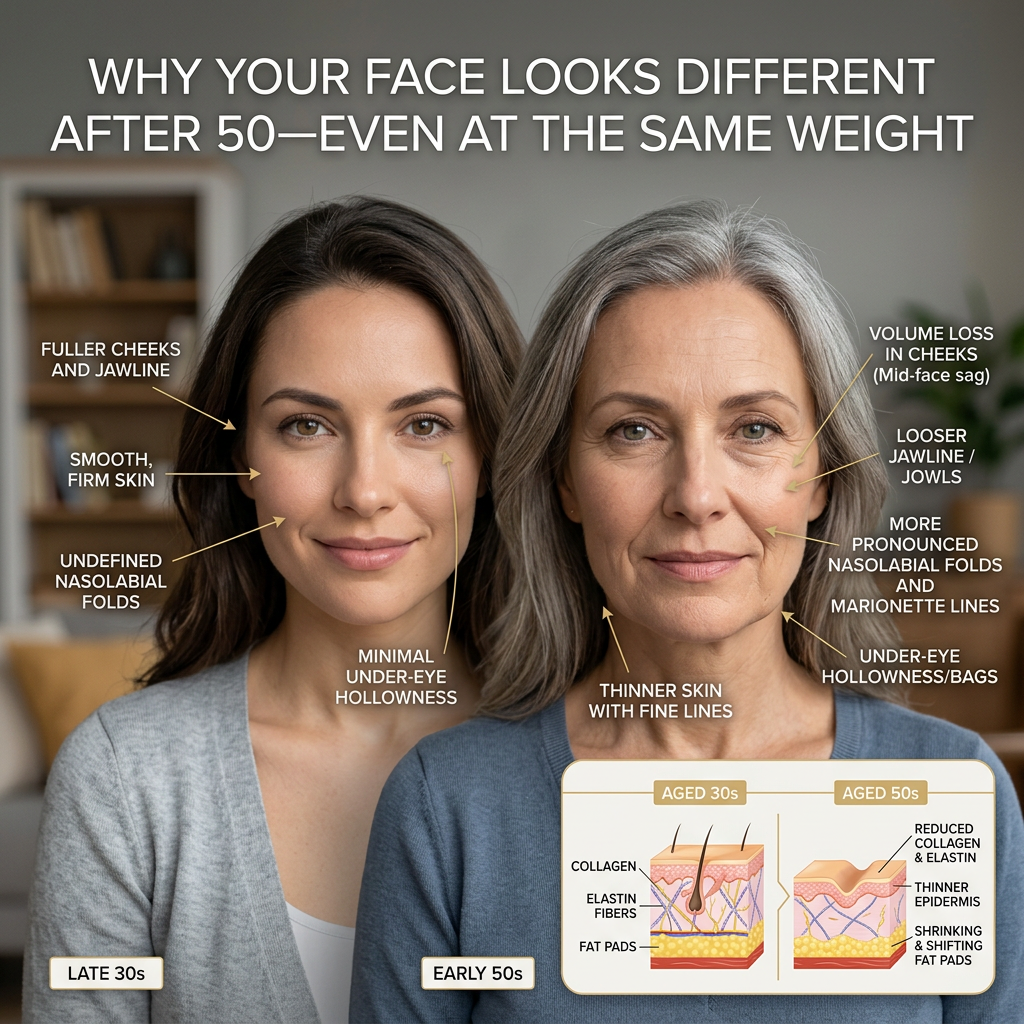
  • Why Your Face Looks Different After 50—Even at the Same Weight

    Why Your Face Looks Different After 50—Even at the Same Weight

    Why does your face look different after 50 even at the same weight?

    Short answer: Your face can look different after 50 even at the same weight because more is changing than your skin. Facial fat shifts and loses volume, and the support underneath, from ligaments to bone, changes too. Creams can help dryness and fine lines, but they can’t replace that deeper volume.

    Ever catch your reflection and wonder why your cheeks or jawline look different even though the scale has hardly moved? I have. The explanation is more interesting than a new wrinkle—and it isn’t always something a cream can fix.

    Have you ever looked in the mirror and thought, “I haven’t gained or lost much weight, so why does my face look different?” I think this is one of the most confusing parts of getting older.

    We tend to blame the scale, but the scale doesn’t tell the whole story. After 50, the face can change because several things are happening at once: skin changes, shifts in facial fat, changes in body composition, sun exposure, hydration, sleep and simply the passage of time.

    Weight Is Only One Piece of the Picture

    When your face changes, it is tempting to assume you need to lose weight, gain weight or buy a new anti-aging product. Sometimes the change has very little to do with the number on the scale.

    • Skin gradually changes in firmness and elasticity.
    • Facial fat can change position and volume over time.
    • Sun exposure can contribute to visible texture and pigmentation changes.
    • Sleep and hydration can affect how tired or drawn the face looks from day to day.
    • Changes in overall muscle and body composition can alter appearance even when weight barely moves.

    Why Your Face Can Look Different From One Day to the Next

    Not every change in the mirror is permanent. Poor sleep, allergies, alcohol, salty meals and normal fluid changes can affect puffiness and definition. That’s one reason I wouldn’t judge my appearance from one bad morning.

    What You Can Actually Work On

    • Protect your skin: Consistent sun protection is one of the most useful long-term habits for exposed skin.
    • Keep skincare simple: Gentle cleansing, appropriate moisture and carefully chosen active ingredients can support healthier-looking skin.
    • Maintain muscle: Resistance training supports strength, function and body composition.
    • Eat enough nutritious food: Constant crash dieting can make some people look drawn while also making muscle maintenance harder.
    • Sleep and recover: A rough stretch of sleep can show up surprisingly quickly.

    Don’t Let Anti-Aging Become a Full-Time Job

    There is nothing wrong with wanting to look your best. I just don’t think every hollow area, line or change in facial shape needs to become a problem that must be fixed.

    My goal is simpler: I want my face to look healthy, cared for and like me. That means taking care of my skin and health without spending every morning searching for something new to fight normal aging.

    It’s Not Just Your Skin: What Changes Underneath

    Your face has layers: skin, fat pads, ligaments, muscles and bone. Over time, those layers can change at different rates. A plumper cheek may become flatter, or the same skin may have less support underneath it. A cream can improve dryness and fine lines, but it cannot rebuild lost facial bone or replace deeper volume.

    Dermatologist Dr. Neil Sadick and coauthors describe how separate superficial and deep facial fat compartments contribute to aging changes in the cheeks, chin and jowls. Surgeons David Kahn and Robert Shaw discuss changes to both soft tissue and the facial skeleton. A review of facial anatomy similarly identifies bone, fat, muscle and skin as interacting factors. None suggests that everybody’s face changes in exactly the same way.

    Three Changes You Might Notice—and What They Mean

    • Cheeks look flatter: ordinary shifts in facial volume and skin support may contribute. More moisturizer won’t replace deeper tissue.
    • Jawline looks softer: skin elasticity and changes in deeper tissues can both play a part; surface products have limits.
    • Fine lines look sharper in the morning: dryness or temporary puffiness can exaggerate appearance; consistent moisturizer may help the surface look smoother.

    Where I’d Spend Money—and Where I Wouldn’t

    I’d start with a gentle cleanser, a moisturizer that suits my skin, and broad-spectrum SPF 30+ when outdoors. The American Academy of Dermatology’s guidance for skin in your 40s and 50s puts sun protection and moisturizing before a cabinet full of miracle products. A carefully chosen retinoid may help certain visible effects of sun damage, but don’t expect topical skincare to change facial bone structure.

    If you’re considering fillers or procedures, ask a qualified board-certified specialist about realistic outcomes, risks, alternatives and cost. There is no obligation to do anything. A natural-looking face that still looks like you is a perfectly good goal.

    A Useful Two-Week Mirror Check

    Instead of studying your reflection every morning, compare photos in the same lighting, time of day and camera angle a couple of weeks apart. Note changes in sleep, salt intake, weight and skincare. It’s an imperfect comparison, but better than letting one unflattering bathroom mirror decide how you feel.

    Keep reading: Skincare After 50: What to Buy and What to Skip. Sudden new facial weakness, drooping or difficulty speaking is an emergency—not normal aging.

    What Named Researchers Actually Found

    Plastic surgeon Dr. Rod Rohrich coauthored a review explaining how superficial and deep facial fat compartments contribute to changes in facial contour. That helps explain why a face can change shape without a dramatic change on the scale.

    Surgeon Dr. Joel Pessa coauthored anatomical research showing that facial fat is organized into distinct compartments, rather than one uniform layer. Those structures matter when understanding aging cheeks and jowls.

    Surgeon Dr. Robert Shaw and colleagues examined age-related changes in the facial skeleton. Their work provides another reason not to promise that a moisturizer alone can reverse every change you notice in the mirror.

    Common Questions

    Why does your face look different after 50?
    Changes in collagen, elastin, facial fat, bone structure, skin thickness, and hydration can gradually change how your face looks.

    Why does your face lose some firmness after 50?
    Collagen and elastin decline with age, which can contribute to looser skin and softer facial contours.

    Why do cheeks look different after 50?
    Changes in facial fat and skin support can make the cheeks look less full or change the way your facial contours appear.

    Why does your jawline change after 50?
    Changes in skin elasticity, facial fat, and underlying tissues can make the jawline appear softer or less defined.

    Can dry skin make your face look older after 50?
    Yes. Dryness can make fine lines and rough texture more noticeable and leave skin looking dull.

    Can skincare improve how your face looks after 50?
    Yes. A consistent routine can improve hydration, texture, and the appearance of some signs of aging.

    Does sunscreen still matter after 50?
    Absolutely. Daily broad-spectrum sunscreen helps protect against UV damage that contributes to wrinkles and uneven skin tone.

    Can exercise affect how your face looks after 50?
    Regular exercise supports overall health, muscle tone, circulation, and body composition, all of which can contribute to a healthier appearance.

    What is a simple skincare routine after 50?
    Morning: Gently cleanse or rinse, moisturize, and apply broad-spectrum sunscreen.
    Evening: Cleanse, use a targeted treatment if appropriate, and moisturize your face and neck.

    Do you need lots of anti-aging products after 50?
    No. A few products you use consistently can be more practical than a complicated routine with too many active ingredients.

    Can you really change how your face looks after 50?
    You can’t stop normal aging, but skincare, sleep, nutrition, exercise, sun protection, and other healthy habits can help you look and feel your best.

    A gentle health note: Facial changes are usually gradual. Sudden or unusual changes—especially swelling, weakness, numbness, or significant asymmetry—should be discussed with a healthcare professional.

    My Take After 50

    If your weight hasn’t changed but your face has, don’t automatically assume you’ve done something wrong. Look at the bigger picture—skin care, sun exposure, sleep, nutrition, activity, muscle and normal aging.

    If a facial change is sudden, dramatic or accompanied by other symptoms, that’s different from ordinary aging and is worth discussing with a healthcare professional.

    I’m sharing personal observations and general healthy-aging information, not medical advice. Everyone ages differently, and persistent or concerning changes should be evaluated by a qualified professional.


    About Tom Green

    Tom Green writes Sturdy Years. He was born in Pell City, Alabama, in 1962, and he’s a country boy and a true Southerner through and through. He’s just a regular, laid-back 64-year-old who keeps things simple. He shares what he learns about skincare, fitness and getting older, and what’s working for him. He’s also the author of A Practical Guide to Getting Older Without Giving Up on Yourself. Tom isn’t a doctor. He reads up on the research and passes along what’s useful, plain and simple.

    I’ve also mapped out some great tools on my new Tech for Independent Living After 50 page.