Tom Green, Sturdy Years
What is the floor test, and can it predict how long you’ll live?
Short answer: The floor test, also called the sitting-rising test, scores how easily you sit down on the floor and get back up, from 0 to 10. In a 2025 study of 4,282 adults aged 46 to 75, people who scored 0 to 4 had about 3.8 times the risk of dying from natural causes as those who scored a perfect 10. The good news: you can raise your score.
We keep a close eye on blood pressure and cholesterol. But when was the last time you checked how well you balance, or whether you can get up off the floor without a struggle?
I’m 64, and I’ve noticed I’m more prone to accidental falls than I used to be. It’s not one thing. It’s a few different things, and it means I have to think ahead in situations where a fall could happen. Balance isn’t something I used to think about. Now I do, and that’s why the research of Dr. Claudio Gil Araújo caught my attention.
Here’s what you’ll get from this article: two simple tests you can try at home, what the research really found (and what it didn’t), what other real writers and bloggers have said about these tests, and a gentle plan for getting steadier. I won’t pretend any test can predict your future, because none can.
Please read this first: safety comes before any score. Do both tests next to something sturdy to grab, and don’t try them alone if you might fall. If you have dizziness, balance problems, recent surgery, a hip or knee replacement, or a history of falls, check with your doctor before you try either one.
Who Is Dr. Claudio Gil Araújo?
Dr. Araújo is a physician in exercise medicine. In 1994 he founded a clinic called CLINIMEX in Copacabana, Rio de Janeiro, and it has done more than 15,000 fitness evaluations since. He created the Sitting-Rising Test and a flexibility test called the Flexitest, and he led the 2022 research on the 10-second one-legged stance. He has published more than 250 papers, and his patients range from Olympic athletes to people recovering from heart surgery, which he says gives a more realistic picture than studies of healthy volunteers only.
He studies what he calls non-aerobic fitness: muscle strength and power, flexibility, balance, and body composition. We usually think of fitness as walking, cycling, and getting the heart rate up. But these other abilities are what you use to get out of a chair, climb steps, pick something up, or catch yourself when you stumble. They are what keeps you independent.
One note: each study below used its own group of patients, not all 15,000, and they all came from one clinic in Rio. The findings may not apply equally to everyone.
Test 1: The 10-Second One-Leg Stand
How to do it
Stand right beside a counter or sturdy support you can grab.
Arms at your sides, eyes on a spot straight ahead.
Lift one foot and rest it behind the opposite calf.
Hold for 10 seconds without putting that foot down.
In his clinic, Dr. Araújo uses a force platform that tracks body sway. The pass-or-fail home version exists because almost nobody has that equipment, so please don’t treat your home result as a diagnosis.
What the research found
The study followed 1,702 people aged 51 to 75 for a median of about 7 years.
Roughly 1 in 5 couldn’t hold the position for 10 seconds.
About 17.5% of that group died during follow-up, compared with 4.6% of those who passed.
After adjusting for age, sex, body mass index, and health conditions, the risk of death was about 84% higher for those who failed.
In plain English: People who couldn’t hold the position were more likely to have died during the study, even after researchers accounted for some differences between them. That’s a reason to pay attention to balance. It is not a prediction about you. The link is an association, not proof that failing the test causes anything, and the study didn’t account for things like recent falls or activity level. Dr. Araújo told an interviewer the same thing: the link is partial, not proven cause and effect. He also said about 60% of 70-year-olds can hold the position for 10 seconds, so if you can’t, you are far from alone. He mentioned a 97-year-old patient who can still do it after exercising at his clinic for 30 years.
What other writers say about the one-leg stand
Alex Brooks, who writes the newsletter Dueto for women over 45, admits she only just passed the one-leg test after years of hot yoga, and says it was strength training that really helped. It’s honest, funny, and very relatable.
Wellness coach Gillian Bogden, in a guest column on Heather Martin’s Tumbleweed newsletter, tested herself the second she read about the study, then tried to beat her age group. She also shares easy daily habits, like standing on one foot while you brush your teeth or putting on your socks and shoes one leg at a time.
Personal trainer Jennifer Rizzuto, who works with seniors, explains how a single-leg balance test can help you think about fall risk and how long you should be able to hold it as you age.
If you couldn’t make 10 seconds, don’t panic. TODAY’s Brianna Steinhilber shares easy ways to build up: start with a few seconds per leg, lightly rest the toe of your lifted foot for help, or touch a wall and lean on it less over time.
And for a smile, the blogger at WorkersCompensation.com had some fun with this study, joking that a thousand readers would push away from their desks to see if they could stand on one leg. I’d bet you’ve already thought about trying it too.
Test 2: The Sitting-Rising Test (the “Floor Test”)
How to do it
Stand barefoot on a firm, non-slip surface with a clear area of about 6 by 6 feet. Put a mat down.
Have another person beside you, clear any obstacles behind you, and keep something sturdy within reach.
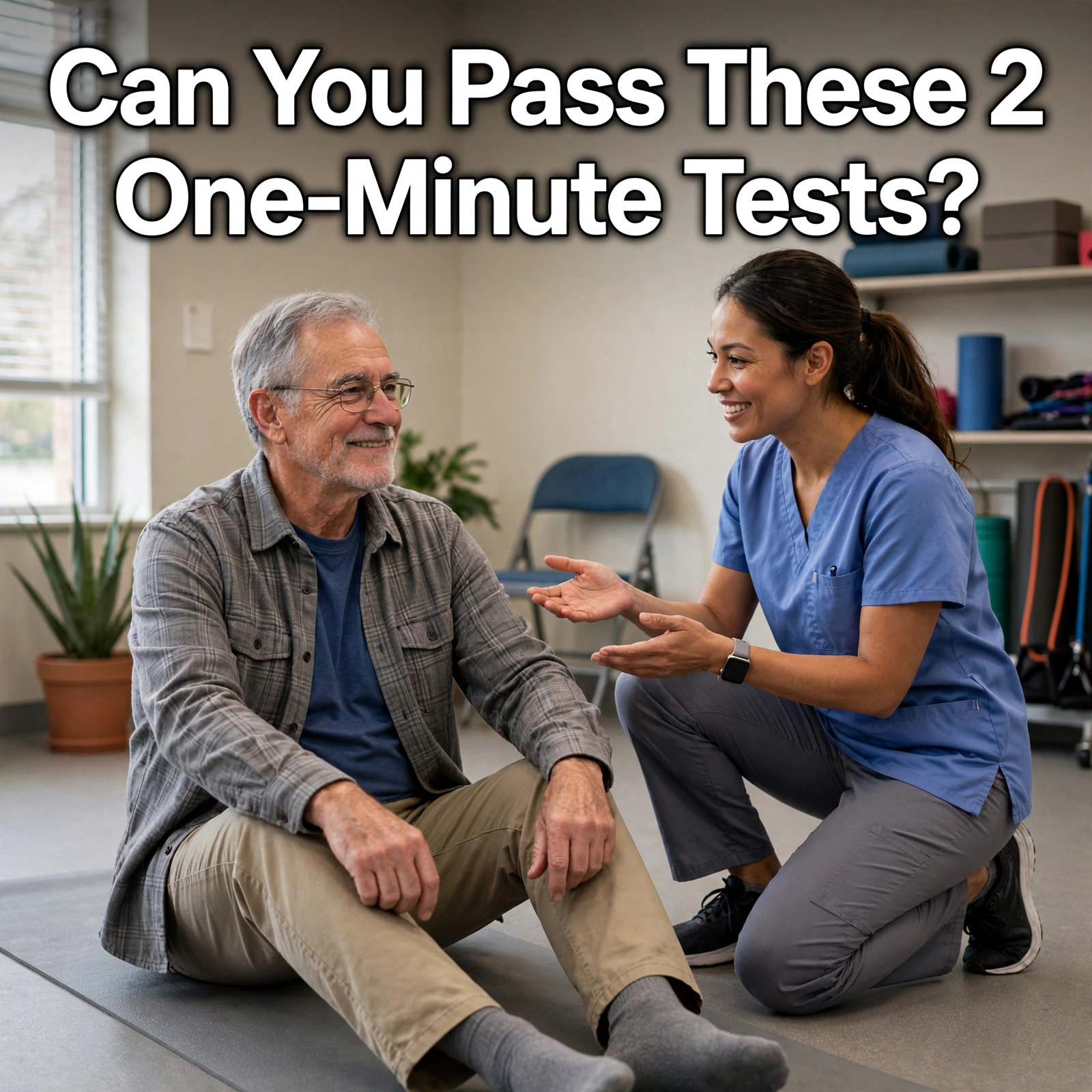
Without rushing, sit down on the floor, then stand back up, using as much support as you need to stay safe. The goal is not to force a high score.
How it’s scored: You start with 5 points for sitting and 5 for rising. You lose a point each time you use a hand, forearm, knee, or the side of your leg for support (yes, a hand on your knee counts), and half a point for a wobble. Crossing your legs is allowed. A perfect score is 10.
Watch it done by the team that created the test
Dr. Araújo kindly shared his team’s updated 2025 demonstration video for Sturdy Years readers. It shows how the test is done and how each point is scored.
He also pointed readers to the full research article, which you can read for free: the sitting-rising test study in the European Journal of Preventive Cardiology (free full-text PDF).
What the research found
A 2025 study followed 4,282 adults aged 46 to 75 for a median of about 12 years.
Death rates ranged from 3.7% among people who scored 10 to 42.1% among those who scored 0 to 4.
After adjustment, the lowest-scoring group had about 3.8 times the risk of death from natural causes and about 6 times the risk of cardiovascular death, compared with the highest-scoring group.
An earlier 2014 study from the same research group had also linked these scores to the risk of dying.
In plain English: The people who needed the most help getting down and back up tended to have worse outcomes over the following years. The test checks muscle power, strength, balance, flexibility, and body weight all in one movement, and it matches real life: picking up something you dropped, or getting down to play with your grandchildren. But scoring poorly doesn’t seal anyone’s fate.
What other writers say about the floor test
This is where I found the most honest takes, and they’re worth your time.
Humorist Dave Barry tried the test in his bedroom, asked his neighbors to try it, and came away convinced a perfect score is unrealistic for most of us. It’s a funny reminder that science still has to make sense to real people.
On her independent blog Fit Is a Feminist Issue, Catherine W. wrote about trying to get up off the floor and asked sharp questions. She pointed out that the lowest scorers were older on average than the highest scorers, that knee problems and arthritis will hurt your score at any age, and that sitting on the floor isn’t part of every culture. That’s a good attitude for all of us: take the science seriously, but ask what it really measures.
Patrick Posten shows himself doing the test on his Substack, losing a point for every hand or shin he needs, and tells readers to try it and see how they score. It’s a good look at what a real, everyday attempt looks like.
Certified trainer Ashley Blake Greenblatt walks through the test in the Philadelphia Inquirer and follows it with simple floor exercises, like glute bridges, to build the strength you need.
Muscle Power May Matter More Than Strength
Strength is how much force you can produce. Power is force plus speed. You use power when you rise from a chair, climb stairs, or move fast enough to catch your balance.
A 2025 study of 3,889 adults aged 46 to 75, with about 11 years of follow-up, found roughly 5.9 times the risk of death in men and 6.9 times in women with the lowest relative muscle power compared with the highest. Handgrip strength alone did not show a statistically significant link in the same analysis. The numbers for women had wide margins of error, so take the exact figure with a grain of salt.
In plain English: The ability to move with power seemed more closely tied to survival than grip strength alone. That doesn’t mean strength is unimportant, and it doesn’t mean training faster will extend your life. Dr. Araújo has observed that after about age 60 we tend to lose speed faster than we lose strength. His approach is to lift a weight fairly quickly and lower it under control, for about 6 to 8 repetitions. That isn’t for everyone, so if you’re new to resistance training or have injuries, work with a qualified trainer or physical therapist first.
Flexibility: The Overlooked Piece
The Flexitest checks 20 movements across seven joints for a score from 0 to 80. In a 2024 study of 3,139 adults aged 46 to 65, women scored about 35% higher than men, and lower flexibility was linked to higher mortality in both sexes.
In plain English: More flexible people tended to have better survival odds in this group. That can’t tell us whether stretching more would itself help anyone live longer. In an interview, Dr. Araújo suggested flexibility may take as little as about 10 minutes a day to improve, far less than aerobic fitness takes. Think ankles, knees, hips, trunk, wrists, elbows, and shoulders, not just hamstrings, and never stretch into pain.
What These Tests Do Not Mean
The numbers can sound frightening without context. Here’s what I want you to remember:
They show associations, not guarantees. A low score might reflect illness, frailty, or other factors.
No study here proves that raising your score adds years to your life.
The groups came from one clinic in Rio. Results may not apply equally to every community.
Standing still isn’t the whole story of falling. Moving safely takes abilities these tests don’t fully measure.
A low score is a reason to ask questions and work on what you safely can. It is not a verdict.
How to Get Steadier Without a Gym
Practice balance with support. If your doctor says it’s safe, try brief one-leg stands next to a counter with your hand on it, even while the microwave runs or you brush your teeth. Don’t add distractions if you’re unsteady.
Practice getting up and down safely. If the floor test seems unsafe, start with supported chair movements, or ask a physical therapist for an adapted progression.
Build controlled leg strength. With medical clearance, practice rising from a sturdy chair and sitting back down slowly.
Move your joints gently. A few minutes of easy stretching goes a long way.
A simple seven-day starter plan
Day 1: Read the instructions and safety notes. Only attempt a test if it’s safe for you. Otherwise, pick one comfortable, supported movement to practice.
Days 2 to 6: Supported balance practice if appropriate, plus about 10 minutes of gentle stretching.
Days 3 and 5: Add a few slow, controlled chair stands if you can do them safely.
Day 7: Notice what feels steadier. Retest only if it’s safe and you want to.
One week won’t change your long-term health. A habit you can stick with will.
If you lose points, work on the part that cost you
- If you needed your hands or knees to get up, that usually points to leg strength. Slow chair stands are a good place to start: sit, stand up without using your hands, then sit back down slowly. Try 8 to 10 if it feels safe.
- If you wobbled or lost your balance, practice the one-leg stand next to a counter with a hand on it. As you get steadier, use just a fingertip, then no hand.
- If getting down or up felt stiff, spend a few minutes a day sitting cross-legged on a mat or firm cushion, with a sturdy chair or couch beside you, practicing the lowering and rising movement.
None of this is a prescription. If you’re unsure what’s safe for you, a physical therapist can tailor it.
Your Turn
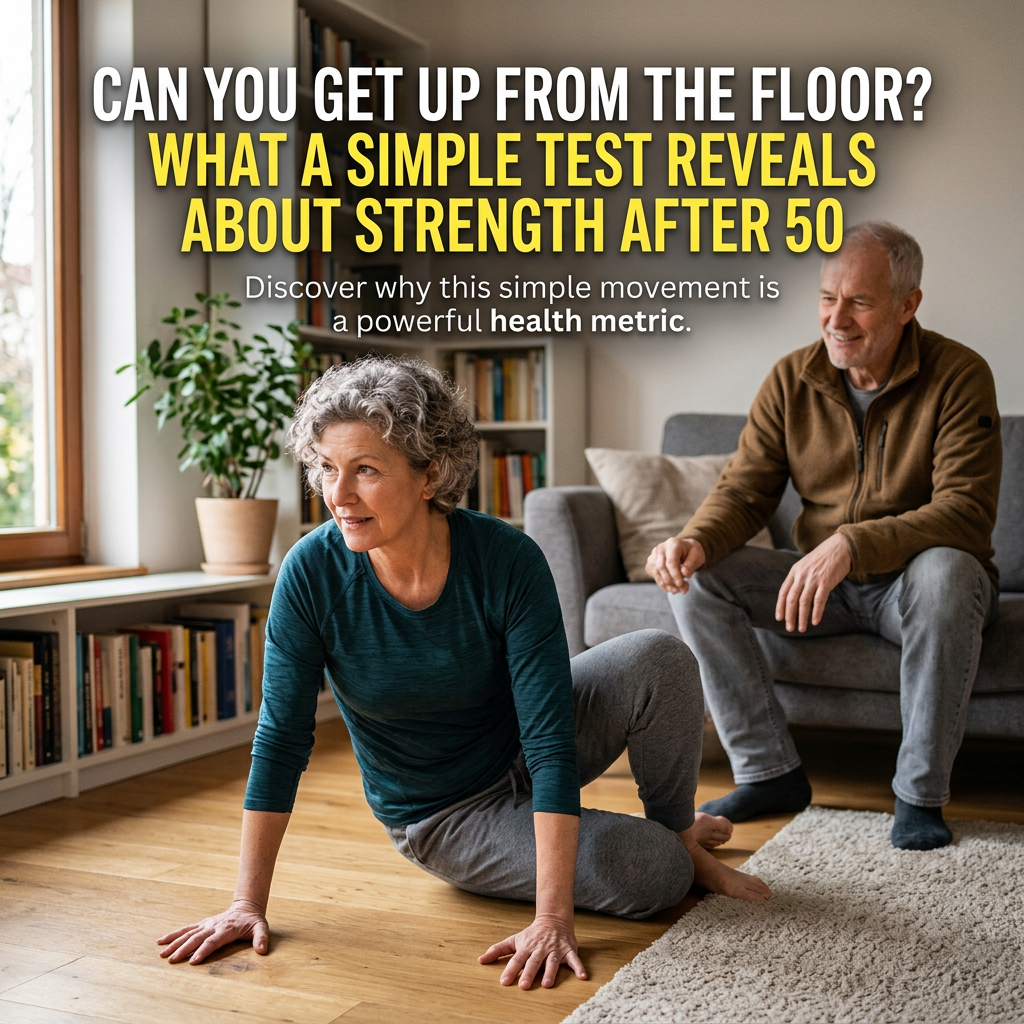
Can you stand on one leg for 10 seconds? If it’s safe for you to try, tell me how it went in the comments. And if you’ve ever struggled to get up off the floor, you are certainly not the only one. You might also enjoy my earlier article, Can You Get Up From the Floor? What a Simple Test Reveals About Strength After 50.
Health note: I’m not a doctor. I’m a man in my 60s sharing personal experience and research that interests me. This article is general information, not medical advice. Please check with your clinician before trying these tests or starting an exercise program, especially if you have fallen, feel dizzy, have joint replacements or recent surgery, or have other health concerns. Do not risk a fall to earn a score.
More Reading From Real People
Alex Brooks (Dueto), “Why balance is brutal”
Gillian Bogden, guest column on Tumbleweed with Heather Martin, “How Long Can You Stand on One Leg?”
Dave Barry, “Aging Well”
Catherine W., “The sit-rise test: trying to get up to save my life”
Patrick Posten, “Scoring Well On This Test Could Extend Your Life”
Jennifer Rizzuto, a personal trainer’s take on the single-leg balance test
Ashley Blake Greenblatt, “What this one-minute fitness test can reveal about your health”
Brianna Steinhilber on TODAY, the 10-second balance test and how to build up to it
Credits: Dr. Claudio Gil Araújo and CLINIMEX (Clínica de Medicina do Exercício), Rio de Janeiro. Dr. Araújo’s interview comments come from a conversation with writer Eli Lichter for Medical Guardian (August 2026).
About the Author
Tom Green writes Sturdy Years. He was born in Pell City, Alabama, in 1962, and he’s a country boy and a true Southerner through and through. He’s just a regular, laid-back 64-year-old who keeps things simple. He shares what he learns about skincare, fitness and getting older, and what’s working for him. He’s also the author of A Practical Guide to Getting Older Without Giving Up on Yourself. Tom isn’t a doctor. He reads up on the research and passes along what’s useful, plain and simple.
I’ve also mapped out some great tools on my new Tech for Independent Living After 50 page.