What are the benefits of climbing stairs as you get older?
Short answer: A big 2026 review of nearly half a million people found that folks who climbed stairs regularly had a 39% lower risk of dying from heart disease and a 24% lower risk of dying from any cause. Stairs work your heart and your legs at the same time, and you don’t need a gym to use them. The steps already in your house, your church or the courthouse will do just fine.
Picture a fella we’ll call Earl. Earl’s got eight wooden steps going up to his back porch, the same eight he’s walked a thousand times. Somewhere along the way he started stopping halfway with one hand on the rail, acting like he was looking at the bird feeder. Then his wife started bringing the groceries in through the garage so he wouldn’t have to bother with the steps at all.
Nobody said a word about it. That’s how it goes with most of us. We don’t quit the stairs in one day. We just find our way around them a little at a time, until one morning they look a whole lot taller than they used to.
Here’s why I’d tell Earl to turn around and go back up them.
What did the big stair study find?
Researchers at the University of East Anglia in England pulled together nine earlier studies covering 480,479 people between 35 and 84, a little over half of them women. Some were healthy and some already had heart trouble, like a past heart attack. They were followed for about 14 years on average. According to Harvard Health, the regular stair climbers had a 39% lower risk of dying from heart disease and a 24% lower risk of dying from anything at all. They also had fewer heart attacks and strokes.
Professor Vassilios Vassiliou, one of the study’s authors, called taking the stairs “a practical and often overlooked way” to get more movement into your day. I like that, because overlooked is the right word. Most of us walk right past the best piece of exercise equipment we own.
Now, to be fair, this kind of research shows a link and can’t prove the stairs did all the work. A lot of the people reported their own stair climbing, and folks who take the stairs may be more active in other ways too. Medical News Today laid those limits out plainly. Even so, when one study after another points the same direction, I pay attention.
Why are stairs so good for your heart?
Because climbing them is harder than it looks. Walking on flat ground is easy on the heart, but every step up means lifting your whole body against gravity. That counts as vigorous activity, the kind that gets you breathing hard in under a minute. And it’s using the big muscles in your thighs and hips, the same ones that get you up out of a chair and keep you steady when you trip on the edge of a rug.
Martin Gibala knows a thing or two about short bursts. He’s a kinesiology professor at McMaster University in Canada and co-wrote the book The One-Minute Workout. His team had out-of-shape adults climb three flights of stairs three times a day, with a few hours of rest in between, three days a week. After six weeks, their fitness had gone up. Gibala called these little climbs “exercise snacks”, and I can’t think of a better name for them. You don’t have to sit down to a whole meal of exercise. You can just keep grabbing a bite all day long.
Those were young folks, so the results won’t line up exactly for us. But the idea holds up at any age. A little climbing, done often, adds up.
How many flights of stairs should you climb a day?
Nobody has pinned down a magic number yet. The study couldn’t say exactly how much is best, though one part of it saw the biggest drop in heart risk at about six flights a day. That’s only 60 or 70 steps. If Earl went up and down his eight porch steps four times, he’d be about halfway there before breakfast.
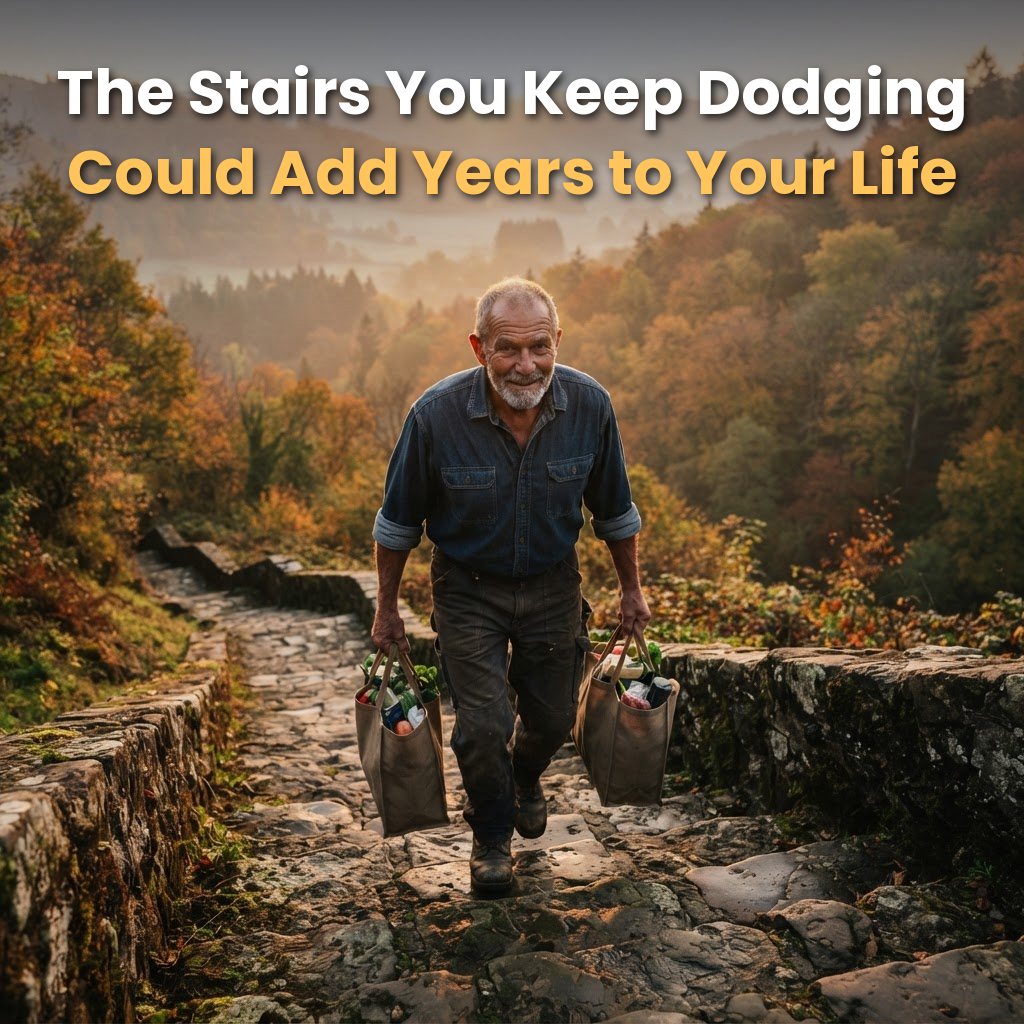
Dr. Peter Attia, the longevity doctor who wrote the bestseller Outlive, keeps a list of things he wants to still be able to do in his last decade. One of them is to walk up three flights of stairs with 10 pounds of groceries in each hand. I talked about his whole list in Nobody Our Age Wants to Look 30 Anymore. That stair goal sticks with me, though, because it’s so ordinary. Carrying your own groceries up your own steps is what staying sturdy looks like on a regular Tuesday.
What do the longest-lived people do differently?
They don’t go to the gym, for one. Dan Buettner, the National Geographic explorer who made the Blue Zones famous, has spent years with the folks around the world who live the longest. In the hill towns of Sardinia, people walk up and down steep streets and stairs just to get through the day, and that’s been linked to their long lives. Buettner’s advice for the rest of us is about as simple as it gets. Before you pay for a gym membership, he told Business Insider, start by skipping the elevator and taking the stairs.
I reckon that’s the part that matters most. A shepherd in Sardinia isn’t doing stair workouts. The climbing is just part of his life, so he never gets the chance to stop. The rest of us have to be a little sneakier about it, because our whole world is built so we never have to go up anything.
What if your knees don’t like stairs?
Then go easy and keep a hand on the rail. That’s what it’s there for, and there’s no shame in it. Take one step at a time, go slow, and stop while it still feels good. The researchers point out that stairs may not suit everybody, especially folks with arthritis or bad joints, so if your knees or hips holler at you, talk it over with your doctor first. Lots of people start by stepping up and down on just the bottom step a few times while they hold the rail, and build from there.
Going down is usually harder on the knees than going up. If that’s you, there’s nothing wrong with taking the stairs up and the elevator down.
So what happened to Earl?
Well, let’s say Earl starts carrying in one bag of groceries through the back door. Just one. He’s huffing at the top that first week, and he still glances at the bird feeder. By the end of the month he’s carrying two bags, and his wife has quietly gone back to parking out back.
That’s really all this is. Those steps you’ve been working your way around are the cheapest heart medicine in the house, and they’re open every day of the year.
Common Questions
Is climbing stairs good for your heart?
Yes. In a 2026 review of 480,479 adults, people who climbed stairs regularly had a 39% lower risk of dying from heart disease and fewer heart attacks and strokes.
Does climbing stairs help you live longer?
It’s linked to it. The same review found a 24% lower risk of dying from any cause among regular stair climbers, though it can’t prove the stairs alone caused it.
How many stairs a day is good for you?
There’s no set number yet. Part of the review saw the biggest drop in heart risk at around six flights a day, which is about 60 to 70 steps.
Is climbing stairs bad for your knees?
Not for most people, but it can bother knees with arthritis. Use the rail, go slowly, and check with your doctor if your knees or hips hurt on stairs.
Is climbing stairs better than walking?
Minute for minute it’s harder work, because you lift your whole body with every step. Walking is still great, and the two go well together.
How many steps are between you and your front door? Tell me in the comments. I’d like to know who’s got the most.
Tom
About Tom Green
Tom Green writes Sturdy Years. He was born in Pell City, Alabama, in 1962, and he’s a country boy and a true Southerner through and through. He’s a regular, laid-back 64-year-old who keeps things simple and passes along what he learns about getting older. Tom isn’t a doctor. He reads up on the research and shares what’s useful, plain and simple. Read more about Tom.
Health note: This article is for general education and isn’t medical advice. If you get chest pain, dizziness or unusual shortness of breath on the stairs, stop and talk to your doctor.
Research & Sources
- Harvard Health: Stair Climbing May Significantly Lower Cardiovascular Risks
- Medical News Today: Climbing Stairs Linked to 39% Lower Risk of Heart Disease Death
- McMaster University: Exercise Snacks Make Fitness Easier (Martin Gibala)
- Peter Attia: How to Train for the Centenarian Olympics
- Business Insider via Yahoo: Gym-Free Ways to Stay Strong, According to Super Agers (Dan Buettner)
Keep Reading
Advertisement
Marley Spoon Meal Kits (affiliate link)