Short answer: This month’s three bestsellers are The Forever Strong Playbook by Dr. Gabrielle Lyon, a six-week plan for getting stronger; Vibe by Adam Grant, on the science of building close friendships; and Replaceable You by Mary Roach, a funny look at how medicine repairs and replaces the parts of us that wear out.
Every month I pick three books worth your time, and they all have to earn a spot on the shelf here: they’ve got to be selling well right now, and they’ve got to have something real to offer folks over 50.
This month’s three line up with the things we talk about most on this site: staying strong, staying connected to people, and understanding the body we’ve got. One will get you moving, one will help you feel less alone, and one will make you laugh while it teaches you something.
1. The Forever Strong Playbook by Dr. Gabrielle Lyon
Dr. Gabrielle Lyon’s first book, Forever Strong, made a lot of folks rethink muscle. Her big idea is that muscle isn’t just about looks. It’s what keeps your metabolism, your balance and your independence going as you age. This new one, which came out in January and has been a New York Times and USA Today bestseller, takes that idea and turns it into a plan you can actually follow.
It’s a six-week program. You get more than 100 exercises you can do at the gym or at home, over 60 recipes, and plain advice on sleep, recovery and stress. The plans scale, so whether you’ve never lifted a thing or you’ve been at it for years, there’s a starting point for you.
Why I picked it: I work out four days a week, and if there’s one thing I’d tell anybody over 50, it’s that strength training matters more now, not less. Most books tell you why. This one tells you what to do on Monday morning. If you liked my post on building muscle after 60, this is the next step.
Great for: men and women who want a simple, week-by-week plan to get stronger without guessing.
2. Vibe: The Secrets of Strong Connections in a Lonely World by Adam Grant
Adam Grant is an organizational psychologist at Wharton and one of the best-known writers on how people work and get along. Vibe came out October 13 and jumped right onto the New York Times, USA Today and independent bookstore bestseller lists. It’s all about the science of friendship, companionship and love, and how to build bonds that are faster, stronger and longer-lasting.
A few of his points surprised me. You don’t have to have a lot in common with somebody to get close to them. Chemistry doesn’t always show up right away. And getting close doesn’t always take years. He backs it up with research and some good stories, from astronauts to a rock band.
Why I picked it: Loneliness isn’t just a bad feeling. In 2023, U.S. Surgeon General Dr. Vivek Murthy put out a whole advisory on it, and he compared the health risk of being cut off from people to smoking up to 15 cigarettes a day. After 50, friend circles tend to shrink with retirement, moves and loss. I wrote about that in how to make new friends after 50, and I reckon this book is the perfect companion to it.
Great for: anybody who’s feeling a little more alone than they’d like, or who wants to get closer to the people already in their life.
3. Replaceable You: Adventures in Human Anatomy by Mary Roach
Mary Roach, the author of Stiff, has a gift for making science funny. In this one she looks at how medicine repairs and replaces the parts of us that wear out. She spends time in a burn unit, travels with cataract surgeons, talks with amputees and people living with ostomies, and visits researchers trying to grow new tissue and even 3D-print it. It was an instant New York Times bestseller and landed on a pile of best-of-the-year lists, and the new paperback came out September 1.
Why I picked it: After 50, replacement parts stop being a joke. Most of us know somebody with a new knee or hip, a pacemaker, or new lenses after cataract surgery, and some of us are that somebody. This book takes something that can feel a little scary and makes it fascinating. You’ll come away amazed at what your body can do and how far medicine has come.
Great for: folks who are curious about how the body works, like a good laugh, or have a surgery coming up and want to feel less nervous about it.
Popular isn’t enough. I check the current bestseller lists to see what folks are actually buying, then I only keep the ones that have something useful to say about health, strength, connection or getting older well. And they have to be books I’d hand to a friend on the porch without thinking twice.
What are y’all reading this month?
Tell me in the comments. You never know who’ll find their next favorite book because of you.
Short answer: Joyspan is how much you actually enjoy your life as you get older. Gerontologist Dr. Kerry Burnight of the UC Irvine School of Medicine came up with the word, and she says four habits build it: grow, connect, give and adapt.
Most of us have spent years thinking about how long we’ll live. Then the doctors started talking about how many of those years we’ll stay healthy. Fair enough.
But here’s a question nobody asks you at your checkup: Are you still enjoying it?
Turns out there’s a word for that. It’s called joyspan, and I reckon it might be the number that matters most.
Where the word came from
Dr. Kerry Burnight came up with it. She’s a gerontologist, which is a doctor who studies aging, and she teaches at the UC Irvine School of Medicine. She spent 16 years working with older folks who’d been neglected and mistreated. After seeing the worst side of growing old, she went looking for the other side: what makes people thrive later in life.
That search turned into her 2025 book, Joyspan: The Art and Science of Thriving in Life’s Second Half. It became a New York Times bestseller.
Her idea is simple. Joyspan is how much you actually enjoy your life as you get older. Not how many pills you take or how many steps your watch counts. Just whether you still wake up glad to be here.
Here’s the part I like best. You don’t have to be in perfect shape to have a long joyspan. Bad knees, stiff back and all, you can still have a good one.
The four things that build it
Dr. Burnight boils it down to four habits: grow, connect, give, and adapt. Harvard Health wrote about them too. Here’s how I look at each one.
1. Grow
Keep learning something. Doesn’t have to be big. A new recipe. A trail you’ve never walked. Finally figuring out what all those buttons on the TV remote do.
For me, it’s been this website. Some days I’ve wanted to toss the computer out in the yard. But every time I finally figure something out, I feel about ten years younger. That’s what growing does for you.
2. Connect
Stay close to people. This one has a lot of science behind it.
Yvette Francino is a retired coach who writes a blog called Living Life to the Fullest. After she read the book, she wrote about what keeps her own joy going. One of the biggest? She calls her mom every single night.
Now, you might think that’s her doing her mom a favor. But Yvette says she gets just as much out of those calls as her mom does. A few minutes on the phone, a few laughs, and they both go to bed a little happier.
That’s what connection looks like. It doesn’t have to be a big family reunion. It just has to happen.
And the experts back her up. In the 2026 U.S. News Healthy Aging Survey, 59% of the 63 health experts they asked named loneliness and isolation as the most overlooked thing that speeds up aging.
Easy start: call one person this week you haven’t talked to in a while. Just to see how they’re doing.
3. Give
Help somebody. Drive a neighbor to an appointment. Teach a grandkid to fish. Share what you’ve learned the hard way. Helping somebody you know does more for you than you’d think, and we’ve all got something worth passing on.
4. Adapt
Things change. Our bodies change, people we love pass on, plans fall through. Dr. Burnight treats those hard times as a normal part of life, not a sign that the good part is over.
Helen Williams writes about getting older on her Substack, and she shared a story about her grandparents that I can’t stop thinking about.
Her grandfather walked everywhere. Swam every day. Kept up with his friends. He stayed in the game right up until illness finally made him stop.
Her grandmother went the other way. One by one, she found reasons to quit the things she loved.
Same family. Same generation. Two very different later years. And a lot of that difference came down to little choices, made one day at a time. Like the old saying goes, you can’t change the wind, but you can adjust your sails.
Quick check: What’s your joyspan?
Grab a pencil or just keep count in your head. Give yourself a score from 1 to 5 on each one. A 1 means “not me at all.” A 5 means “that’s me all day long.”
Grow: I’ve learned or tried something new in the last month.
Connect: I talk with somebody I care about most days.
Give: I’ve helped somebody this week, even in a small way.
Adapt: When things don’t go my way, I find a way to keep going.
Now add them up:
16 to 20: You’re doing great. Keep it up, and maybe share what’s working with a friend.
10 to 15: Pretty good, with some room to grow. Look at your lowest score and start there.
4 to 9: No shame in that. It just means you’ve got the most to gain. Pick one area and do one small thing this week.
This is just for fun, not a medical test. It’s a way to see where you stand today.
A few small ways to start this week
Jane Woods is a blogger over in England. She’s closing in on 70, taking care of her husband, and still chasing her own goals. She gave Joyspan five stars on her blog Changing People, and she pointed out something I’d never really thought about.
Joy and happiness aren’t the same thing.
You can be going through a rough patch, not happy at all, and still catch a moment of joy. A grandbaby’s laugh. A good cup of coffee on a cool morning. Joy lives in the little moments, if you slow down long enough to notice them.
So here are a few easy ways to catch more of them. None of them cost a dime.
Slow down for the good stuff. That first cup of coffee, a sunset, and a song you love. Actually notice it.
Take a “joy snapshot” every day. Before bed, think of one moment that made you smile.
Volunteer. Church, food bank, library, or wherever fits you.
Tend your friendships. They’re like a garden. They need a little water now and then.
Get moving outside. A walk in fresh air does more than you’d think.
How it fits with everything else
That same U.S. News survey found the experts put plain old exercise and good food at the top of the list, way ahead of trendy supplements and gadgets. (I looked at one of those trendy supplements in my post on NMN.)
Joyspan is the other half of that. Exercise and good food help you get more years. Joy is the reason you want them.
If you want to dig deeper, Dr. Burnight’s book Joyspan is a good place to start. It’s a good one to keep on the nightstand.
Common Questions
What is joyspan? Joyspan is a word coined by gerontologist Dr. Kerry Burnight. It means how much joy and satisfaction you get out of life as you get older, not just how many years you have.
How is joyspan different from lifespan and healthspan? Lifespan is how long you live. Healthspan is how many of those years you’re healthy. Joyspan is how much you enjoy them.
What are the four parts of joyspan? Grow, connect, give, and adapt. Keep learning, stay close to people, help others, and roll with the changes life brings.
Can you raise your joyspan after 60? Yes. Dr. Burnight treats joyspan as a habit, not luck, and says the best time to start is now. Small steps, like calling a friend or trying something new, count.
Do you have to be healthy to have a long joyspan? No. Plenty of folks with aches, health problems, or hard seasons still find real joy. It’s more about how you live your days than how perfect your body is.
One question to sit with
What did you enjoy this week?
If the answer comes quick, good for you. If it comes slow, pick one of the four, grow, connect, give, or adapt, and do one small thing with it before Sunday.
Y’all let me know in the comments which one you’re working on. I’d like to hear it.
What are the best books for staying strong this October?
Short answer: This month’s three bestsellers are Protocols by Stanford neuroscientist Dr. Andrew Huberman, a reference on sleep, energy, mood and strength; Heal Your Cells by Dr. Josh Axe and Dr. Will Cole, a food-first plan for feeling less worn out; and Unbreakable by orthopedic surgeon Dr. Vonda Wright, a strength plan for women going through and past menopause.
Every month I pick three books worth your time. This month all three are about the same thing we talk about here: staying strong, sharp and independent as we get older. They’re all on the bestseller lists right now.
1. Protocols: An Operating Manual for the Human Body by Andrew Huberman, PhD
If you’ve listened to podcasts at all in the last few years, you’ve probably heard of Dr. Huberman. He’s a Stanford neuroscientist, and his health podcast is one of the most popular in the world. Protocols is his first book, and it’s built around one simple idea: small daily habits, done consistently, change how you feel.
He covers the basics that matter most at our age, including sleep, energy, mood and stress, and he includes protocols for getting stronger and leaner at any age. For each one he explains the science in plain language, then tells you exactly what to do.
It’s a big book at over 500 pages, but you don’t have to read it front to back. Pick the chapter you need most, probably sleep, and start there.
Great for: anyone who wants one solid reference book on the shelf for all-around health.
2. Heal Your Cells by Dr. Josh Axe and Dr. Will Cole
Ever feel like you’re doing everything right, eating well, taking your vitamins, getting your walks in, and you still feel worn out? That’s the question this book tries to answer. The authors argue that tiredness, brain fog, gut trouble and hormone changes are all early signs that our cells aren’t working the way they should.
The book walks you through foods that support your cells, like bone broth, pomegranate and fermented foods, along with ideas about meal timing. There’s also a quiz that tries to show whether one part of your body is aging faster than the rest.
One honest note from me: Dr. Axe comes from the natural and functional medicine world, and some of what he suggests, like supplements and fasting, is worth running by your own doctor first, especially if you take medications. The food advice, though, is something most of us can use right away.
Great for: readers who feel tired all the time and want a food-first plan to try.
3. Unbreakable: A Woman’s Guide to Aging with Power by Dr. Vonda Wright
Ladies, this one is for you. Dr. Wright is an orthopedic surgeon who has spent over 20 years helping people stay active as they age. Her message is simple: getting older doesn’t have to mean getting weaker.
She explains how menopause speeds up the loss of muscle and bone, which is what leads to falls, broken bones and losing your independence later on. Then she gives you a plan to fight back, covering nutrition, exercise and lifestyle, with a six-week exercise program, the blood and mobility tests worth asking your doctor about, and twenty easy anti-inflammatory recipes.
If you’ve read my posts on building muscle after 60, you know how much I believe in strength training. This book makes that case better than almost anything I’ve read.
Great for: any woman over 50, and honestly any man who wants to understand what his wife or sister is going through.
Disclosure: The book links in this post are Amazon affiliate links. As an Amazon Associate, Sturdy Years earns from qualifying purchases, at no extra cost to you.
What are you reading this month?
Tell me in the comments or in our Facebook group. I’m always looking for the next good one.
Tom Green writes Sturdy Years. He was born in Pell City, Alabama, in 1962, and he’s a country boy and a true Southerner through and through. He’s just a regular, laid-back 64-year-old who keeps things simple. He shares what he learns about skincare, fitness and getting older, and what’s working for him. He’s also the author of A Practical Guide to Getting Older Without Giving Up on Yourself.
Tom isn’t a doctor. He reads up on the research and passes along what’s useful, plain and simple.
What are the best award-winning books on healthy aging?
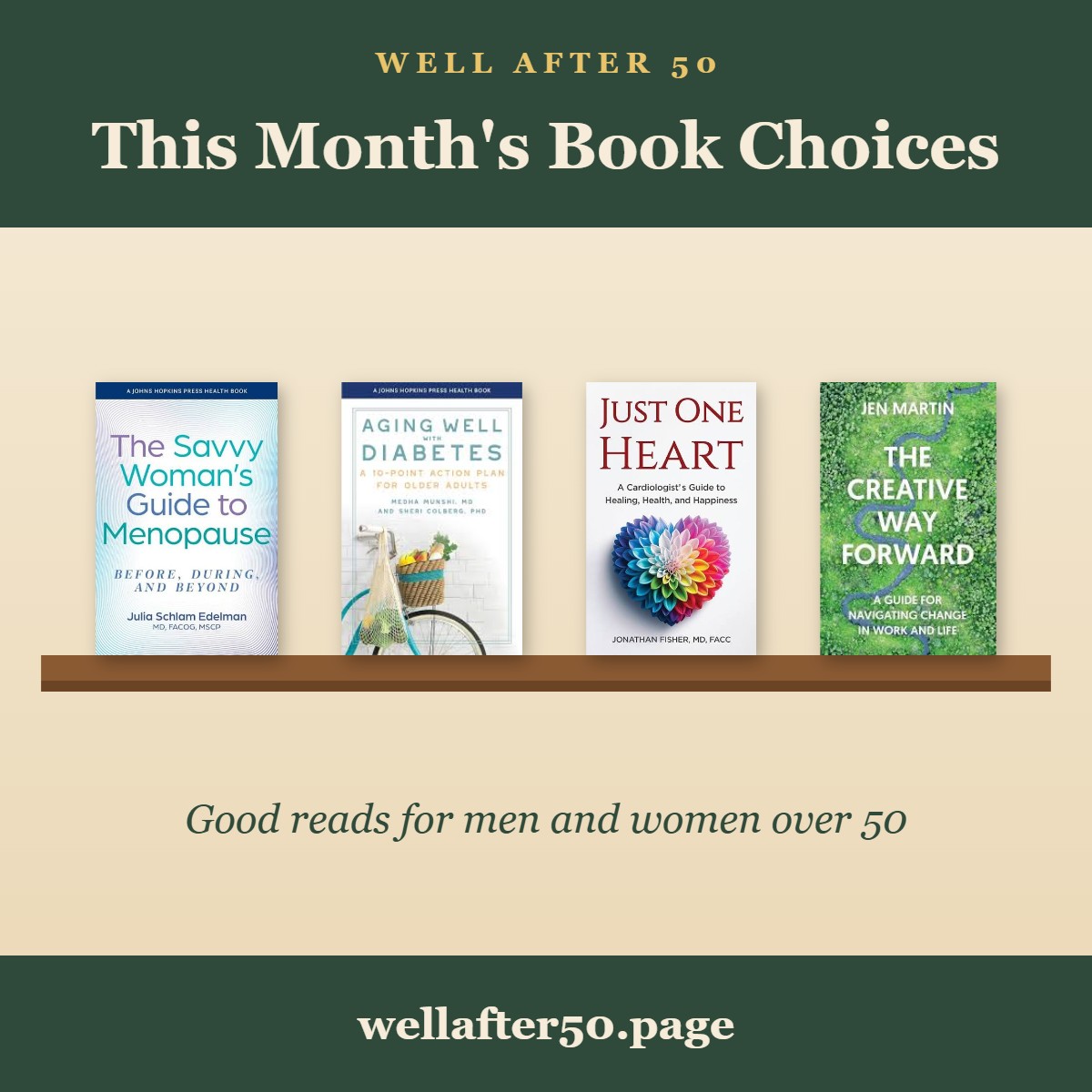
Short answer: This month’s four picks are Savvy Woman’s Guide to Menopause by Dr. Julia Schlam Edelman, a 2026 IBPA Gold winner; Aging Well with Diabetes by Dr. Medha Munshi and Dr. Sheri Colberg, a 2026 IBPA Silver winner; Just One Heart by cardiologist Dr. Jonathan Fisher; and The Creative Way Forward by coach Jen Martin, a 2025 IBPA Gold winner.
Welcome to our monthly Book Choices post!
Each month, we’ll share a few books that might be interesting, useful, inspiring, or just enjoyable to read.
This month, I’d also like to hear from you.
What are you reading right now — or what book would you recommend to someone 50+?
Share the title in the comments and tell us a little about why you liked it.
You never know who might discover their next favorite book because of your recommendation! 📖
Let’s build our Sturdy Years reading list together.
🏆 2026 IBPA Gold Winner — Health & Fitness Excellent fit for our menopause, wellness, nutrition, and healthy-aging discussions. The book is specifically described as evidence-based and covers lifestyle, hormonal and non-hormonal approaches.
A practical guide to getting through menopause, before, during and after the change, and doing well on the other side.
Dr. Julia Schlam Edelman has spent more than 30 years as a gynecologist and menopause doctor. She trained at Yale, Columbia and Harvard, she’s a Menopause Society Certified Practitioner, and she also wrote the earlier book Menopause Matters. In this one she takes all that experience and puts it in plain words for the rest of us.
She walks you through all three stages, perimenopause, menopause and postmenopause, and covers the body, the mind and the feelings that come with each. She doesn’t push one answer. She lays out the choices, from lifestyle changes to hormone and non-hormone treatments to other remedies, and explains the evidence behind them so you can talk it over with your own doctor.
Here’s what the book covers:
Hot flashes, poor sleep, mood swings and memory slips, and practical ways to handle each one
Hormone and non-hormone treatments, other remedies, and care tailored to you
Lifestyle and medical steps to lower your risk of heart trouble, bone loss, diabetes and cancer
Why menopause looks different from one woman to the next, and how that can change your treatment options
Why I picked it: A lot of women go through menopause with hardly any straight answers, and some get told to just wait it out. This book is the straight answers, from a doctor who’s been doing this work for three decades. It also won the 2026 IBPA Gold Award for Health & Fitness, which tells you other folks think highly of it too.
Great for: any woman in her 40s, 50s or 60s, whether you’re just starting to notice changes or you’re years past it and want to protect your heart and bones. And fellas, if your wife or sister is going through it, this one will help you understand what’s going on.
Disclosure: Some of the books mentioned on Sturdy Years may include affiliate links. If you purchase through one of these links, I may earn a small commission at no additional cost to you. I only recommend books I believe may be genuinely useful or interesting to people 50+.
Aging Well with Diabetes: A 10-Point Action Plan for Older Adults (A Johns Hopkins Press Health Book)
An essential guide to navigating diabetes for older adults and their caregivers.
Silver Winner of the 2026 IBPA Book Award for Health & Fitness
In Aging Well with Diabetes, Dr. Medha Munshi and Dr. Sheri Colberg provide practical advice to redefine living with diabetes in later life. As experts in geriatric care and diabetes management, they introduce a clear and accessible 10-step action plan to help you manage diabetes effectively while enhancing your overall vitality and independence.
Each step in the action plan is detailed with achievable goals, making it a crucial toolkit for anyone living with diabetes or caring for someone who does. The authors discuss:
• Comprehensive health management, including dietary adjustments, physical activity, medication management, and more • How aging and diabetes interact, detailing the physiological changes and challenges that come with managing diabetes at an older age • The diversity of experiences among older adults with diabetes and the importance of personalized treatment plans • Practical tips and strategies, such as modifying exercises to prevent falls and dietary tips that accommodate older digestive systems • Guidance for caregivers and health care providers on how to support older adults with diabetes
Whether you’re newly diagnosed or a long-time diabetic, this guide will empower you to take control of your health and manage your diabetes with confidence and grace as you age.
Disclosure: Some of the books mentioned on Sturdy Years may include affiliate links. If you purchase through one of these links, I may earn a small commission at no additional cost to you. I only recommend books I believe may be genuinely useful or interesting to people 50+.
Just One Heart: A Cardiologist’s Guide to Healing, Health, and Happiness
A multiple award-winning, evidence-based guide to healing and strengthening the heart—from the inside out
Our hearts are under strain—physically, emotionally, socially, and spiritually.
Stress, anxiety, loneliness, and disconnection don’t just affect how we feel.
They change how our hearts function.
In Just One Heart, Dr. Jonathan Fisher, a Harvard-trained cardiologist and mindfulness teacher, offers a clear, science-grounded path to restoring health, resilience, and meaning through the heart–mind connection.
Drawing on the latest research from medicine, psychology, and neuroscience—and integrating time-tested wisdom from contemplative traditions—this book translates complex science into practical, everyday tools to help you:
Reduce stress and calm the nervous system
Build emotional steadiness and resilience
Support heart health beyond numbers and tests
Reconnect with purpose, connection, and what matters most
Part I explores the science of the heart–mind connection and the hidden drivers of modern heart disease, stress, and burnout.
Part II offers guided practices to cultivate the Seven Timeless Traits of the Heart:
steadiness, wisdom, openness, wholeness, courage, lightness, and warmth.
Interwoven throughout are reflections from Dr. Fisher’s own journey through anxiety and burnout, moving patient stories, and insights from more than fifty leaders in mind–body medicine and human flourishing.
Whether you’re a healthcare professional, a leader under pressure, or someone seeking greater clarity, calm, and wholeness, Just One Heart shows how caring for the heart—fully and wisely—can transform both health and life.
Just One Heart
Disclosure: Some of the books mentioned on Sturdy Years may include affiliate links. If you purchase through one of these links, I may earn a small commission at no additional cost to you. I only recommend books I believe may be genuinely useful or interesting to people 50+.
The Creative Way Forward: A Guide for Navigating Change in Work and Life
2025 IBPA Book Awards Gold Winner: Self-Help 2025 IBPA Book Awards Silver Winner: Best New Voice, Nonfiction 2025 Axiom Awards Gold Medalist in Personal Development 2024 Foreword INDIES Book Awards Bronze Winner: Career (Adult Nonfiction) 2024 American Book Fest Award Winner – Self-Help: General 2024 American Book Fest Award Finalist – Business: Motivational
“Martin’s well-researched and thoughtfully crafted book provides a road map for staying resilient, adaptable, and true to yourself in the face of life’s challenges.” -Daniel H. Pink, New York Times best-selling author of The Power of Regret and Drive
Learn How to Creatively Adapt, Improvise Solutions, and Embrace Change
Change is inevitable. If there’s one thing we can plan on, it’s that nothing will stay the same. Yet change can also be challenging, especially when it’s unexpected. In times of disruption when we most need to be creative, we’re often reactive. We hang on to what we know instead of being open to the vast possibilities of what’s next. Professional coach and consultant Jen Martin shows us another way: how to build your creative capacity and ability to improvise forward, even during life’s biggest twists and turns.For those navigating any type of change—whether at work or in life—Jen shares research-backed practices and tools to help you strengthen your agility and adaptability. In this book, you will learn:
The four-part Change Curve for navigating transitions
How to regulate your nervous system to be creative versus reactive
Why knowing “what’s core for you” is critical for being adaptive
Three powerful ways to reframe your perspective
The type of curiosity you’ll need in order to embrace what’s next
How to creatively navigate detours and setbacks on the journey
This book is a beautiful reminder that while the future is inherently uncertain, it’s precisely when we don’t have all the answers that we often come up with the most interesting ideas and discover the creative way forward.
Want to Hear More Before You Pick One?
I like to hear an author talk before I buy a book. If Just One Heart caught your eye, Dr. Kevin Pho had Dr. Jonathan Fisher on The Podcast by KevinMD, and it’s a good listen while you’re out walking.
And if you’re still looking after these four, Margaret Manning’s site Sixty and Me has a nice list of inspirational books for women over 60. Fellas, don’t skip The Creative Way Forward up above. Change at work and in life hits all of us, and I reckon that one’s worth your time too.
How We Choose Our Books
We don’t choose books simply because they’re popular. We look for books that offer something worthwhile for people 50+.
When putting together our monthly Book Choices, we consider:
Useful information — Does the book teach, explain, or offer something readers can actually use?
Quality and credibility — Is the author knowledgeable and does the book have substance behind it?
Reader response — We look at reviews and what readers consistently say about the book.
Relevance to life after 50 — Does it speak to health, wellness, relationships, personal growth, aging, or simply enjoying life more?
Different kinds of books — We try to include a mix rather than recommending the same type of book every month.
Overall value — Would we feel comfortable suggesting the book to a friend?
The goal isn’t to find the “perfect” book. It’s to find books that might make your month a little more interesting, useful, or enjoyable.
Affiliate Disclaimer: Sturdy Years may earn a small commission when you purchase products through links on this site, at no additional cost to you. I only share products I believe may be helpful to my readers. Your support helps keep Sturdy Years going. Thank you!
Tom Green writes Sturdy Years. He was born in Pell City, Alabama, in 1962, and he’s a country boy and a true Southerner through and through. He’s just a regular, laid-back 64-year-old who keeps things simple. He shares what he learns about skincare, fitness and getting older, and what’s working for him. He’s also the author of A Practical Guide to Getting Older Without Giving Up on Yourself. Tom isn’t a doctor. He reads up on the research and passes along what’s useful, plain and simple.