Tag: consistent sleep schedule

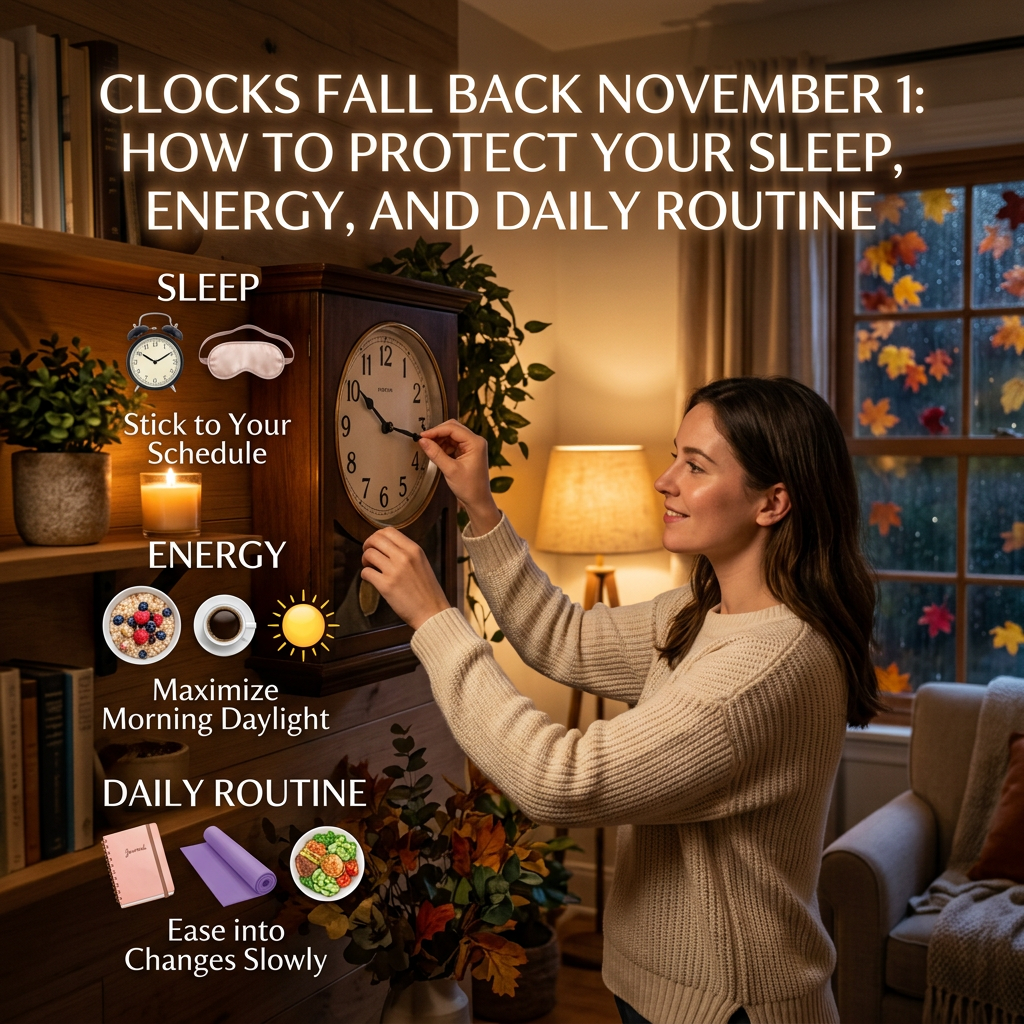
  • Clocks Fall Back November 1: How to Protect Your Sleep, Energy, and Daily Routine

    Clocks Fall Back November 1: How to Protect Your Sleep, Energy, and Daily Routine

    When did the clocks fall back, and how do you protect your sleep?

    Short answer: Daylight saving time ended Sunday, November 1, 2026, at 2 a.m., when clocks went back to 1 a.m. To protect your sleep, start shifting your bedtime a few days ahead, get some daylight early in the day, and go easy on the afternoon coffee and naps.

    That extra hour of sleep sounds wonderful. But changing the clock can throw more than your bedtime off. Here’s how to make the adjustment a little easier.

    Every fall, we turn our clocks back an hour, and everybody talks about getting an extra hour of sleep.

    Sounds pretty good, doesn’t it?

    But there’s something they don’t always tell you. Just because the clock says one thing doesn’t mean your body agrees.

    You might find yourself waking up at 4:30 in the morning, getting sleepy before supper, or wondering why you’re dragging around when you supposedly gained an hour.

    And then there’s the darkness. One day you’re enjoying daylight in the early evening, and the next it seems like somebody turned the lights off before you’ve even finished your day.

    I’ve always thought the older we get, the more important it becomes to pay attention to these little changes. Not because getting older means we can’t handle them, but because getting good sleep and having enough energy are worth protecting.

    So instead of just telling you to turn your clocks back, I want to share some things that can actually help you feel better during the change.

    First, When Do the Clocks Change?

    This year, daylight saving time ends on Sunday, November 1, 2026, at 2 a.m.

    At that moment, clocks go backward to 1 a.m.

    Most of the United States makes this change, although Hawaii and most of Arizona do not.

    Here’s what that means for your day:

    • You’ll have an extra hour on the clock overnight.
    • Sunrise will happen about an hour earlier by the clock.
    • Sunset will also happen about an hour earlier.
    • Your body may need a few days to adjust, even though you haven’t traveled anywhere.

    And while some people won’t notice much difference, others may experience earlier waking, tiredness, or changes in their usual sleep patterns.

    1. Start Getting Ready Before Sunday

    One of the easiest things you can do is start making small changes a few days before the clocks go back.

    You don’t have to change everything overnight.

    Try moving your bedtime and wake-up time about 15 minutes later each day, beginning Wednesday, October 28.

    DayWhat to do
    Wednesday, October 28Go to bed and wake up 15 minutes later
    Thursday, October 29Move both another 15 minutes later
    Friday, October 30Move another 15 minutes later
    Saturday, October 31Move another 15 minutes later

    For example, if you normally go to bed at 10 p.m., you’d aim for 10:15 on Wednesday, 10:30 on Thursday, 10:45 on Friday, and 11 p.m. on Saturday.

    After the clocks fall back, that 11 p.m. bedtime corresponds to 10 p.m. on the new clock.

    Why does this help?

    Your body follows an internal 24-hour clock that helps regulate when you feel sleepy and awake. Making small adjustments gives that system a chance to adapt without such an abrupt change.

    Sleep specialists recommend gradual schedule changes for people who have trouble adjusting.

    And don’t worry if you can’t follow the plan perfectly. Even a couple of small adjustments may help.

    2. Don’t Let That Extra Hour Throw Off Your Whole Week

    Here’s something that’s easy to do.

    You realize you’re getting an extra hour, so you stay up late Saturday night watching television, looking at your phone, or doing a little more around the house.

    Then Sunday morning comes, you sleep late, and Sunday night you aren’t tired.

    By Monday, you’re wondering why your sleep is all mixed up.

    The best approach is to keep a fairly regular schedule once the clocks change.

    Try getting up around the same time each morning, including weekends.

    If you normally wake at 7 a.m., aim to keep that 7 a.m. wake-up time on the new clock rather than drifting an hour earlier or later every day.

    And if you do sleep poorly one night, don’t feel like you’ve ruined anything. Get back to your usual routine the next day.

    One more thing: Don’t deliberately cut your sleep short just to make yourself tired. Most adults need at least seven hours of sleep, and many do best with seven to nine.

    3. Get Some Daylight — It Does More Than You Think

    This may be one of the simplest things on the whole list, and it doesn’t cost a penny.

    Get outside during the day.

    You don’t have to go for a long walk or start a new exercise program. Sit on the porch, walk to the mailbox, have your morning coffee outdoors, or spend a little time working in the yard.

    Natural light helps tell your brain when it’s daytime. That helps regulate your sleep-wake cycle.

    Morning daylight can be especially useful for establishing a regular wake-up routine, and daylight later in the day may help people who find themselves getting sleepy too early after the fall change.

    If walking is difficult, sitting outside is perfectly fine.

    And if the weather isn’t cooperating, open the curtains and spend time near a bright window. Outdoor light is generally stronger, but getting some daytime brightness is better than spending the whole day in a dim room.

    There’s another benefit, too. Shorter days can affect how energetic and cheerful we feel, so getting outside and staying active can be helpful for our mood.

    4. Those Dark Evenings Can Affect Your Mood

    Nobody talks about this enough.

    For some people, that early darkness is more difficult than the clock change itself.

    You finish a few chores, look outside, and it’s already getting dark. It can make the whole day feel shorter.

    And when it’s dark early, it’s tempting to sit down, turn on the television, and stay there for the rest of the evening.

    There’s nothing wrong with relaxing. But we don’t want those shorter days to take away the things that keep us feeling good.

    Here are a few things worth trying:

    • Schedule your walks, errands, or outdoor activities earlier while there’s still daylight.
    • Keep doing things you enjoy, even if it’s already dark outside.
    • Turn on the lights and enjoy your home instead of treating sunset like bedtime.
    • Stay connected with friends and family rather than spending every evening alone.
    • Keep some gentle physical activity in your day.

    If you notice that every fall brings ongoing sadness, a loss of interest in things you enjoy, or changes in sleep and appetite, mention it to your healthcare provider. Seasonal depression is real, and help is available.

    The important thing is not to let the darker evenings quietly take over your routine.

    5. Watch the Coffee and Afternoon Naps

    I know how tempting another cup of coffee can be when you’re dragging through the afternoon.

    But caffeine can stay in your system for hours, and that late cup may be part of the reason you’re still awake when you want to be sleeping.

    If you’re having trouble falling asleep, try keeping coffee and other caffeinated drinks to the morning or early afternoon.

    The same goes for naps.

    A short nap can be refreshing, but sleeping for an hour or two late in the afternoon can make it harder to fall asleep at night.

    If you need a nap, try keeping it around 20 to 30 minutes and taking it earlier in the day.

    And don’t make the mistake of thinking you have to stay awake at all costs. If you’re genuinely exhausted, rest. The goal is a healthier routine, not making yourself miserable.

    6. Make Your Bedroom Work for You

    You don’t need expensive bedding, sleep gadgets, or a cabinet full of supplements to get started.

    A few simple changes may help.

    Keep your bedroom cool and comfortable. Most people sleep better when the room isn’t overly warm.

    Comfortable goes for your pillow too. If you sleep on your side and keep waking up with a sore shoulder, MedCline makes a pillow system for side sleepers that’s designed to take the pressure off. (affiliate link)

    Block unwanted light. Streetlights, hallway lights, and glowing electronics can make a difference, especially if you’re already a light sleeper.

    Turn the television and phone down before bed. Bright screens and stimulating programs can keep your mind active when you’re trying to wind down.

    Give yourself a little quiet time. Read a few pages of a book, listen to peaceful music, or enjoy a warm shower.

    And here’s something people overlook: If you lie awake for a long time and start getting frustrated, get up for a little while and do something relaxing in dim light. Return to bed when you feel sleepy.

    Sometimes trying harder to sleep only makes it more difficult.

    7. Check Your Medications, Alarms, and Appointments

    This is one of those practical details that’s easy to forget.

    Your smartphone will usually change time automatically. Many computers and smartwatches will, too.

    But your microwave, stove, wall clock, car clock, and older alarm clocks may need to be changed manually.

    Take a few minutes Saturday evening to check them.

    And pay particular attention if you take medications at specific times.

    Don’t automatically move your medication schedule by an hour without checking.

    For most routine reminders, you can simply confirm they’re set correctly for the new time. But certain medications require more careful timing.

    If you take insulin, seizure medication, medication for Parkinson’s disease, or anything else that must be taken at precise intervals, ask your pharmacist or healthcare provider how to handle the change.

    Also check medical equipment with programmed schedules, such as some feeding pumps or medication devices.

    A little preparation can prevent a lot of confusion.

    8. Be Especially Careful Driving After Dark

    When the clocks change, your familiar evening drive may suddenly happen after sunset.

    That matters.

    Pedestrians, cyclists, animals, and other hazards are harder to see in low light, especially around intersections, parking lots, and roads without good lighting.

    A few reminders:

    • Clean the inside and outside of your windshield.
    • Make sure your headlights are working properly.
    • Slow down when visibility is poor.
    • Watch carefully for people crossing streets or walking through parking lots.
    • Avoid driving if you’re unusually sleepy.
    • Give yourself a little more time instead of rushing.

    As we get older, glare from oncoming headlights and changes in nighttime vision can become more noticeable. If night driving is getting difficult, bring it up at your next eye exam.

    There’s no shame in planning errands earlier in the day when visibility is better.

    9. What If You Already Have Trouble Sleeping?

    Some people are fortunate enough to sleep through just about anything.

    Others have a difficult time getting a good night’s rest even when the clocks aren’t changing.

    If that’s you, don’t feel like you need to follow every suggestion perfectly.

    Start with three things:

    1. Get up at roughly the same time each day.
    2. Spend some time outdoors during daylight hours.
    3. Give yourself a consistent, relaxing bedtime routine.

    If you regularly wake up exhausted, snore loudly, gasp during sleep, or have ongoing insomnia, don’t automatically blame age or daylight saving time.

    Those can be signs of sleep problems worth discussing with your doctor.

    Good sleep matters at every age, and poor sleep isn’t something we’re simply supposed to accept after 50.

    If you want to understand why sleep matters so much, Matthew Walker’s book Why We Sleep is worth a read. He’s a sleep scientist at UC Berkeley, and he explains in plain language what sleep does for your memory, your mood and your body. It might make you think twice about that late-night TV.

    Your Simple Weekend Clock-Change Checklist

    Before you head to bed Saturday night, here’s a quick list worth checking off:

    • Set your manual clocks back one hour.
    • Check your phone’s time-zone and automatic-time settings.
    • Make sure your alarms are set correctly.
    • Review medication reminders and any time-sensitive dosing instructions.
    • Check your Sunday appointments and activities.
    • Make a plan to get some daylight on Sunday.
    • Keep your bedtime and wake-up routine as steady as possible.
    • Prepare for darker evening driving.

    Nothing complicated. Just a few minutes of preparation.

    A Final Thought: Don’t Let One Hour Steal Your Energy

    Getting older teaches us something important: Sometimes the smallest changes in our daily routine can make a bigger difference than we expect.

    A good night’s sleep, a little sunshine, some movement, and a regular routine may not sound exciting. But they’re part of what helps us feel good enough to enjoy our lives.

    The clocks are going to change whether we like it or not.

    What we can do is make the adjustment easier on ourselves.

    So enjoy that extra hour if you can. Just remember that your body may need a little time to catch up.

    And if the darker evenings bother you, don’t let them convince you the day is over.

    There’s still plenty of life to enjoy after sunset.

    That’s what Sturdy Years is all about — finding practical ways to take care of ourselves and keep enjoying the years ahead.

    I’ve also mapped out some great tools on my new Tech for Independent Living After 50 page.

    About Tom Green

    Tom Green writes Sturdy Years. He was born in Pell City, Alabama, in 1962, and he’s a country boy and a true Southerner through and through. He’s just a regular, laid-back 64-year-old who keeps things simple. He shares what he learns about skincare, fitness and getting older, and what’s working for him. He’s also the author of A Practical Guide to Getting Older Without Giving Up on Yourself. Tom isn’t a doctor. He reads up on the research and passes along what’s useful, plain and simple.

  • Does a Consistent Sleep Schedule Help You Live Longer?

    Does a Consistent Sleep Schedule Help You Live Longer?

    Does a consistent sleep schedule help you live longer?

    Short answer: It looks that way. In a study of about 61,000 adults averaging 63, people with more regular sleep had a 20% to 48% lower risk of dying during the study than the least regular sleepers. It doesn’t prove cause and effect. The easiest start is the same wake-up time every day, weekends included.

    New research suggests that when you sleep may matter more than many of us realize. Here’s what the science actually says—and what you can do about it.

    By Tom Green | Sturdy Years

    Most of us have heard that we need seven or eight hours of sleep. We’ve heard it from doctors, read it in magazines, and probably told ourselves a hundred times that we ought to get to bed earlier.

    But here’s something I found interesting: What if getting enough sleep is only part of the picture? What if keeping a regular sleep schedule matters, too?

    Researchers studying thousands of adults have found a connection between irregular sleep patterns and a higher risk of dying earlier. That certainly caught my attention.

    Before anybody starts worrying about staying up late on Saturday night, though, there’s something important to understand. These studies show an association. They don’t prove that going to bed at the same time every night will make you live longer.

    Still, the findings are worth looking at, especially for those of us over 50.

    What Researchers Discovered About Sleep and Longevity

    A study published in the journal SLEEP examined sleep patterns in 60,977 UK Biobank participants, whose average age was approximately 63. Instead of simply asking people how long they slept, researchers used wearable devices to measure their sleep and activity patterns.

    They were interested in something called sleep regularity—how consistently someone was asleep or awake at similar times from one day to the next.

    Over an average follow-up of about 6.3 years, researchers found that participants in the four groups with more regular sleep patterns had a 20% to 48% lower risk of death from any cause, compared with those in the least regular group.

    Perhaps the most surprising finding was that sleep regularity predicted mortality risk more strongly than sleep duration in the researchers’ models. That’s not the same as saying sleep duration doesn’t matter. It absolutely does. But it suggests we’ve been overlooking an important part of healthy sleep.

    Read the original study: Sleep Regularity Is a Stronger Predictor of Mortality Risk Than Sleep Duration — SLEEP.

    Another Large Study Found a Similar Connection

    A separate study published in eLife examined 88,975 UK Biobank participants, with an average age of about 62. Researchers again used activity-monitoring devices to examine sleep regularity.

    They found that people with highly irregular sleep patterns had higher mortality risks than those with more consistent patterns. In one comparison, participants near the low end of the sleep-regularity scale had a 53% higher estimated mortality hazard than those around the middle of the scale, after adjustments for other factors.

    These findings weren’t based on somebody remembering how much they slept last Tuesday. They came from objective recordings. That’s valuable, although wearable measurements and statistical adjustments still can’t eliminate every possible source of error.

    The two studies also drew on the UK Biobank, so they shouldn’t be treated as two completely independent populations.

    Read the study: Sleep Regularity and Mortality: A Prospective Analysis in the UK Biobank — eLife.

    What a 2025 Review Added to the Picture

    By 2025, there was enough research on sleep regularity for scientists to examine the findings across many different studies. A systematic review published in Sleep Medicine Reviews included 59 primary studies.

    The researchers found that irregular sleep timing was associated with several health concerns, including higher blood pressure, insulin resistance, cardiovascular events, and symptoms of depression and anxiety. Five of the reviewed cohorts also linked less regular sleep with higher all-cause mortality.

    The review strengthens the argument that sleep regularity deserves attention alongside sleep duration and quality. But the authors also called for further intervention research. That’s important because we still need stronger evidence about whether deliberately improving sleep regularity lowers the risk of disease or premature death.

    Read the review: Sleep Regularity as an Important Component of Sleep Hygiene — Sleep Medicine Reviews.

    Why Might Your Sleep Schedule Matter?

    Our bodies run on an internal timing system commonly called the circadian rhythm. It’s involved in much more than deciding when we feel sleepy. This system helps coordinate hormone activity, body temperature, alertness, and other biological functions throughout the day and night.

    Light exposure, mealtimes, physical activity, and sleep schedules all interact with this internal clock. When bedtime and waking time shift considerably from one day to another, the body’s timing signals may become less consistent.

    Researchers are investigating whether this kind of disruption contributes to metabolic changes, inflammation, and cardiovascular problems. However, that doesn’t mean an irregular schedule automatically causes these conditions. Health problems, work schedules, stress, medications, and other circumstances can also disrupt sleep. The relationship may work in more than one direction.

    Does Sleep Change After 50?

    Yes, and that’s something many of us recognize without needing a scientific study to tell us. You might fall asleep earlier than you used to, wake during the night, or find yourself wide awake before sunrise.

    Pain, medications, bathroom trips, stress, and sleep disorders can make matters worse. But needing less sleep simply because we’re getting older is a common misconception.

    According to the CDC, adults ages 61–64 generally need 7–9 hours, while adults 65 and older are advised to get 7–8 hours per night. And those hours need to be reasonably restorative.

    If you’re spending eight hours in bed but waking repeatedly and feeling exhausted the next day, it’s worth finding out why. That’s particularly important when poor sleep has become something you’ve simply learned to live with.

    Seven Ways to Build a More Consistent Sleep Routine After 50

    You don’t have to buy expensive gadgets, track every minute of sleep, or build your entire evening around a complicated routine. Start with a few manageable habits.

    1. Give Yourself a Regular Wake-Up Time

    If you change only one part of your sleep schedule, a consistent wake-up time is a practical place to begin. Try getting up around the same time each morning, including weekends. You don’t need to panic about an occasional late morning. The goal is a pattern your body can become accustomed to.

    2. Get Some Daylight Early in the Day

    Morning daylight helps your internal clock distinguish daytime from nighttime. If you’re able, spend some time outdoors after getting up. Even a morning walk or sitting outside with your coffee can help establish a routine. And you don’t have to turn it into a workout.

    3. Watch That Afternoon Coffee

    Here’s one that can sneak up on us. You may enjoy an afternoon cup of coffee and never feel especially stimulated by it. But caffeine can remain active in the body for hours. If you’re having trouble falling asleep, try moving your last caffeinated drink earlier and see whether your sleep improves.

    4. Keep Moving During the Day

    Regular physical activity supports better sleep and overall health. Walking, gardening, swimming, or strength training can all fit into a healthy routine. If evening exercise leaves you wide awake, try doing it earlier. And if pain is interfering with your sleep, choose activities that don’t aggravate it.

    5. Make Your Bedroom Work for You

    A dark, quiet, comfortable room can make sleeping easier. Keep the temperature comfortable, reduce unnecessary light, and limit distractions. If television or phone use keeps you awake longer than intended, try putting those aside during your wind-down period.

    6. Pay Attention to Alcohol and Late Meals

    Alcohol may make you sleepy initially, but it can also disrupt sleep later in the night. Heavy meals close to bedtime may cause discomfort, especially if you experience acid reflux. You don’t need a rigid set of rules for every evening. Pay attention to what seems to disturb your sleep and make adjustments where you can.

    7. Don’t Ignore Persistent Sleep Problems

    This might be the most important point in the entire article. If you’re regularly struggling to sleep, waking up gasping, snoring heavily, or feeling unusually sleepy during the day, don’t assume it’s just part of getting older.

    Sleep apnea and chronic insomnia are health problems that deserve proper evaluation. For persistent insomnia, cognitive behavioral therapy for insomnia (CBT-I) is recommended as a first-line treatment by the American College of Physicians. There’s a difference between improving your sleep habits and trying to treat a medical sleep disorder on your own.

    A Simple 7-Day Sleep Schedule Reset

    Want to try this without overthinking it? Here’s a one-week plan I’d follow:

    • Day 1: Choose your wake-up time, one you can keep every day of the week. Set an alarm.
    • Day 2: Get outside, or sit by a bright window, within an hour of waking. Even 10 minutes helps set your body clock.
    • Day 3: Make 2 p.m. your coffee cutoff.
    • Day 4: Take a walk sometime during the day. Moving in daylight helps you sleep at night.
    • Day 5: Start a 30-minute wind-down before bed: dim lights, screens down, something calm.
    • Day 6: Keep your wake-up time even though it’s the weekend. This is the hard one, and the one that matters most.
    • Day 7: Notice how you feel. Most people find they get sleepy at about the same time each night once the wake-up time is steady.

    What If You Wake Up at 3 A.M. Every Night?

    First, don’t assume you’ve ruined your night’s sleep. An occasional awakening doesn’t mean something is seriously wrong. If you wake up and can’t get back to sleep, try to avoid watching the clock and becoming frustrated about how many hours you have left.

    When you’re lying awake for a long time, getting out of bed briefly for a quiet, relaxing activity may be more helpful than continuing to struggle. If this happens frequently, a sleep diary can help you notice patterns.

    Write down your bedtime, wake-up time, nighttime awakenings, caffeine use, and how rested you feel. Bring that information to your healthcare provider if the problem persists. You may discover that stress, pain, medication timing, or another treatable issue is affecting your rest.

    Can Better Sleep Actually Help You Live Longer?

    Here’s where I think we need to be careful. The research gives us good reason to take regular sleep seriously. But we cannot honestly say that setting an alarm for the same time every morning will add five years to your life. The studies don’t establish that.

    What they do suggest is that sleep regularity is an important part of overall sleep health—and one that’s easy to overlook. We already have strong reasons to care about getting enough good-quality sleep. Poor sleep is linked with cardiovascular and metabolic health problems, and it can affect how we feel and function during the day.

    Building a steadier routine is a reasonable step toward better sleep, even though its effect on lifespan hasn’t been proven.

    Some folks reach for a supplement before fixing their sleep. If you’ve wondered about NMN for energy and aging, I looked into it here: Been Hearing About NMN Supplements? Would It Work for You After 50?

    Common Questions

    How many hours of sleep do you need after 60?
    The CDC recommends 7 to 9 hours for adults 61 to 64, and 7 to 8 hours for adults 65 and older. Quality and regularity matter too.

    Is it bad to sleep in on weekends?
    An occasional lie-in won’t hurt, but regularly shifting your schedule by a couple of hours can leave you feeling like you have jet lag on Monday. A steady wake-up time is the most helpful habit.

    What is the best bedtime after 50?
    There isn’t one perfect time. The best bedtime is one you can keep consistently that still gives you 7 or more hours before your wake-up time.

    Are naps okay after 50?
    A short nap of 20 to 30 minutes in the early afternoon is fine for most people. Long or late naps can make it harder to fall asleep at night.

    Why do I wake up so early now?
    Our body clock tends to shift earlier as we age, so many people feel sleepy earlier and wake earlier. If you’re waking too early and can’t get back to sleep, morning light and a consistent schedule can help, and it’s worth mentioning to your doctor.

    My Take: Don’t Turn Sleep Into Another Thing to Worry About

    One thing I’ve learned about getting older is that there always seems to be another health rule we’re supposed to follow. Eat this. Don’t eat that. Exercise more. Avoid stress. Get eight hours of sleep. Sometimes it can feel exhausting just trying to do everything right.

    I don’t think that’s the lesson here. The lesson is that something as ordinary as our daily sleep routine deserves a little more attention.

    If you’re sleeping well, feeling rested, and keeping a fairly steady schedule, that’s encouraging. If you’re struggling, maybe start by making one small change instead of trying to fix everything at once.

    And remember, healthy aging isn’t about being perfect. It’s about making choices that give us a better chance of feeling good and staying active in the years ahead. That’s something worth getting a good night’s sleep for.

    About the Author

    Tom Green writes Sturdy Years. He was born in Pell City, Alabama, in 1962, and he’s a country boy and a true Southerner through and through. He’s just a regular, laid-back 64-year-old who keeps things simple. He shares what he learns about skincare, fitness and getting older, and what’s working for him. He’s also the author of A Practical Guide to Getting Older Without Giving Up on Yourself.

    Tom isn’t a doctor. He reads up on the research and passes along what’s useful, plain and simple.

    Medical Disclaimer

    This article is for educational purposes and is not a substitute for professional medical advice. Talk with your healthcare provider about persistent sleep problems, medications, or suspected sleep disorders.

    Research and Further Reading

    Sleep Regularity and Mortality — SLEEP

    Sleep Regularity and Mortality — eLife

    2025 Systematic Review — Sleep Medicine Reviews

    Sleep Recommendations — CDC

    Insomnia Treatment and Sleep Habits — NIH

    Sleep and Older Adults — National Institute on Aging

    CBT-I Guidelines — American College of Physicians

    I’ve also mapped out some great tools on my new Tech for Independent Living After 50 page.