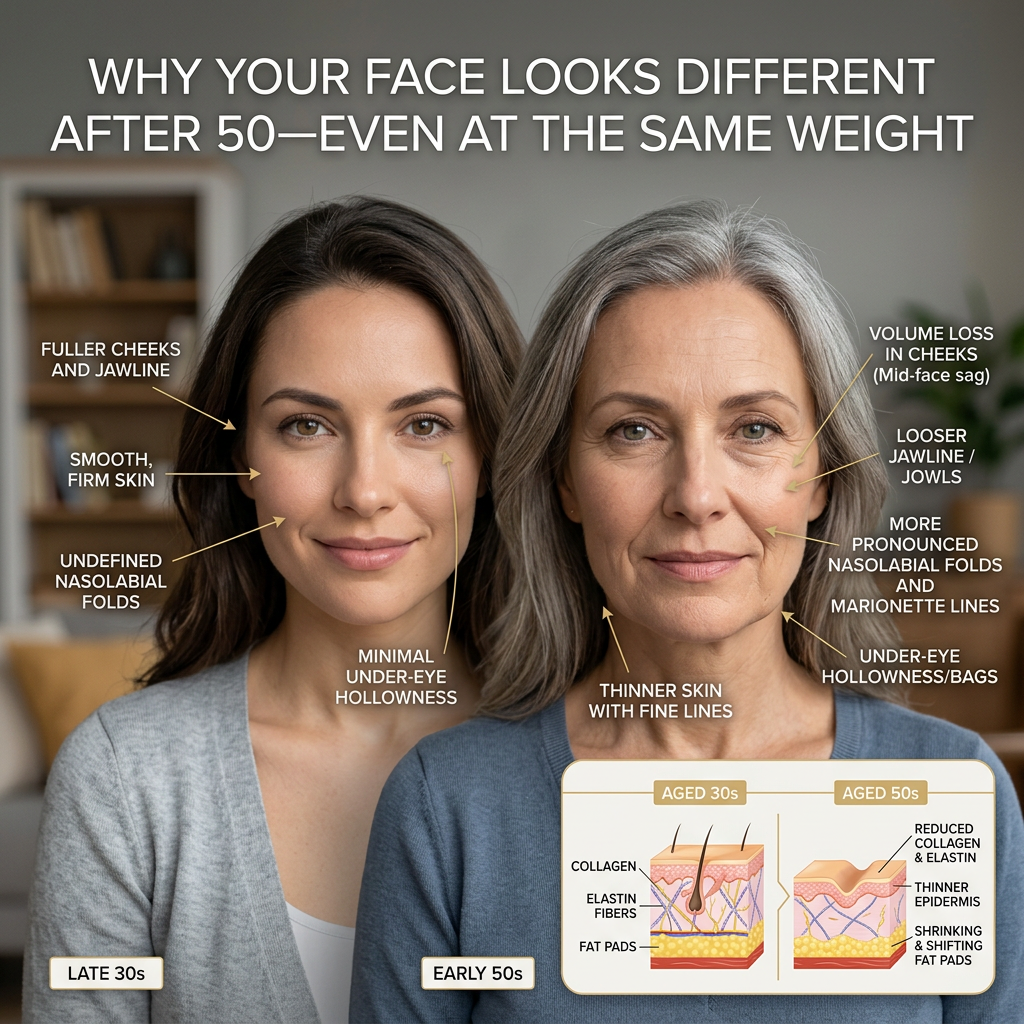
Why does your face look different after 50 even at the same weight?
Short answer: Your face can look different after 50 even at the same weight because more is changing than your skin. Facial fat shifts and loses volume, and the support underneath, from ligaments to bone, changes too. Creams can help dryness and fine lines, but they can’t replace that deeper volume.
Ever catch your reflection and wonder why your cheeks or jawline look different even though the scale has hardly moved? I have. The explanation is more interesting than a new wrinkle—and it isn’t always something a cream can fix.
Have you ever looked in the mirror and thought, “I haven’t gained or lost much weight, so why does my face look different?” I think this is one of the most confusing parts of getting older.
We tend to blame the scale, but the scale doesn’t tell the whole story. After 50, the face can change because several things are happening at once: skin changes, shifts in facial fat, changes in body composition, sun exposure, hydration, sleep and simply the passage of time.
Weight Is Only One Piece of the Picture
When your face changes, it is tempting to assume you need to lose weight, gain weight or buy a new anti-aging product. Sometimes the change has very little to do with the number on the scale.
- Skin gradually changes in firmness and elasticity.
- Facial fat can change position and volume over time.
- Sun exposure can contribute to visible texture and pigmentation changes.
- Sleep and hydration can affect how tired or drawn the face looks from day to day.
- Changes in overall muscle and body composition can alter appearance even when weight barely moves.
Why Your Face Can Look Different From One Day to the Next
Not every change in the mirror is permanent. Poor sleep, allergies, alcohol, salty meals and normal fluid changes can affect puffiness and definition. That’s one reason I wouldn’t judge my appearance from one bad morning.
What You Can Actually Work On
- Protect your skin: Consistent sun protection is one of the most useful long-term habits for exposed skin.
- Keep skincare simple: Gentle cleansing, appropriate moisture and carefully chosen active ingredients can support healthier-looking skin.
- Maintain muscle: Resistance training supports strength, function and body composition.
- Eat enough nutritious food: Constant crash dieting can make some people look drawn while also making muscle maintenance harder.
- Sleep and recover: A rough stretch of sleep can show up surprisingly quickly.
Don’t Let Anti-Aging Become a Full-Time Job
There is nothing wrong with wanting to look your best. I just don’t think every hollow area, line or change in facial shape needs to become a problem that must be fixed.
My goal is simpler: I want my face to look healthy, cared for and like me. That means taking care of my skin and health without spending every morning searching for something new to fight normal aging.
It’s Not Just Your Skin: What Changes Underneath
Your face has layers: skin, fat pads, ligaments, muscles and bone. Over time, those layers can change at different rates. A plumper cheek may become flatter, or the same skin may have less support underneath it. A cream can improve dryness and fine lines, but it cannot rebuild lost facial bone or replace deeper volume.
Dermatologist Dr. Neil Sadick and coauthors describe how separate superficial and deep facial fat compartments contribute to aging changes in the cheeks, chin and jowls. Surgeons David Kahn and Robert Shaw discuss changes to both soft tissue and the facial skeleton. A review of facial anatomy similarly identifies bone, fat, muscle and skin as interacting factors. None suggests that everybody’s face changes in exactly the same way.
Three Changes You Might Notice—and What They Mean
- Cheeks look flatter: ordinary shifts in facial volume and skin support may contribute. More moisturizer won’t replace deeper tissue.
- Jawline looks softer: skin elasticity and changes in deeper tissues can both play a part; surface products have limits.
- Fine lines look sharper in the morning: dryness or temporary puffiness can exaggerate appearance; consistent moisturizer may help the surface look smoother.
Where I’d Spend Money—and Where I Wouldn’t
I’d start with a gentle cleanser, a moisturizer that suits my skin, and broad-spectrum SPF 30+ when outdoors. The American Academy of Dermatology’s guidance for skin in your 40s and 50s puts sun protection and moisturizing before a cabinet full of miracle products. A carefully chosen retinoid may help certain visible effects of sun damage, but don’t expect topical skincare to change facial bone structure.
If you’re considering fillers or procedures, ask a qualified board-certified specialist about realistic outcomes, risks, alternatives and cost. There is no obligation to do anything. A natural-looking face that still looks like you is a perfectly good goal.
A Useful Two-Week Mirror Check
Instead of studying your reflection every morning, compare photos in the same lighting, time of day and camera angle a couple of weeks apart. Note changes in sleep, salt intake, weight and skincare. It’s an imperfect comparison, but better than letting one unflattering bathroom mirror decide how you feel.
Keep reading: Skincare After 50: What to Buy and What to Skip. Sudden new facial weakness, drooping or difficulty speaking is an emergency—not normal aging.
What Named Researchers Actually Found
Plastic surgeon Dr. Rod Rohrich coauthored a review explaining how superficial and deep facial fat compartments contribute to changes in facial contour. That helps explain why a face can change shape without a dramatic change on the scale.
Surgeon Dr. Joel Pessa coauthored anatomical research showing that facial fat is organized into distinct compartments, rather than one uniform layer. Those structures matter when understanding aging cheeks and jowls.
Surgeon Dr. Robert Shaw and colleagues examined age-related changes in the facial skeleton. Their work provides another reason not to promise that a moisturizer alone can reverse every change you notice in the mirror.
Common Questions
Why does your face look different after 50?
Changes in collagen, elastin, facial fat, bone structure, skin thickness, and hydration can gradually change how your face looks.
Why does your face lose some firmness after 50?
Collagen and elastin decline with age, which can contribute to looser skin and softer facial contours.
Why do cheeks look different after 50?
Changes in facial fat and skin support can make the cheeks look less full or change the way your facial contours appear.
Why does your jawline change after 50?
Changes in skin elasticity, facial fat, and underlying tissues can make the jawline appear softer or less defined.
Can dry skin make your face look older after 50?
Yes. Dryness can make fine lines and rough texture more noticeable and leave skin looking dull.
Can skincare improve how your face looks after 50?
Yes. A consistent routine can improve hydration, texture, and the appearance of some signs of aging.
Does sunscreen still matter after 50?
Absolutely. Daily broad-spectrum sunscreen helps protect against UV damage that contributes to wrinkles and uneven skin tone.
Can exercise affect how your face looks after 50?
Regular exercise supports overall health, muscle tone, circulation, and body composition, all of which can contribute to a healthier appearance.
What is a simple skincare routine after 50?
Morning: Gently cleanse or rinse, moisturize, and apply broad-spectrum sunscreen.
Evening: Cleanse, use a targeted treatment if appropriate, and moisturize your face and neck.
Do you need lots of anti-aging products after 50?
No. A few products you use consistently can be more practical than a complicated routine with too many active ingredients.
Can you really change how your face looks after 50?
You can’t stop normal aging, but skincare, sleep, nutrition, exercise, sun protection, and other healthy habits can help you look and feel your best.
A gentle health note: Facial changes are usually gradual. Sudden or unusual changes—especially swelling, weakness, numbness, or significant asymmetry—should be discussed with a healthcare professional.
My Take After 50
If your weight hasn’t changed but your face has, don’t automatically assume you’ve done something wrong. Look at the bigger picture—skin care, sun exposure, sleep, nutrition, activity, muscle and normal aging.
If a facial change is sudden, dramatic or accompanied by other symptoms, that’s different from ordinary aging and is worth discussing with a healthcare professional.
I’m sharing personal observations and general healthy-aging information, not medical advice. Everyone ages differently, and persistent or concerning changes should be evaluated by a qualified professional.
About Tom Green
Tom Green writes Sturdy Years. He was born in Pell City, Alabama, in 1962, and he’s a country boy and a true Southerner through and through. He’s just a regular, laid-back 64-year-old who keeps things simple. He shares what he learns about skincare, fitness and getting older, and what’s working for him. He’s also the author of A Practical Guide to Getting Older Without Giving Up on Yourself. Tom isn’t a doctor. He reads up on the research and passes along what’s useful, plain and simple.
I’ve also mapped out some great tools on my new Tech for Independent Living After 50 page.