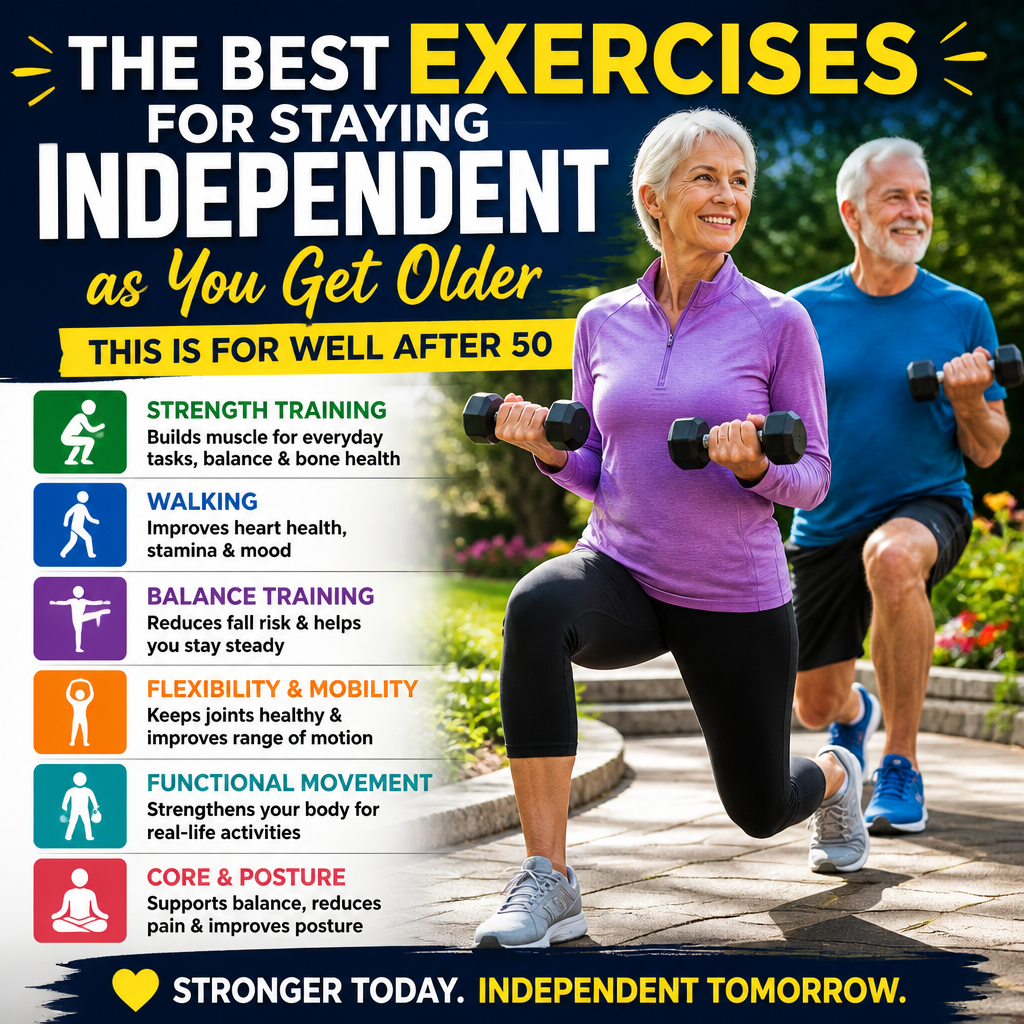
What are the best exercises for staying independent as you get older?
Short answer: The best exercises for staying independent are the ones that train everyday life: strength training first, then practicing getting up and sitting down, walking, and balance work. Together they help you get up from the floor, climb stairs and carry your own groceries for years to come.
There is a difference between getting older and feeling like your world is getting smaller.
Maybe you have already noticed it in little ways. A flight of stairs feels different. Getting up from a low chair takes more effort. Carrying groceries from the car is not quite as easy as it used to be. You may not think of these things as fitness problems. They are really independence problems.
That is why the best exercise after 50 is not necessarily the exercise that burns the most calories or makes you sweat the hardest.
The best exercise is the kind that helps you keep doing your own life.
Think about the life you want your body to handle
Instead of asking, “What exercise should I do to look better?” try asking:
- Can I get up from the floor if I need to?
- Can I climb stairs without feeling defeated?
- Can I carry my groceries?
- Can I walk through an airport, museum or shopping center?
- Can I get out of a chair without using my hands?
- Can I keep traveling, working around the house and doing the things I enjoy?
Those are not vanity questions. They are freedom questions.
1. Strength training may be the most important place to start
Muscle does not disappear simply because we reach a certain birthday, but muscle and strength can decline with age when we are inactive. The good news is that the body can respond to resistance training well into later life.
You do not have to become a bodybuilder. Sit-to-stands, resistance bands, machines, dumbbells, wall push-ups and other simple movements can help.
Think about training the muscles you use to live: legs, hips, back, chest, shoulders and arms.
2. Practice getting up and sitting down
This sounds almost too simple to count as exercise. It counts.
Standing from a chair without pushing off with your arms trains the legs and hips in a movement you actually use. Start with a sturdy chair and use your hands if you need to. Over time, work toward smoother, stronger repetitions.
3. Walk for the life outside the gym
Walking is wonderfully unglamorous—and that is part of its strength. It is accessible, easy to repeat and useful for building endurance.
You can walk around your neighborhood, inside a store, on a treadmill or with a friend. The goal is not to prove anything. The goal is to make movement part of ordinary life.
4. Do not ignore balance
Balance deserves attention because a strong body still needs to know where it is in space.
Simple balance practice might include standing near a counter and briefly standing on one leg, walking heel-to-toe, or practicing controlled sit-to-stands. Use support when needed and do not turn balance work into a dare.
5. Train your ability to push, pull, carry and reach
Real life is full of awkward little strength tests. Opening a stubborn door. Lifting a bag. Reaching for something on a shelf. Carrying laundry. Moving a box.
Your workout does not need to copy these tasks perfectly, but it should prepare your body for them.
A simple week can be enough to make a difference
- 2 days: strength training for the major muscle groups
- Most days: some walking or other aerobic activity you enjoy
- Several times a week: brief balance practice
- Every day: look for opportunities to sit less and move more
CDC guidance for adults 65+ recommends aerobic activity, muscle-strengthening activity at least two days a week, and balance activities. You do not have to jump straight into the full recommendation. Start from where you are and build gradually.
The goal is not to become 30 again
This may be the most important part.
You are not exercising to erase your age. You are exercising so your age does not unnecessarily erase parts of your life.
You want to be the person who can say yes when someone suggests a day trip. You want to carry your own bags. You want to get out of a chair without thinking about it. You want enough strength and balance to keep making your own choices.
That is what fitness after 50 can really be about: keeping your world open.
Common Questions
What is the best exercise after 50?
A combination of strength, aerobic activity and balance is more useful for healthy aging than relying on one type of exercise alone.
Can I start strength training if I have never lifted weights?
Yes. Start with manageable resistance, controlled movements and gradual progress. If you have a medical condition or significant physical limitation, ask your health professional what is appropriate.
Do I have to exercise every day?
No. Consistency matters more than perfection. Regular movement spread across the week is a practical goal.
Can walking really help me stay independent?
Walking can improve endurance and physical activity levels, while strength and balance work address other abilities needed for everyday independence.
Keep Reading
For more practical healthy-aging ideas, explore Sturdy Years.
About Tom Green
Tom Green writes Sturdy Years. He was born in Pell City, Alabama, in 1962, and he’s a country boy and a true Southerner through and through. He’s just a regular, laid-back 64-year-old who keeps things simple. He shares what he learns about skincare, fitness and getting older, and what’s working for him. He’s also the author of A Practical Guide to Getting Older Without Giving Up on Yourself. Tom isn’t a doctor. He reads up on the research and passes along what’s useful, plain and simple.
Sources & Proof
CDC: Older Adult Activity Guidelines
National Institute on Aging: Health Benefits of Exercise and Physical Activity
National Institute on Aging: Types of Exercise and Physical Ability
Safety note: Start at a level appropriate for your current ability. Stop if you develop unusual pain, dizziness, chest pressure, severe shortness of breath or other concerning symptoms, and seek medical advice when appropriate.
I’ve also mapped out some great tools on my new Tech for Independent Living After 50 page.