Tag: senior fitness

  • Does Walking Prevent Falls After 65? What Actually Cuts Falls by 25%

    Does Walking Prevent Falls After 65? What Actually Cuts Falls by 25%

    Does walking prevent falls after 65?

    Short answer: Walking alone doesn’t cut falls much. In one Australian trial of 386 inactive people 65 and older, a 48-week walking program didn’t lower falls in any way that mattered. What works is balance exercise. A big review of 108 trials found balance and everyday-movement exercise cut falls by about 24 percent, and about 34 percent when strength work was added.

    Does walking prevent falls after 65? Not on its own, it doesn’t. I wish somebody had sat me down and told me that plain years ago.

    Now don’t get me wrong, I walk every day and I’m not about to quit. It’s good for my heart and my blood pressure and my mood, and it gets me out the door. But walking doesn’t teach your body how to catch itself when your toe snags a rug, or how to stay steady when you spin around too quick in the kitchen. That takes a different kind of work, and the good news is it’s simple, it’s free and you can do it holding onto your own counter.

    So I went digging through what the research actually says. Here’s what I found and what I’m doing about it.

    The big study that surprised a lot of folks

    This September a big Cochrane review came out on tailored fall-prevention plans. That’s the kind where a professional checks all your risks and builds a plan just for you. It pulled together 110 studies and close to 49,000 older people living in their own homes.

    Here’s what caught me off guard. Those fancy personalized plans did no better than plain good fall-prevention advice, the kind you’d get in a leaflet. Matter of fact, compared with just getting the advice, people on the tailored plans probably had a few more falls, not fewer.

    That doesn’t mean fall prevention doesn’t work. It means the complicated stuff isn’t the magic answer. Dr. Cynthia Swarnalatha at the University of Exeter, one of the lead researchers, put it pretty simple: give people good advice and get them exercising. Those simpler things looked like they help the most.

    So what does work? Balance work

    It’s the boring-sounding answer, but it’s the one that holds up.

    Back in 2019, Professor Cathie Sherrington and her team in Sydney rounded up 108 exercise trials with more than 23,000 people, average age 76. Exercise overall cut the rate of falls by about 23 percent. Balance and functional exercise, the kind that challenges your balance on purpose and works the moves you do every day, cut falls by about 24 percent. That was high-certainty evidence, the strongest kind they’ve got.

    Put some strength work together with that balance work and the drop looked even bigger, around 34 percent fewer falls. Tai Chi helped too, about 19 percent fewer.

    And walking all by itself? The evidence was uncertain. Not proven to stop falls and not proven not to. In one Australian trial, 386 inactive people 65 and older followed a walking program for 48 weeks. They walked more, sure enough, but their falls didn’t go down in any way that mattered.

    Dr. Peter Attia, who wrote the bestseller Outlive, says he treats stability as just as important as cardio and strength. I reckon he’s onto something. You can have a strong heart and still go down hard if your balance is shot.

    So keep walking. Just don’t count on walking alone to keep you on your feet.

    If Tai Chi sounds like more your speed, an easy way to get started at home is Tai Chi Walking for Weight Loss. It’s a beginner 28-day plan with 10 minutes a day, it comes in large print, and it mixes slow Tai Chi moves into your walk, so you’re working your balance while you’re out there anyway. It’s a how-to book, not a study, so think of it as a friendly guide to the kind of moves the research backs.

    As an Amazon Associate I earn from qualifying purchases. It doesn’t cost you a penny more.

    The 10-minute routine your doctor might hand you

    Here’s a newer one I really liked. It’s called the eSTEPS trial, led by Nancy Latham and her team at Mass General Brigham, and it came out in JAMA Network Open this October. They followed 11,945 people 65 and older who were at risk of falling, across 22 regular doctor’s offices.

    Doctors in half the offices got a tool that helped them hand patients a simple home exercise plan that fit their balance level, plus handouts or an app to follow along. Those offices ended up with about 9 percent fewer falls showing up in patients’ medical records.

    Nine percent might not sound like a lot, but think about this. Only about 1 in 5 of those patients actually got the exercise plan. Imagine what could happen if more of us got it and stuck with it. It’s not some fringe idea either. The US Preventive Services Task Force tells doctors to recommend exercise to folks 65 and up who are at higher risk of falling. So if your doctor hasn’t brought it up, you bring it up.

    A lot of these home routines come from the Otago Exercise Programme, which was built in New Zealand. Done properly with a physio, about 30 minutes three times a week, it cut falls and fall injuries by about 35 percent, and folks over 80 got the most out of it.

    A starter routine for your kitchen counter

    Here’s a simple version you can start with at home. Stand at the kitchen counter so you’ve got something to grab.

    • Chair rise. Stand up from a sturdy chair and sit back down, 10 to 15 times. Use your hands only if you need to.
    • One-leg stand. Hold the counter, lift one foot, hold for 5 to 10 seconds, then switch. Build up over the weeks.
    • Heel-to-toe walk. Walk a straight line along the counter with your heel right in front of your toes, holding on at first.
    • Toe stands. Rise up on your toes, hold a second, then lower down slow, 10 to 15 times.

    Do it three times a week and push it a little each week. Hold a second longer, use one less finger on the counter, stand a little further from the wall. Give it at least 12 weeks and then keep right on going. The World Falls Guidelines say the same thing: balance and strength work that gets a little harder over time, and that you keep doing. This isn’t a 12-week fix, it’s a habit.

    If you want to see where your balance stands right now, try the 10-second one-leg test from Dr. Claudio Gil Araújo’s research. I wrote about it in The Floor Test That May Predict Longevity. And if you’re working on the strength side too, my post on getting back the muscle you lose after 50 is a good place to start.

    If you already feel unsteady or dizzy, or you’ve had a fall, talk to your doctor first and ask about seeing a physical therapist. Don’t try to push through pain or dizziness on your own.

    It’s not just exercise

    Two more things in the research are worth knowing.

    Your home. Occupational therapist Lindy Clemson and her team looked at 22 trials with 8,463 people in 2023. Fixing trip hazards like loose rugs, cluttered walkways, poor lighting and missing grab bars cut falls by about 26 percent overall, and about 38 percent in people at higher risk, like folks who’d already had a fall or just come home from the hospital. That 38 percent number was the strongest kind of evidence there is. It didn’t do much for people who weren’t at much risk to begin with, and just reading about it without fixing anything didn’t help much either. So go walk your house tonight and look at it like a stranger would.

    Your medicines. Some medicines are strongly tied to falls, especially certain antidepressants, antipsychotics and sleeping pills. That doesn’t mean stop taking them, and never stop a medicine on your own. It means ask your doctor or pharmacist for a medicine review, and speak up if you feel dizzy, sleepy or wobbly after starting something new.

    Getting your eyes checked matters for plenty of reasons, but in the trials, just fixing vision didn’t clearly cut falls on its own. Still get them checked.

    My take from the porch

    I’m still walking every day, and I hope you are too.

    But I’m adding the balance work three times a week, ten minutes at my kitchen counter. The way I see it, walking keeps you moving and balance work keeps you upright. Men and women both, it doesn’t matter, our balance slips as we get older if we don’t use it, and it comes back when we do.

    Start with the good advice like the researchers said, clear out the trip hazards, and then do the exercise. That’s the part that can cut falls by about a quarter, and it’s never too late to start.

    This is general information only, not medical advice, and it’s no substitute for your own doctor who knows your history. If you’ve fallen, feel unsteady or have a condition that affects your balance, talk to your doctor before starting a new exercise routine.

    — Tom, Sturdy Years

    Sources

    Join the Conversation

  • Grip Strength Predicts How You Age. Can a Band Routine Change Yours?

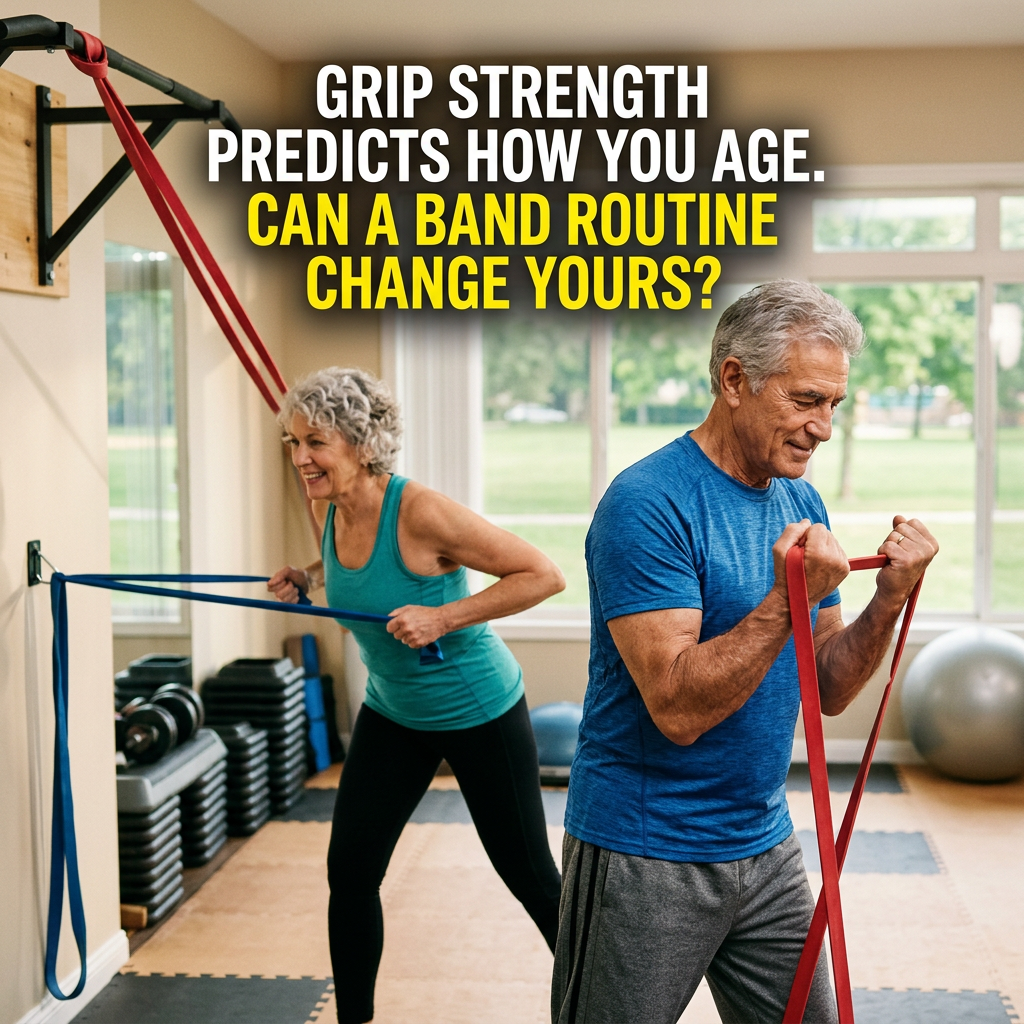
    Grip Strength Predicts How You Age. Can a Band Routine Change Yours?

    Can a resistance band routine build grip strength as you age?

    Short answer: Yes, a simple band routine can build grip strength. In a 2026 study, 82 women who averaged 75 years old did chair-based resistance band exercises for 12 weeks. The ones who trained three times a week built a lot more grip strength than the ones who trained twice, though they also did 50% more exercise each week.

    A surprising study shows what resistance bands can do for grip strength—and how a simple routine could help you stay stronger.

    Now here’s something worth knowing if you’ve got a resistance band stuck in a drawer somewhere, or you’ve been thinking about picking one up.

    Researchers worked with a group of women who averaged 75 years old. The ones who used resistance bands three times a week built a whole lot more grip strength than the ones who did it twice.

    And I don’t mean just a little bit more.

    Grip strength is one of those plain, simple things that says a good bit about how we’re aging. So let’s sit a spell and look at what they found, and what it might mean for the rest of us.

    The Study, in Plain English

    Published in 2026 in the European Review of Aging and Physical Activity, the study involved older women at geriatric centers in Serbia. Eighty-two women completed the 12-week program of chair-based resistance-band exercises.

    Both groups followed the same basic routine, targeting the hips, knees, shoulders, and trunk. The difference? One group exercised twice a week. The other exercised three times.

    After 12 weeks, both groups improved in several areas, including chair stands, arm curls, endurance, and flexibility. Both also reduced total and LDL cholesterol.

    But two results really stood out:

    • Grip strength increased 28% in the three-day group, compared with 7% in the twice-weekly group.
    • HDL (good) cholesterol increased 9% in the three-day group, compared with 1% in the twice-weekly group.

    Fasting glucose and triglycerides didn’t change much. Still, not bad for a chair and a few stretchy bands!

    One Important Thing to Remember

    Now before y’all go adding another workout day, there’s one thing worth knowing.

    The three-day group also performed 50% more exercise each week. That means researchers couldn’t determine whether the greater improvements came from exercising more frequently or simply doing more total work.

    And because there wasn’t a no-exercise comparison group, this study alone can’t tell us how much improvement was directly caused by the program.

    Still, the results are encouraging. Twice a week is a good place to start. If you’re comfortable adding a third session, it may offer additional benefits.

    Why Grip Strength Deserves Your Attention

    Think about how often you use your hands throughout the day: opening jars, carrying groceries, working in the garden, pushing yourself out of a chair, or grabbing something to steady yourself.

    We don’t always appreciate how important these everyday movements are until they become difficult. Researchers use grip strength as a quick, inexpensive way to assess aspects of overall muscle and nerve health.

    The landmark PURE study, published in The Lancet in 2015, followed approximately 140,000 adults across 17 countries. Researchers found that every 5-kilogram decrease in grip strength was associated with a 16% higher risk of death from any cause and a 17% higher risk of cardiovascular death.

    Those numbers will make you sit up, won’t they? But remember, grip strength is a health marker, not a crystal ball. A strong grip won’t promise you a longer life. What counts is keeping your muscles strong enough to stay active and keep doing for yourself.

    A Simple Resistance-Band Routine

    Want to give resistance bands a try? You don’t need anything complicated. Here’s a practical routine inspired by the study:

    1. Choose two or three nonconsecutive days a week. Monday, Wednesday, and Friday work nicely if you’re ready for three sessions.
    2. Warm up for 10 minutes. Try gentle marching in place, shoulder rolls, or easy movements.
    3. Aim for two sets of 12–15 repetitions using light-to-moderate resistance, with about a minute of rest between sets.
    4. Work your whole body. Try chair stands, seated rows, chest presses, biceps curls, band pull-aparts, hip hinges, triceps extensions, and side steps.
    5. Start with a light band. Increase resistance gradually as movements become easier.
    6. Finish with gentle stretching.

    You don’t have to master everything on the first day. Start with what feels comfortable, learn the movements, and build from there.

    A quick safety reminder: Inspect your bands for wear before using them. Stop if you experience sharp pain or dizziness. If you have arthritis, carpal tunnel syndrome, recent surgery, or balance difficulties, check with your healthcare professional before beginning.

    The original study used a supervised chair-based program, so this home routine is an adaptation rather than an exact copy.

    What You Need

    One basic set of resistance bands is enough to get started. Choose a set with several resistance levels so you can gradually increase the challenge. If flat bands are uncomfortable to grip, bands with handles may be easier to use.

    If you enjoy following a book, another option is Resistance Band Workout for Seniors by Fit Forever. It offers low-impact exercise ideas designed for older adults, with options for different experience levels.

    Resistance Band Workout for Seniors book cover

    Take a Look at Resistance Band Workout for Seniors

    Track Your Progress With Sturdy Years

    One of the most encouraging things about exercise is looking back and realizing how far you’ve come. Maybe you’re completing a few more repetitions. Maybe that light resistance band doesn’t feel quite so challenging anymore.

    That’s exactly the kind of progress our upcoming Sturdy Years Strength & Fitness app is being developed to help you track. The app is intended to help you record exercises, sets, and repetitions so you can follow your progress over time.

    It’s not available for purchase yet, but you can explore what’s coming on our Sturdy Years Apps & Store page.

    A Final Thought

    Here’s what I like most about this one. These women weren’t young athletes. They were regular folks averaging 75 years old, and they got measurably stronger just by showing up and doing the work.

    That’s good news at any age. You don’t have to jump in at three workouts a week or push past what feels right.

    Two sessions a week is a fine place to start. And if you add a third down the road, I reckon you might surprise yourself. Sometimes getting stronger starts with something as simple as picking up a resistance band.

    Other Voices Worth Following

    SilverSneakers — Offers fitness classes focused on strength, endurance, and fall prevention, including chair-based and resistance-tubing options.

    Kris Herbert, featured in Tom’s Guide — Shares a 15-minute resistance-band routine designed for adults over 70.

    Chris Tiley of Never Too Old To Lift — Offers practical advice and resistance-band exercises for older adults who want to build strength at home.

    Research Sources

    Purchases made through affiliate links on this page may earn Sturdy Years a commission at no additional cost to you.

    Keep Reading

    Your Turn

    Have you tried resistance bands, or would you give them a try? Do you prefer working out at home or at the gym? Tell me in the comments—I’d love to hear what works for you.

    About the Author

    Tom Green writes Sturdy Years. He was born in Pell City, Alabama, in 1962, and he’s a country boy and a true Southerner through and through. At 64, he shares practical research and everyday experiences about staying active, living well, and making the most of life after 50. He believes it’s never too late to keep learning and getting stronger.

    Tom is not a doctor or medical professional. This article is for general education, not personal medical advice. Check with your healthcare professional before starting a new exercise program, especially if you have an injury or health condition.

    I’ve also mapped out some great tools on my new Tech for Independent Living After 50 page.

  • Why Fall Might Be the Best Season to Get Serious About Fitness After 50

    Why Fall Might Be the Best Season to Get Serious About Fitness After 50

    Is fall a good time to start getting fit?

    Short answer: Fall is a great time to start, because the weather’s easier and you won’t be starting with the January crowd. Keep it simple this week: take a 10-minute walk on a nice day, and do one short strength session, standing up from a sturdy chair 5 to 10 times and doing a few wall push-ups.

    Fall has a way of making a fresh start feel possible. The sweltering days ease, the leaves change, and walking outside can become enjoyable again. If you’ve been telling yourself you need to get moving, why wait for January?

    After 50, getting fit isn’t about proving you can exercise like you’re 25. It’s about walking without getting winded, carrying groceries, climbing stairs, staying steady and having energy left for the people and activities you love.

    If you only do three things this week

    • Take a 10-minute walk on a day when the weather is nice. That’s it. Don’t make it a big production.
    • Do one short strength session: stand up from a sturdy chair 5 to 10 times, then do a few wall push-ups.
    • Put your next two walks on the calendar. A plan you’ve written down is much harder to skip.

    If that’s all you do, you’re already ahead of where you were last week.

    Why I’d start now instead of waiting for January

    Here’s the way I look at it. January is when everybody starts at once, the weather is cold and gray, and most of us are coming off the holidays feeling a little heavier and a lot less motivated. Fall gives you a head start. The weather is on your side, the days are still reasonably long, and you have a couple of months to build a habit before the holiday season gets busy.

    I’m in my 60s, and I work out to feel like a healthier me as I age. What I care about is being able to keep doing the everyday things without thinking twice. That’s the goal of everything in this post: simple, safe and repeatable.

    Cooler weather can remove one big excuse

    If you’ve ever tried walking through a Southern summer, you know heat and humidity can sap your enthusiasm quickly. Autumn often makes outdoor exercise more comfortable. The season itself isn’t a fitness shortcut: the benefit comes when pleasant conditions help you move consistently. Getting started now also gives you time to establish a habit before the busy holiday season.

    Stop thinking only about the scale

    Weight isn’t the only measurement that matters. Strength helps you rise from a chair and carry bags. Cardio builds endurance. Balance helps you move with confidence. The CDC’s older-adult activity guidance recommends that people 65 and older work toward at least 150 minutes of moderate aerobic activity weekly, muscle strengthening at least twice, and balance activities. Adults in their 50s and early 60s also benefit from cardio and strength work. Build gradually if you are returning after a break.

    If you want a simple way to check where your strength stands right now, try the floor test I wrote about in Can You Get Up From the Floor? What a Simple Test Reveals About Strength After 50. It’s a good “before” picture you can compare against in a couple of months.

    Make your next walk more interesting

    Walking doesn’t need an expensive app or a complicated plan. Matthew Solan offers practical ideas in Harvard Health’s “Step up your walking routine.” Rather than walking at the same pace every time, try three or four minutes at your comfortable pace followed by 30 seconds a little faster. You can also mark the faster stretches using mailboxes or telephone poles.

    Keep it safe: aim for an effort where you breathe more noticeably but can still speak. If you’re unsteady or have painful joints, stay on level ground and keep a comfortable pace. Progress isn’t a contest.

    Don’t let walking become your entire fitness plan

    Walking can strengthen your endurance, but it doesn’t cover every physical need. Erica Sweeney explains why in AARP’s “4 Types of Exercise You Need as You Age.” Strength, cardio, balance and flexibility serve different purposes. Relying exclusively on one can leave important gaps.

    Consider two short strength sessions a week, choosing movements suitable for your abilities: supported chair sit-to-stands, calf raises, resistance-band rows, wall push-ups or controlled exercises on gym machines. Start with manageable resistance and avoid exercises that aggravate an injury. The point is to become more capable, not to leave yourself too sore to move the next day.

    For more on which strength habits are worth your time, see 7 Strength Habits That Matter More After 60.

    Enjoy autumn scenery, but watch your footing

    Those beautiful fallen leaves can hide roots, potholes and slick pavement. Earlier sunsets can leave your favorite walking route poorly lit. In Harvard Health’s “Protect yourself from falls outside the home,” Heidi Godman shares physical therapist Barbara Ranucci’s advice about supportive, nonslip shoes, uneven terrain, weather and building leg and core strength for balance.

    Choose a familiar route with firm, even ground. Wear shoes with good grip, carry your phone, and walk in daylight when possible. If you have balance problems, seek guidance rather than testing yourself alone on a slippery path.

    A first week that won’t wear you out

    You don’t need to overhaul your entire life on Monday. Here’s a flexible starting point if you’re returning to activity:

    • Monday: Walk 10–15 minutes at a comfortable pace.
    • Tuesday: Do a short, gentle strength session.
    • Wednesday: Walk again; try brief faster intervals only if comfortable.
    • Thursday: Rest or stretch gently.
    • Friday: Complete a second strength session.
    • Saturday: Enjoy a park or another active outing.
    • Sunday: Recover and plan your next week.

    These are examples, not requirements. Five minutes may be the right starting point for some people. Increase gradually and speak with a qualified clinician about exercise restrictions if you have significant health conditions or injuries.

    What to do on the days you don’t feel like it

    There will be days when it’s chilly, it’s getting dark early, and the couch looks a lot better than a walk. That’s normal. On those days, don’t skip it completely. Just shrink it. Walk to the end of the street and back. Do five chair stands while the coffee brews. A small win keeps the habit alive, and the habit is what matters.

    Make movement the easy choice

    Motivation comes and goes, so don’t count on it. Put your walking shoes where you’ll see them, keep comfortable workout clothes ready, and leave any home equipment where you’ll actually use it. Then treat your walks and strength sessions like appointments: pick the day and time ahead of time.

    It also helps to make it enjoyable. Walk somewhere with changing leaves, listen to music or a podcast, take the dog, or meet a friend for a walk instead of another meal. If an activity feels good, you’re far more likely to keep doing it.

    And if you spend a lot of the day sitting, break it up. Stand up, walk around the house, or step outside for a few minutes. Small movement breaks add up.

    Consistency beats punishment

    One of the easiest ways to give up is to exercise so hard on day one that you dread day two. You don’t need to prove anything with painful soreness. A repeatable routine is more valuable than one heroic workout. Stop for sharp pain, dizziness, chest discomfort or unusual shortness of breath and seek appropriate care.

    Here’s the best thing about beginning in fall: when January finally rolls around, you might already have a habit rather than another resolution. Start with a walk. Add some strength. Practice safe balance work. Make it something you actually enjoy. That’s real progress after 50.

    Common Questions

    Is fall a good time to start exercising after 50?
    Yes. Cooler weather often makes walking and outdoor activity more comfortable, and starting in fall gives you a couple of months to build a habit before the holidays and winter.

    How much exercise do I need after 50?
    The CDC suggests older adults work toward about 150 minutes of moderate activity a week, plus muscle strengthening at least two days a week and balance activities. If you’re starting from scratch, begin with much less and build up gradually.

    Is walking enough exercise after 50?
    Walking is a great foundation, but it doesn’t do everything. Adding simple strength work, like chair stands and wall push-ups, helps you keep the muscle you need for everyday tasks.

    What’s the easiest way to start if I haven’t exercised in years?
    Start small: a 10-minute walk and a few chair stands. Do that consistently for two weeks before adding more. If you have health conditions or injuries, check with your healthcare professional first.

    How do I stay safe walking outside in the fall?
    Wear shoes with good grip, stick to familiar routes with even ground, walk in daylight when you can, and watch for wet leaves, roots and potholes. Carry your phone.

    How do I stay motivated when the days get shorter?
    Schedule your walks like appointments, walk earlier in the day, and on low-energy days do a shorter version instead of skipping. Small, regular wins keep the habit going.

    Keep Reading

    About the author

    Tom Green writes Sturdy Years. He was born in Pell City, Alabama, in 1962, and he’s a country boy and a true Southerner through and through. He’s just a regular, laid-back 64-year-old who keeps things simple. He shares what he learns about skincare, fitness and getting older, and what’s working for him. He’s also the author of A Practical Guide to Getting Older Without Giving Up on Yourself. Tom isn’t a doctor. He reads up on the research and passes along what’s useful, plain and simple.

    I’m not a doctor—I’m a man in my 60s sharing research and practical experience. This article is for general education, not individual medical advice.

    I’ve also mapped out some great tools on my new Tech for Independent Living After 50 page.

  • The Floor Test That May Predict Longevity: How to Score It and Improve It

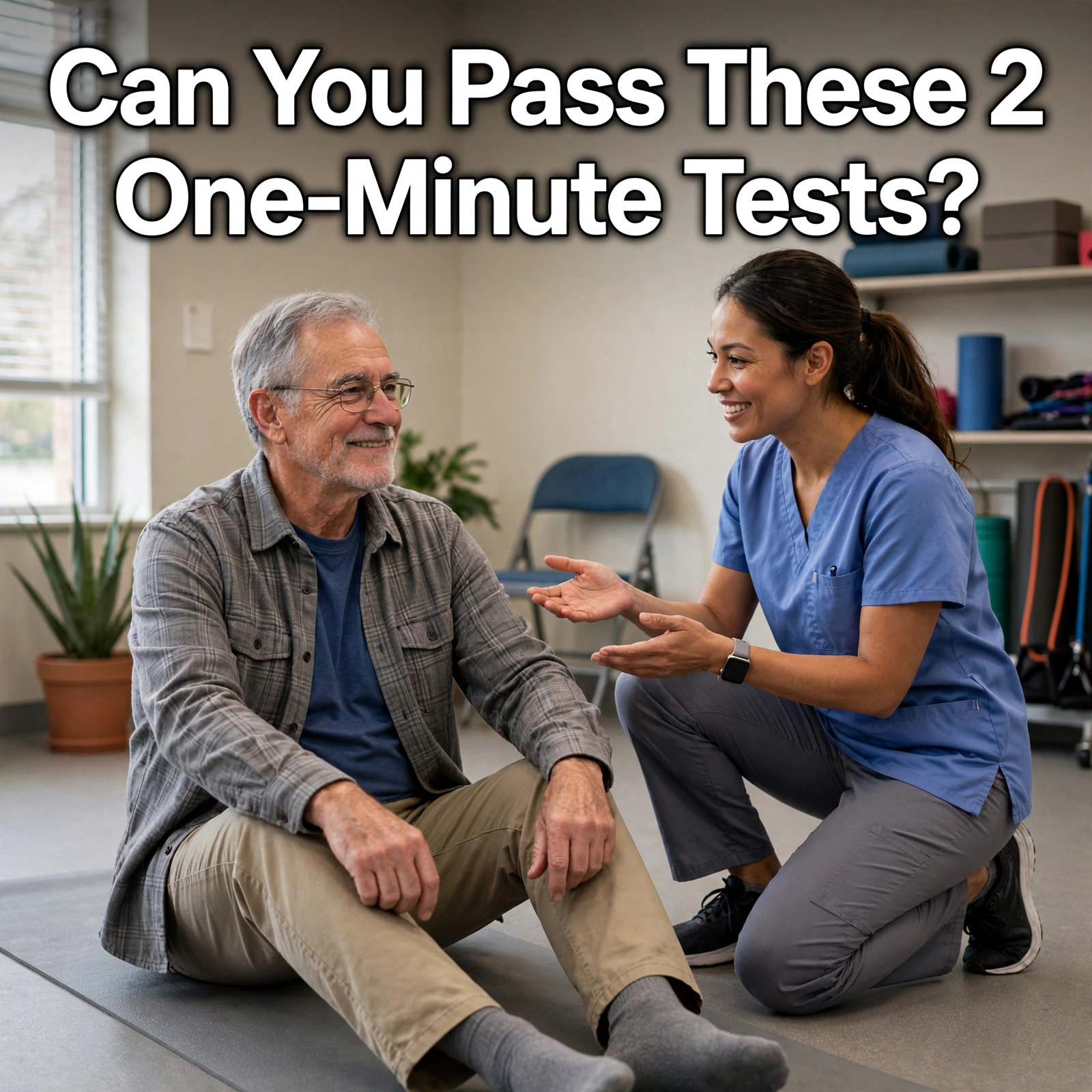
    The Floor Test That May Predict Longevity: How to Score It and Improve It

    Tom Green, Sturdy Years

    What is the floor test, and can it predict how long you’ll live?

    Short answer: The floor test, also called the sitting-rising test, scores how easily you sit down on the floor and get back up, from 0 to 10. In a 2025 study of 4,282 adults aged 46 to 75, people who scored 0 to 4 had about 3.8 times the risk of dying from natural causes as those who scored a perfect 10. The good news: you can raise your score.

    We keep a close eye on blood pressure and cholesterol. But when was the last time you checked how well you balance, or whether you can get up off the floor without a struggle?

    I’m 64, and I’ve noticed I’m more prone to accidental falls than I used to be. It’s not one thing. It’s a few different things, and it means I have to think ahead in situations where a fall could happen. Balance isn’t something I used to think about. Now I do, and that’s why the research of Dr. Claudio Gil Araújo caught my attention.

    Here’s what you’ll get from this article: two simple tests you can try at home, what the research really found (and what it didn’t), what other real writers and bloggers have said about these tests, and a gentle plan for getting steadier. I won’t pretend any test can predict your future, because none can.

    Please read this first: safety comes before any score. Do both tests next to something sturdy to grab, and don’t try them alone if you might fall. If you have dizziness, balance problems, recent surgery, a hip or knee replacement, or a history of falls, check with your doctor before you try either one.

    Who Is Dr. Claudio Gil Araújo?

    Dr. Araújo is a physician in exercise medicine. In 1994 he founded a clinic called CLINIMEX in Copacabana, Rio de Janeiro, and it has done more than 15,000 fitness evaluations since. He created the Sitting-Rising Test and a flexibility test called the Flexitest, and he led the 2022 research on the 10-second one-legged stance. He has published more than 250 papers, and his patients range from Olympic athletes to people recovering from heart surgery, which he says gives a more realistic picture than studies of healthy volunteers only.

    He studies what he calls non-aerobic fitness: muscle strength and power, flexibility, balance, and body composition. We usually think of fitness as walking, cycling, and getting the heart rate up. But these other abilities are what you use to get out of a chair, climb steps, pick something up, or catch yourself when you stumble. They are what keeps you independent.

    One note: each study below used its own group of patients, not all 15,000, and they all came from one clinic in Rio. The findings may not apply equally to everyone.

    Test 1: The 10-Second One-Leg Stand

    How to do it

    Stand right beside a counter or sturdy support you can grab.

    Arms at your sides, eyes on a spot straight ahead.

    Lift one foot and rest it behind the opposite calf.

    Hold for 10 seconds without putting that foot down.

    In his clinic, Dr. Araújo uses a force platform that tracks body sway. The pass-or-fail home version exists because almost nobody has that equipment, so please don’t treat your home result as a diagnosis.

    What the research found

    The study followed 1,702 people aged 51 to 75 for a median of about 7 years.

    Roughly 1 in 5 couldn’t hold the position for 10 seconds.

    About 17.5% of that group died during follow-up, compared with 4.6% of those who passed.

    After adjusting for age, sex, body mass index, and health conditions, the risk of death was about 84% higher for those who failed.

    In plain English: People who couldn’t hold the position were more likely to have died during the study, even after researchers accounted for some differences between them. That’s a reason to pay attention to balance. It is not a prediction about you. The link is an association, not proof that failing the test causes anything, and the study didn’t account for things like recent falls or activity level. Dr. Araújo told an interviewer the same thing: the link is partial, not proven cause and effect. He also said about 60% of 70-year-olds can hold the position for 10 seconds, so if you can’t, you are far from alone. He mentioned a 97-year-old patient who can still do it after exercising at his clinic for 30 years.

    What other writers say about the one-leg stand

    Alex Brooks, who writes the newsletter Dueto for women over 45, admits she only just passed the one-leg test after years of hot yoga, and says it was strength training that really helped. It’s honest, funny, and very relatable.

    Wellness coach Gillian Bogden, in a guest column on Heather Martin’s Tumbleweed newsletter, tested herself the second she read about the study, then tried to beat her age group. She also shares easy daily habits, like standing on one foot while you brush your teeth or putting on your socks and shoes one leg at a time.

    Personal trainer Jennifer Rizzuto, who works with seniors, explains how a single-leg balance test can help you think about fall risk and how long you should be able to hold it as you age.

    If you couldn’t make 10 seconds, don’t panic. TODAY’s Brianna Steinhilber shares easy ways to build up: start with a few seconds per leg, lightly rest the toe of your lifted foot for help, or touch a wall and lean on it less over time.

    And for a smile, the blogger at WorkersCompensation.com had some fun with this study, joking that a thousand readers would push away from their desks to see if they could stand on one leg. I’d bet you’ve already thought about trying it too.

    Test 2: The Sitting-Rising Test (the “Floor Test”)

    How to do it

    Stand barefoot on a firm, non-slip surface with a clear area of about 6 by 6 feet. Put a mat down.

    Have another person beside you, clear any obstacles behind you, and keep something sturdy within reach.

    Without rushing, sit down on the floor, then stand back up, using as much support as you need to stay safe. The goal is not to force a high score.

    How it’s scored: You start with 5 points for sitting and 5 for rising. You lose a point each time you use a hand, forearm, knee, or the side of your leg for support (yes, a hand on your knee counts), and half a point for a wobble. Crossing your legs is allowed. A perfect score is 10.

    Watch it done by the team that created the test

    Dr. Araújo kindly shared his team’s updated 2025 demonstration video for Sturdy Years readers. It shows how the test is done and how each point is scored.

    CLINIMEX: Sitting-rising test (SRT), an updated 2025 video

    He also pointed readers to the full research article, which you can read for free: the sitting-rising test study in the European Journal of Preventive Cardiology (free full-text PDF).

    What the research found

    A 2025 study followed 4,282 adults aged 46 to 75 for a median of about 12 years.

    Death rates ranged from 3.7% among people who scored 10 to 42.1% among those who scored 0 to 4.

    After adjustment, the lowest-scoring group had about 3.8 times the risk of death from natural causes and about 6 times the risk of cardiovascular death, compared with the highest-scoring group.

    An earlier 2014 study from the same research group had also linked these scores to the risk of dying.

    In plain English: The people who needed the most help getting down and back up tended to have worse outcomes over the following years. The test checks muscle power, strength, balance, flexibility, and body weight all in one movement, and it matches real life: picking up something you dropped, or getting down to play with your grandchildren. But scoring poorly doesn’t seal anyone’s fate.

    What other writers say about the floor test

    This is where I found the most honest takes, and they’re worth your time.

    Humorist Dave Barry tried the test in his bedroom, asked his neighbors to try it, and came away convinced a perfect score is unrealistic for most of us. It’s a funny reminder that science still has to make sense to real people.

    On her independent blog Fit Is a Feminist Issue, Catherine W. wrote about trying to get up off the floor and asked sharp questions. She pointed out that the lowest scorers were older on average than the highest scorers, that knee problems and arthritis will hurt your score at any age, and that sitting on the floor isn’t part of every culture. That’s a good attitude for all of us: take the science seriously, but ask what it really measures.

    Patrick Posten shows himself doing the test on his Substack, losing a point for every hand or shin he needs, and tells readers to try it and see how they score. It’s a good look at what a real, everyday attempt looks like.

    Certified trainer Ashley Blake Greenblatt walks through the test in the Philadelphia Inquirer and follows it with simple floor exercises, like glute bridges, to build the strength you need.

    Muscle Power May Matter More Than Strength

    Strength is how much force you can produce. Power is force plus speed. You use power when you rise from a chair, climb stairs, or move fast enough to catch your balance.

    A 2025 study of 3,889 adults aged 46 to 75, with about 11 years of follow-up, found roughly 5.9 times the risk of death in men and 6.9 times in women with the lowest relative muscle power compared with the highest. Handgrip strength alone did not show a statistically significant link in the same analysis. The numbers for women had wide margins of error, so take the exact figure with a grain of salt.

    In plain English: The ability to move with power seemed more closely tied to survival than grip strength alone. That doesn’t mean strength is unimportant, and it doesn’t mean training faster will extend your life. Dr. Araújo has observed that after about age 60 we tend to lose speed faster than we lose strength. His approach is to lift a weight fairly quickly and lower it under control, for about 6 to 8 repetitions. That isn’t for everyone, so if you’re new to resistance training or have injuries, work with a qualified trainer or physical therapist first.

    Flexibility: The Overlooked Piece

    The Flexitest checks 20 movements across seven joints for a score from 0 to 80. In a 2024 study of 3,139 adults aged 46 to 65, women scored about 35% higher than men, and lower flexibility was linked to higher mortality in both sexes.

    In plain English: More flexible people tended to have better survival odds in this group. That can’t tell us whether stretching more would itself help anyone live longer. In an interview, Dr. Araújo suggested flexibility may take as little as about 10 minutes a day to improve, far less than aerobic fitness takes. Think ankles, knees, hips, trunk, wrists, elbows, and shoulders, not just hamstrings, and never stretch into pain.

    What These Tests Do Not Mean

    The numbers can sound frightening without context. Here’s what I want you to remember:

    They show associations, not guarantees. A low score might reflect illness, frailty, or other factors.

    No study here proves that raising your score adds years to your life.

    The groups came from one clinic in Rio. Results may not apply equally to every community.

    Standing still isn’t the whole story of falling. Moving safely takes abilities these tests don’t fully measure.

    A low score is a reason to ask questions and work on what you safely can. It is not a verdict.

    How to Get Steadier Without a Gym

    Practice balance with support. If your doctor says it’s safe, try brief one-leg stands next to a counter with your hand on it, even while the microwave runs or you brush your teeth. Don’t add distractions if you’re unsteady.

    Practice getting up and down safely. If the floor test seems unsafe, start with supported chair movements, or ask a physical therapist for an adapted progression.

    Build controlled leg strength. With medical clearance, practice rising from a sturdy chair and sitting back down slowly.

    Move your joints gently. A few minutes of easy stretching goes a long way.

    A simple seven-day starter plan

    Day 1: Read the instructions and safety notes. Only attempt a test if it’s safe for you. Otherwise, pick one comfortable, supported movement to practice.

    Days 2 to 6: Supported balance practice if appropriate, plus about 10 minutes of gentle stretching.

    Days 3 and 5: Add a few slow, controlled chair stands if you can do them safely.

    Day 7: Notice what feels steadier. Retest only if it’s safe and you want to.

    One week won’t change your long-term health. A habit you can stick with will.

    If you lose points, work on the part that cost you

    • If you needed your hands or knees to get up, that usually points to leg strength. Slow chair stands are a good place to start: sit, stand up without using your hands, then sit back down slowly. Try 8 to 10 if it feels safe.
    • If you wobbled or lost your balance, practice the one-leg stand next to a counter with a hand on it. As you get steadier, use just a fingertip, then no hand.
    • If getting down or up felt stiff, spend a few minutes a day sitting cross-legged on a mat or firm cushion, with a sturdy chair or couch beside you, practicing the lowering and rising movement.

    None of this is a prescription. If you’re unsure what’s safe for you, a physical therapist can tailor it.

    Your Turn

    Can you stand on one leg for 10 seconds? If it’s safe for you to try, tell me how it went in the comments. And if you’ve ever struggled to get up off the floor, you are certainly not the only one. You might also enjoy my earlier article, Can You Get Up From the Floor? What a Simple Test Reveals About Strength After 50.

    Health note: I’m not a doctor. I’m a man in my 60s sharing personal experience and research that interests me. This article is general information, not medical advice. Please check with your clinician before trying these tests or starting an exercise program, especially if you have fallen, feel dizzy, have joint replacements or recent surgery, or have other health concerns. Do not risk a fall to earn a score.

    More Reading From Real People

    Alex Brooks (Dueto), “Why balance is brutal”

    Gillian Bogden, guest column on Tumbleweed with Heather Martin, “How Long Can You Stand on One Leg?”

    Dave Barry, “Aging Well”

    Catherine W., “The sit-rise test: trying to get up to save my life”

    Patrick Posten, “Scoring Well On This Test Could Extend Your Life”

    Jennifer Rizzuto, a personal trainer’s take on the single-leg balance test

    Ashley Blake Greenblatt, “What this one-minute fitness test can reveal about your health”

    Brianna Steinhilber on TODAY, the 10-second balance test and how to build up to it

    Credits: Dr. Claudio Gil Araújo and CLINIMEX (Clínica de Medicina do Exercício), Rio de Janeiro. Dr. Araújo’s interview comments come from a conversation with writer Eli Lichter for Medical Guardian (August 2026).

    About the Author

    Tom Green writes Sturdy Years. He was born in Pell City, Alabama, in 1962, and he’s a country boy and a true Southerner through and through. He’s just a regular, laid-back 64-year-old who keeps things simple. He shares what he learns about skincare, fitness and getting older, and what’s working for him. He’s also the author of A Practical Guide to Getting Older Without Giving Up on Yourself. Tom isn’t a doctor. He reads up on the research and passes along what’s useful, plain and simple.

    I’ve also mapped out some great tools on my new Tech for Independent Living After 50 page.

  • After 50, You’re Losing Muscle Every Year. Here’s How to Get It Back.

    After 50, You’re Losing Muscle Every Year. Here’s How to Get It Back.

    Can you get back muscle you’ve lost with age?

    Short answer: Yes, you can get muscle back, even in your 80s. Older adults who do resistance training gain strength, muscle and everyday function. Start with strength training two or more days a week, with one or two sets of about 8 to 12 slow reps, and eat enough protein to help your body repair and keep muscle.

    Getting up out of a chair shouldn’t feel like a workout. Carrying groceries shouldn’t leave you struggling. And climbing stairs shouldn’t make you wonder when everyday life got so much harder.

    If you’re over 50 and noticing changes like these, it’s worth paying attention. One possible reason is sarcopenia, the medical term for age-related loss of muscle strength and muscle mass. The encouraging news: people can improve strength at many ages, and practical habits can help protect mobility and independence.

    You don’t need to become a bodybuilder, spend a fortune on supplements, or live at the gym. A sensible strength routine, nutritious food, regular movement, and recovery are a useful place to start.

    Why Muscle Loss After 50 Deserves Your Attention

    Muscles change as we age. Muscle mass and strength can decline, although the pace varies from person to person. The concern isn’t simply how your arms and legs look in the mirror; it’s whether weakness begins to affect everyday life.

    Your muscles help you stand, walk, climb stairs, carry shopping bags, maintain balance, and respond to physical challenges. Significant declines in strength and function can make falls and independent living greater concerns.

    Muscle isn’t just about appearance. It’s part of what helps you remain capable, active, and independent. Aging doesn’t automatically mean becoming weak. Resistance training is an important way to improve strength and support physical function.

    For a medical overview, read the National Institutes of Health article Slowing Sarcopenia.

    The Science Says You Can Get Stronger — Even in Your 80s

    Older adults can respond to resistance training with improvements in strength, muscle mass, and physical function. Results vary, and exercise won’t reverse every cause of weakness, but age alone isn’t a reason to give up.

    Protein matters because your body uses it to maintain and repair muscle tissue. Getting enough protein alongside appropriate exercise can support muscle health. Be cautious of claims that one powder, pill, or supplement will solve muscle loss on its own.

    For additional background, see the International Clinical Practice Guidelines for Sarcopenia.

    Real People Are Showing That It’s Not Too Late to Get Stronger

    1. A woman who started lifting at 65

    Women’s Health featured Shelly Stettner, who began barbell training just before her 65th birthday. By age 73, she had become a competitive powerlifter and could squat 250 pounds. Her achievement is exceptional, and nobody needs to lift that much to benefit from strength training. The useful lesson is that she didn’t assume age meant she had to stop getting stronger.

    Read her story in Women’s Health.

    2. A fitness coach adapting his training after 50

    Men’s Health interviewed fitness coach Bryan Krahn about adapting training as the body ages. A good routine isn’t necessarily one that leaves you exhausted or encourages you to push through pain. Training should account for your experience, recovery, physical limitations, and goals.

    Read the Men’s Health interview.

    3. A personal account of getting stronger after 50

    The blog Muscle Log offers a personal perspective on pursuing strength after 50. Not everybody wants to compete in powerlifting. Success might mean carrying groceries more comfortably, feeling steadier on your feet, or finding that an everyday task has become easier.

    These stories don’t prove that everyone can reverse every form of muscle loss. They do show why it’s worth considering safe, realistic ways to keep building strength.

    Your Six-Step Action Plan to Fight Muscle Loss

    1. Start strength training two or more days a week

    You don’t need a gym membership to begin. Choose movements that challenge your muscles safely and can be adapted to your current ability.

    • Sit-to-stands: Stand up from a sturdy chair and sit down slowly. Use your hands for assistance if needed.
    • Wall push-ups: Place your hands against a wall and bend and straighten your elbows under control.
    • Resistance-band rows: Pull a securely anchored band toward your body.
    • Supported calf raises: Hold a sturdy support and slowly raise and lower your heels.
    • Light dumbbell exercises: Choose suitable movements for your major muscle groups.

    One or two sets of around 8–12 controlled repetitions may be a reasonable starting point for many people, depending on the exercise and their abilities. Increase resistance or repetitions gradually as exercises become easier. You don’t need to push to exhaustion. If you have balance problems, medical conditions, or are new to exercise, ask a healthcare professional about a safe starting plan.

    2. Eat protein throughout the day

    Protein provides building blocks your body uses to maintain and repair muscle. You can get it from everyday foods rather than relying on expensive powders.

    • Breakfast: Eggs, Greek yogurt, or cottage cheese.
    • Lunch: Chicken, tuna, beans, or lentils.
    • Dinner: Fish, turkey, tofu, lean meat, or beans.
    • Snacks: Yogurt, a hard-boiled egg, or nuts alongside other nutritious foods.

    Try to include a protein-rich food at each meal. The right amount depends on body size, activity, overall diet, and health. If you have kidney disease or have been advised to limit protein, ask your healthcare professional what is appropriate. More isn’t automatically better.

    3. Keep moving every day

    Walking, gardening, dancing, cycling, and other activities you enjoy support general health and mobility. Walking alone usually doesn’t provide the same muscle-building stimulus as resistance training, so include both when appropriate.

    For adults 65 and older, CDC guidance recommends at least 150 minutes of moderate-intensity aerobic activity weekly, muscle-strengthening activity on at least two days, and activities that improve balance. Adapt activity to your abilities and health conditions. Read the CDC guide to physical activity for older adults.

    4. Pay attention to balance

    Strength and balance work together to help you move safely. Practise near a sturdy support and don’t attempt challenging movements if you’re unsteady or at risk of falling. Gentle tai chi or supervised balance training may be options. If your balance has recently worsened or you’ve fallen, speak with a healthcare professional.

    5. Don’t ignore nutrition or vitamin D

    Vitamin D plays a role in bone and muscle function. Low levels can be associated with weakness, but taking extra vitamin D isn’t a guaranteed treatment for sarcopenia. Ask your healthcare professional whether testing or supplementation makes sense for your situation, and be cautious with supplements that may interact with medication.

    Been hearing folks talk about NMN supplements for energy and aging? I dug into what the studies really show here: Been Hearing About NMN Supplements? Would It Work for You After 50?

    6. Make sleep and recovery part of your plan

    Your body needs time to recover from exercise. Many adults do well aiming for around seven to nine hours of sleep, though individual needs vary. Allow recovery between challenging workouts and don’t keep increasing exercise if you’re persistently exhausted or in pain. Consistency over months matters more than one perfect week.

    Five Questions to Help You Check In With Yourself

    These questions aren’t a diagnostic test, but they may help you notice changes worth discussing with a healthcare professional.

    1. Has getting out of a chair become noticeably harder?
    2. Can you carry your usual groceries comfortably?
    3. Have walking or climbing stairs become more difficult?
    4. Are you eating enough nutritious food, including protein?
    5. Have you stopped doing strength-building activities? If so, could you safely begin a manageable routine?

    A chair-stand assessment can help trained professionals evaluate lower-body strength and physical function, but a simple home test cannot diagnose sarcopenia. If you have mobility or balance problems, don’t attempt a challenging test without suitable support.

    What If You’ve Already Lost a Lot of Muscle?

    Don’t panic, but don’t ignore significant changes. If you’ve become noticeably weaker, lost weight without trying, started falling, or found everyday activities increasingly difficult, make an appointment with your healthcare professional.

    Muscle loss can be related to inactivity or nutrition, but weakness can also result from medication effects, illness, nerve problems, and other medical conditions. A clinician can assess your strength and physical function and decide whether further evaluation is needed.

    The Bottom Line: Your Independence Is Worth Protecting

    Muscle loss after 50 isn’t something to be ashamed of, and it isn’t a reason to give up on yourself. You may not be able to prevent every change that comes with aging, but you can take meaningful steps to support strength and physical function.

    Train your muscles. Eat nutritious food. Stay active. Work on balance. Get enough recovery. Pay attention to changes that may need medical attention. You don’t have to spend a fortune or transform yourself overnight. Start with one manageable step and build from there.

    Getting older is inevitable. Giving up on your strength doesn’t have to be.

    What about you?

    Have you noticed changes in your strength since turning 50? Have you found an exercise or everyday habit that helped you feel stronger? Share your experience in the comments. Your story might help someone else take that first step.

    Medical disclaimer

    This article is for educational purposes and isn’t a substitute for individual medical advice, diagnosis, or treatment. If you have unexplained muscle loss, persistent weakness, repeated falls, or difficulty with everyday activities, speak with a healthcare professional before starting a new exercise programme.

    Written by Tom Green, creator of Sturdy Years

    Tom Green writes Sturdy Years. He was born in Pell City, Alabama, in 1962, and he’s a country boy and a true Southerner through and through. He’s just a regular, laid-back 64-year-old who keeps things simple. He shares what he learns about skincare, fitness and getting older, and what’s working for him. He’s also the author of A Practical Guide to Getting Older Without Giving Up on Yourself. Tom isn’t a doctor. He reads up on the research and passes along what’s useful, plain and simple.

    Sources and further reading

    Sturdy Years — Look better. Feel stronger. Age well.

    I’ve also mapped out some great tools on my new Tech for Independent Living After 50 page.

  • The Best Exercises for Staying Independent as You Get Older

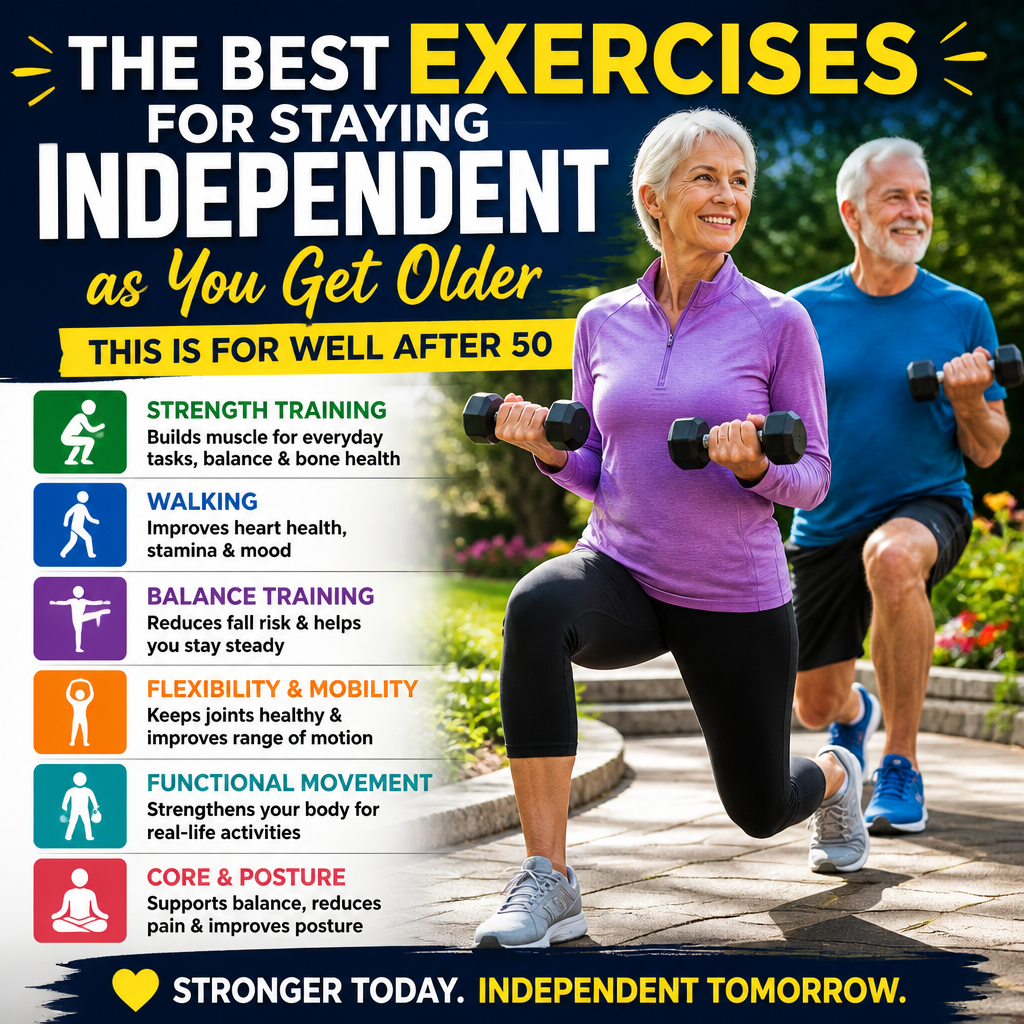
    The Best Exercises for Staying Independent as You Get Older

    What are the best exercises for staying independent as you get older?

    Short answer: The best exercises for staying independent are the ones that train everyday life: strength training first, then practicing getting up and sitting down, walking, and balance work. Together they help you get up from the floor, climb stairs and carry your own groceries for years to come.

    There is a difference between getting older and feeling like your world is getting smaller.

    Maybe you have already noticed it in little ways. A flight of stairs feels different. Getting up from a low chair takes more effort. Carrying groceries from the car is not quite as easy as it used to be. You may not think of these things as fitness problems. They are really independence problems.

    That is why the best exercise after 50 is not necessarily the exercise that burns the most calories or makes you sweat the hardest.

    The best exercise is the kind that helps you keep doing your own life.

    Think about the life you want your body to handle

    Instead of asking, “What exercise should I do to look better?” try asking:

    • Can I get up from the floor if I need to?
    • Can I climb stairs without feeling defeated?
    • Can I carry my groceries?
    • Can I walk through an airport, museum or shopping center?
    • Can I get out of a chair without using my hands?
    • Can I keep traveling, working around the house and doing the things I enjoy?

    Those are not vanity questions. They are freedom questions.

    1. Strength training may be the most important place to start

    Muscle does not disappear simply because we reach a certain birthday, but muscle and strength can decline with age when we are inactive. The good news is that the body can respond to resistance training well into later life.

    You do not have to become a bodybuilder. Sit-to-stands, resistance bands, machines, dumbbells, wall push-ups and other simple movements can help.

    Think about training the muscles you use to live: legs, hips, back, chest, shoulders and arms.

    2. Practice getting up and sitting down

    This sounds almost too simple to count as exercise. It counts.

    Standing from a chair without pushing off with your arms trains the legs and hips in a movement you actually use. Start with a sturdy chair and use your hands if you need to. Over time, work toward smoother, stronger repetitions.

    3. Walk for the life outside the gym

    Walking is wonderfully unglamorous—and that is part of its strength. It is accessible, easy to repeat and useful for building endurance.

    You can walk around your neighborhood, inside a store, on a treadmill or with a friend. The goal is not to prove anything. The goal is to make movement part of ordinary life.

    4. Do not ignore balance

    Balance deserves attention because a strong body still needs to know where it is in space.

    Simple balance practice might include standing near a counter and briefly standing on one leg, walking heel-to-toe, or practicing controlled sit-to-stands. Use support when needed and do not turn balance work into a dare.

    5. Train your ability to push, pull, carry and reach

    Real life is full of awkward little strength tests. Opening a stubborn door. Lifting a bag. Reaching for something on a shelf. Carrying laundry. Moving a box.

    Your workout does not need to copy these tasks perfectly, but it should prepare your body for them.

    A simple week can be enough to make a difference

    • 2 days: strength training for the major muscle groups
    • Most days: some walking or other aerobic activity you enjoy
    • Several times a week: brief balance practice
    • Every day: look for opportunities to sit less and move more

    CDC guidance for adults 65+ recommends aerobic activity, muscle-strengthening activity at least two days a week, and balance activities. You do not have to jump straight into the full recommendation. Start from where you are and build gradually.

    The goal is not to become 30 again

    This may be the most important part.

    You are not exercising to erase your age. You are exercising so your age does not unnecessarily erase parts of your life.

    You want to be the person who can say yes when someone suggests a day trip. You want to carry your own bags. You want to get out of a chair without thinking about it. You want enough strength and balance to keep making your own choices.

    That is what fitness after 50 can really be about: keeping your world open.

    Common Questions

    What is the best exercise after 50?

    A combination of strength, aerobic activity and balance is more useful for healthy aging than relying on one type of exercise alone.

    Can I start strength training if I have never lifted weights?

    Yes. Start with manageable resistance, controlled movements and gradual progress. If you have a medical condition or significant physical limitation, ask your health professional what is appropriate.

    Do I have to exercise every day?

    No. Consistency matters more than perfection. Regular movement spread across the week is a practical goal.

    Can walking really help me stay independent?

    Walking can improve endurance and physical activity levels, while strength and balance work address other abilities needed for everyday independence.

    Keep Reading

    For more practical healthy-aging ideas, explore Sturdy Years.

    About Tom Green

    Tom Green writes Sturdy Years. He was born in Pell City, Alabama, in 1962, and he’s a country boy and a true Southerner through and through. He’s just a regular, laid-back 64-year-old who keeps things simple. He shares what he learns about skincare, fitness and getting older, and what’s working for him. He’s also the author of A Practical Guide to Getting Older Without Giving Up on Yourself. Tom isn’t a doctor. He reads up on the research and passes along what’s useful, plain and simple.

    Sources & Proof

    CDC: Older Adult Activity Guidelines
    National Institute on Aging: Health Benefits of Exercise and Physical Activity
    National Institute on Aging: Types of Exercise and Physical Ability

    Safety note: Start at a level appropriate for your current ability. Stop if you develop unusual pain, dizziness, chest pressure, severe shortness of breath or other concerning symptoms, and seek medical advice when appropriate.

    I’ve also mapped out some great tools on my new Tech for Independent Living After 50 page.