Tag: wellness routine

  • 5 Signs You Might Need a Mental Health Day After 50

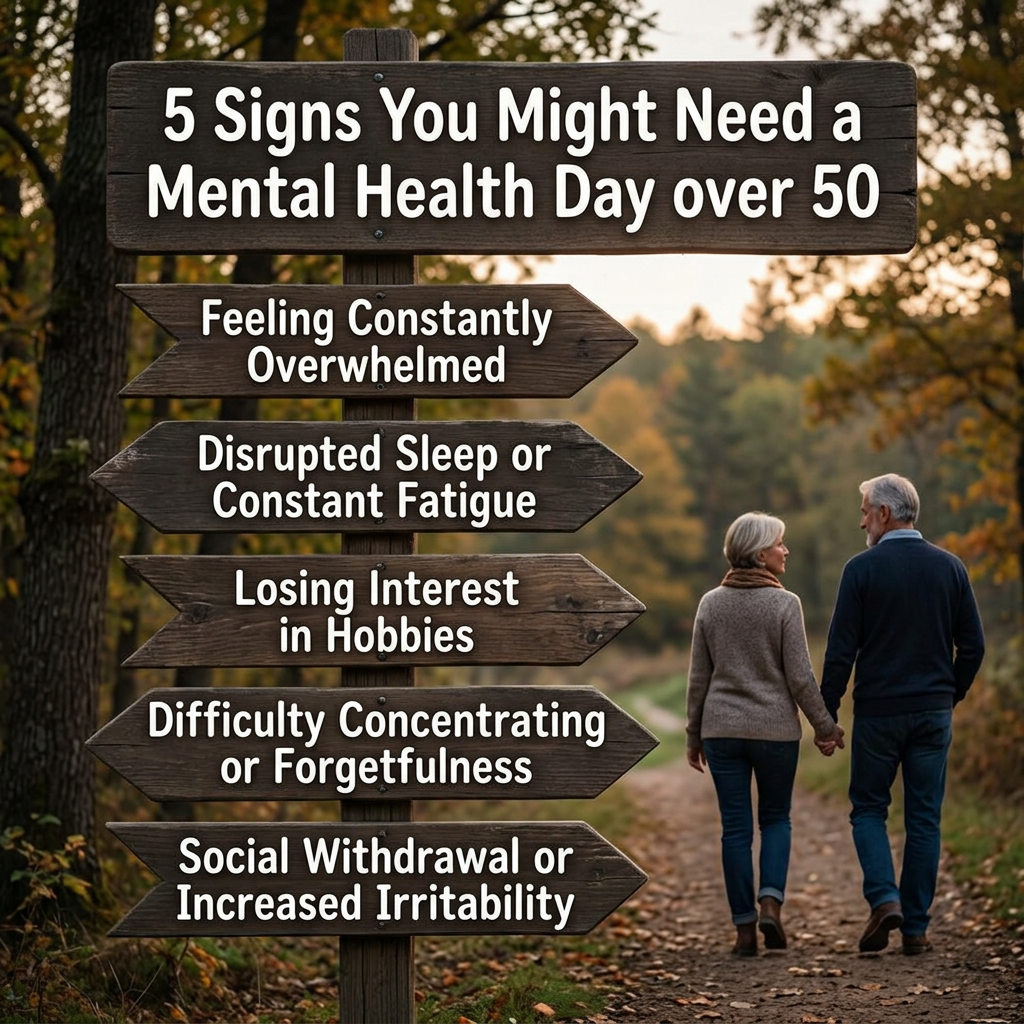
    5 Signs You Might Need a Mental Health Day After 50

    How do you know you need a mental health day?

    Short answer: You might need a mental health day if you’re more irritable than usual, everything feels like a chore, your brain won’t shut off, you’re worn out even after sleeping, or you just want to get away from everyone. A day to rest and reset can help, but it’s no substitute for professional help if those feelings stick around.

    Everyone has days when life feels like too much. Work, family responsibilities, everyday stress, poor sleep, and simply having too much on your mind can leave you feeling worn down.

    A mental health day can be a simple way to pause, reset, and give yourself some breathing room. It is not a cure for a mental health condition, but it can be a useful form of self-care when you recognize that you are running on empty.

    5 Signs You Might Need a Mental Health Day After 50

    1. You Are More Irritable Than Usual

    If little things that normally would not bother you suddenly get under your skin, it may be a sign that you are mentally overloaded.

    Stress can affect your mood and patience. If you find yourself snapping at people, feeling unusually frustrated, or having a much shorter fuse than normal, a day to slow down may be worthwhile.

    2. Everything Feels Like a Chore

    When even simple tasks seem exhausting, pay attention. You may still be getting everything done, but it feels like you are forcing yourself through every part of the day.

    There is an important difference between occasionally having a lazy day and feeling persistently drained or losing interest in things you normally enjoy. If that loss of interest continues or starts interfering with everyday life, it is worth talking with a health professional rather than simply taking a day off.

    3. Your Brain Will Not Shut Off

    You sit down to relax, but your mind keeps going. You replay conversations, worry about tomorrow, think about unfinished tasks, or jump from one concern to another.

    A mental health day can give you permission to step away from the constant pressure to accomplish something. A quiet morning, a walk outside, reading, or another relaxing activity may help you create some mental space.

    4. You Feel Mentally Exhausted Even After Sleeping

    Sometimes your body gets enough time in bed but your mind still feels completely worn out.

    Stress and poor-quality sleep can leave you feeling foggy, tired, and unable to concentrate. If fatigue is new, severe, persistent, or unexplained, do not assume it is simply stress. Sleep problems and many physical health conditions can also cause fatigue and deserve proper attention.

    5. You Want to Get Away From Everyone

    Wanting a little quiet time is perfectly normal. But if you suddenly stop wanting to see people, answer messages, participate in hobbies, or do things you normally enjoy, take notice.

    Sometimes a little solitude is exactly what you need. But ongoing social withdrawal can also be associated with depression, anxiety, or other mental health concerns. The key is to notice whether you are taking a healthy break or gradually pulling away from life.

    What Should You Actually Do on a Mental Health Day?

    You do not need an elaborate plan. The goal is to reduce pressure and give your mind some room to recover.

    • Start slowly. Give yourself permission not to rush through the morning.
    • Get outside. A walk, sitting in the sunshine, or simply spending time in nature can make a day feel different.
    • Put the phone down for a while. Constant notifications and scrolling can keep your brain switched on.
    • Do something you genuinely enjoy. Read, listen to music, work on a hobby, cook something you like, or simply relax.
    • Do not feel guilty about resting. Rest is not wasted time. Sometimes it is exactly what you need to get back to feeling like yourself.

    A Mental Health Day Is Not a Substitute for Professional Help

    A mental health day is best thought of as a short pause, not a replacement for treatment. If sadness, anxiety, hopelessness, loss of interest, sleep problems, fatigue, difficulty concentrating, or other symptoms are persistent or are interfering with your everyday life, talk with a doctor or qualified mental health professional.

    If you are in immediate emotional distress or thinking about harming yourself, call or text 988 in the United States to reach the Suicide & Crisis Lifeline, or call 911 for an emergency.

    For thoughtful writing about later-life wellbeing and the emotional side of aging, Next Avenue offers reporting and resources on mental health, aging, and finding support when life feels overwhelming. Persistent or severe symptoms deserve support from a qualified professional.

    Common Questions About Taking a Mental Health Day After 50

    What is a mental health day?

    A mental health day is a planned break from normal responsibilities so you can rest, decompress, and take care of your emotional well-being.

    How do I know if I really need one?

    If you are unusually irritable, mentally exhausted, overwhelmed, unable to relax, or simply feel like you need to step away from the usual routine, a day of rest may help. If symptoms are persistent or getting worse, seek professional advice instead of relying only on time off.

    Should I spend my mental health day alone?

    That depends on what you need. Some people benefit from quiet time alone, while others feel better talking with a trusted friend or spending relaxed time with family. Choose what feels restorative rather than what you think you are supposed to do.

    Should I stay in bed all day?

    Rest is fine, but staying in bed all day is not necessarily the most helpful choice. Getting up, eating normally, getting some daylight, moving gently, and doing one enjoyable thing can make the day feel more restorative.

    When should I talk to a professional instead of taking a mental health day?

    If symptoms last, become severe, interfere with daily life, or make it difficult to function, talk with a doctor or mental health professional. A mental health day can provide a pause, but it should not replace appropriate care.

    I suggest this for a great fun read work your mind:

    About the Author

    Tom Green writes Sturdy Years. He was born in Pell City, Alabama, in 1962, and he’s a country boy and a true Southerner through and through. He’s just a regular, laid-back 64-year-old who keeps things simple. He shares what he learns about skincare, fitness and getting older, and what’s working for him. He’s also the author of A Practical Guide to Getting Older Without Giving Up on Yourself. Tom isn’t a doctor. He reads up on the research and passes along what’s useful, plain and simple.

    Sources

    For general information about mental health, symptoms, stress, and when to seek help, see the National Institute of Mental Health and the Centers for Disease Control and Prevention.

    Image Attribution

    Featured image: Original image created for Sturdy Years.

    I’ve also mapped out some great tools on my new Tech for Independent Living After 50 page.

  • The Simple Morning Routine That Can Make You Look and Feel Better After 50

    The Simple Morning Routine That Can Make You Look and Feel Better After 50

    What’s a good morning routine to look and feel better as you age?

    Short answer: A good morning routine after 50 doesn’t need to be 90 minutes. Give yourself a few minutes to wake up, get some daylight and movement, take care of basics like your skin, eat and drink what your body needs, and decide what actually matters today.

    My ideal morning after 50 is not a 90-minute checklist that makes me feel guilty if I skip one step. I want a routine that wakes me up, gets my body moving, takes care of my skin and gives the day some direction.

    The best morning routine is the one that helps the rest of the day go better.

    1. Give yourself a few minutes to wake up

    I do not think every body wants to go from the bed straight into a hard workout. Get up, move around and let yourself become fully awake before demanding much from your body.

    2. Get some daylight and movement

    Open the blinds, step outside or take a short walk. Even a few minutes of movement can be a useful transition from sleep to the day.

    You do not need to complete your entire exercise program before breakfast. Strength training can happen later. The goal here is simply to stop the morning from becoming another long period of sitting.

    3. Take care of the basics

    Wash your face if you need to. Moisturize if your skin is dry. Use sunscreen when you will be exposed to daylight. Brush your teeth and take care of the ordinary things that make you feel put together.

    4. Eat and drink according to your needs

    There is no universal breakfast rule that works for everyone. Some people prefer breakfast early; others do not. What matters is that your overall diet provides enough nutritious food and that you are not routinely ignoring hunger and then trying to power through the day.

    And if your morning cup could use a change of pace, there are some good ones out there. More Than Matcha makes matcha you can whip up in about a minute, and Azomalli Tea has a cacao shell tea with a nice chocolatey taste. (affiliate links)

    5. Decide what actually matters today

    This may be my favorite part. Pick one useful thing that needs to happen. It might be a workout, an errand, work, a phone call or simply getting outside.

    A morning routine should create momentum, not another opportunity to feel like you failed.

    What I don’t put on the list

    I do not believe you need a complicated supplement stack, a dozen skincare products or an extreme morning workout to have a healthy morning.

    Simple habits repeated most days beat a perfect routine that lasts a week.

    My morning goal after 50

    I want to start the day feeling awake, reasonably cared for and ready to move. That is enough.

    Common Questions

    What should a simple morning routine look like after 50?
    Keep it practical: wake up, hydrate, move your body, eat a nutritious breakfast if you eat in the morning, take care of your skin, and get ready for the day.

    What should you do first in the morning after 50?
    Start with something simple such as drinking water, getting some natural light, and moving around rather than immediately sitting down.

    Can a morning walk help you feel better after 50?
    Yes. A morning walk can help you get moving, support physical activity, and start the day with a positive routine.

    Should you exercise in the morning after 50?
    You don’t have to exercise first thing. The best time is one that fits your schedule and that you can maintain consistently.

    What should you eat in the morning after 50?
    Focus on nutritious foods that provide protein, fiber, fruits or vegetables, and other foods that fit your individual needs.

    Can a simple skincare routine make you look better after 50?
    Yes. Gentle cleansing or rinsing, moisturizer, and broad-spectrum sunscreen can help keep your skin comfortable and protected.

    Why is sunscreen important in a morning routine after 50?
    Daily broad-spectrum sunscreen helps protect your skin from UV exposure, one of the major contributors to visible skin aging.

    Can getting outside in the morning help after 50?
    Getting some natural light and moving outdoors can be a simple way to make your morning more active and enjoyable.

    Do you need a complicated morning routine after 50?
    No. A routine you can actually follow every day is more useful than a long list of things you rarely do.

    What is the simplest morning routine after 50?
    Water → natural light → movement → nutritious food → skincare → sunscreen → get on with your day.

    Practical takeaway: Don’t try to completely reinvent your mornings. Pick a few habits that make you feel better and repeat them consistently.

    A gentle health note: If you have medical conditions, significant pain, dizziness, or other limitations, adjust your activity appropriately and talk with a healthcare professional before making major changes to your exercise routine.

    This is my practical approach based on personal experience and general healthy-aging information, not medical advice.

    About Tom Green

    Tom Green writes Sturdy Years. He was born in Pell City, Alabama, in 1962, and he’s a country boy and a true Southerner through and through. He’s just a regular, laid-back 64-year-old who keeps things simple. He shares what he learns about skincare, fitness and getting older, and what’s working for him. He’s also the author of A Practical Guide to Getting Older Without Giving Up on Yourself. Tom isn’t a doctor. He reads up on the research and passes along what’s useful, plain and simple.

    Keep Reading

    I’ve also mapped out some great tools on my new Tech for Independent Living After 50 page.

  • Self-Care After 50: A Simple Daily Routine That Actually Helps

    Self-Care After 50: A Simple Daily Routine That Actually Helps

    What’s a simple self-care routine that actually helps?

    Short answer: Self-care after 50 doesn’t have to cost a fortune. Start your day by moving your body, eat like your body still matters, keep skincare simple, make sleep a priority, keep the doctor’s appointments you’ve been putting off, and protect your mind and your relationships. Fellas, this goes for you too.

    Self-care gets made to sound much more complicated than it needs to be. After 50, you can spend a fortune on products, appointments and wellness gadgets and still overlook the things that make the biggest difference in how you feel every day.

    For me, a useful self-care routine is less about pampering and more about maintenance. Take care of your body. Take care of your skin. Give your mind some breathing room. And don’t keep putting off the health stuff because it is inconvenient.

    The good news is that none of this requires a perfect schedule. You need a routine you can actually repeat.

    Start Your Day With Your Body

    You don’t have to wake up at 5 a.m. and complete a ten-step wellness routine. Start with movement.

    A walk, some light mobility work, a workout or simply getting up and moving around regularly can help keep your body from becoming increasingly sedentary. If strength training is appropriate for you, it deserves a place in the routine too because maintaining muscle becomes increasingly important as we get older.

    The goal isn’t to punish yourself for getting older. It is to keep giving your body a reason to stay capable.

    Eat Like Your Body Still Matters

    This sounds obvious, but it is easy to get careless with food when life gets busy. Skipping meals, living on snacks or relying on highly processed convenience foods can leave you feeling like you have no energy.

    Try to build meals around foods that actually give you something: adequate protein, vegetables and fruit, whole grains or other high-fiber foods, and healthy sources of fat. You don’t have to eat perfectly. Consistency matters more than chasing a flawless diet.

    Don’t Treat Skincare Like a Beauty Emergency

    Skin changes after 50. It can become drier, thinner and less forgiving when you overdo products. That doesn’t mean you need an entire shelf of anti-aging treatments.

    A simple routine can be enough for many people: gentle cleansing, moisturizer when you need it, and sun protection during the day. If you use active ingredients such as retinoids or exfoliating acids, introduce them thoughtfully rather than piling everything on at once.

    And remember that skincare isn’t just for women. Men deal with dryness, sun damage, wrinkles and changing skin too.

    Make Sleep Part of Self-Care

    Sleep is one of those things people often sacrifice first and try to fix with coffee the next morning.

    A regular sleep schedule, a reasonably comfortable sleep environment and a wind-down period can help. If you regularly have trouble sleeping or feel exhausted despite getting enough time in bed, that’s worth discussing with a healthcare professional rather than simply buying another supplement.

    Take Care of the Appointments You’ve Been Avoiding

    This may be the least glamorous part of self-care, but it matters.

    Keep up with recommended health screenings and routine appointments for your age and personal health history. Get persistent symptoms checked instead of deciding they are simply part of aging. Stay on top of dental and vision care too.

    Self-care is not only about how you look in the mirror. It is also about paying attention when something changes.

    Protect Your Mind, Too

    There is a difference between being busy and feeling fulfilled. After 50, it can be easy to let work, family obligations, responsibilities and other people’s expectations consume all the available space.

    Make room for things you actually enjoy. Call a friend. Spend time outside. Read. Listen to music. Work on a hobby. Take the dog for a walk. Whatever gives you a genuine break from the constant list of things that need doing.

    You don’t have to justify every enjoyable thing by making it productive.

    Self-Care Includes Relationships

    Staying connected matters. That doesn’t mean you need a huge social circle. A few people you can laugh with, talk honestly with or simply spend time around can be more valuable than hundreds of online connections.

    If you have been withdrawing because life has gotten busy, make one small effort to reconnect. Send the text. Make the call. Have coffee with someone.

    Men Need Self-Care Too

    Self-care is sometimes presented as if it means spa days, beauty treatments and a collection of skincare products. There is nothing wrong with any of those things, but they are not the definition of self-care.

    Men over 50 need the same basics: movement, adequate nutrition, sleep, grooming, social connection, preventive care and attention to changes in their health.

    Taking care of yourself isn’t vanity. It is maintenance.

    A Simple Weekly Reset

    If you want something practical, pick one day each week and take 20 minutes to check in with yourself.

    • What did I do this week that made me feel better?
    • Did I move enough?
    • Did I get enough sleep?
    • Have I been eating reasonably well?
    • Is there an appointment or health issue I’ve been avoiding?
    • What is one thing I can do next week just because I enjoy it?

    You don’t need to overhaul your life every Sunday. One or two small adjustments can be enough.

    The Routine That Actually Works

    The best self-care routine isn’t the most expensive one or the one that looks impressive on social media. It is the routine you can keep doing when life gets messy.

    Move your body. Eat reasonably well. Protect your skin. Get enough sleep. Stay connected. Keep up with appropriate healthcare. And leave yourself some room to enjoy being alive.

    That is a pretty good self-care routine at any age—and especially after 50.

    A Realistic Daily Self-Care Routine After 50

    Morning (10–20 minutes): Get up at a reasonably consistent time, drink water if thirsty, take prescribed medications as directed, eat a breakfast with some protein if you’re hungry, and get outdoors or move in a way you can safely manage. You don’t need to complete every item before 8 a.m.

    During the day: Build in a walk or other movement, a nutritious meal, and one brief social interaction. If you work at a desk or sit a lot, stand and move regularly when possible. Even a short phone call counts as a deliberate connection.

    Evening: Set yourself up for sleep with a calming wind-down, basic skincare if you use it, and a moment to prepare tomorrow’s medications or appointments. If insomnia persists, a clinician can help address underlying causes.

    The Three Expert Perspectives I Think Are Most Useful

    Researcher Dr. Julianne Holt-Lunstad has helped bring the health consequences of social isolation into public discussion. Her work is a reminder that reaching out to people is not a luxury add-on to self-care. See also her published paper on social-connection guidelines.

    Geriatrician Dr. Carla Perissinotto coauthored a New England Journal of Medicine perspective with Holt-Lunstad about social isolation and loneliness as medical issues. That doesn’t mean everyone needs a large circle of friends; it means persistent isolation deserves attention, just as poor sleep or poor nutrition might.

    Exercise researcher Maren Fragala led a published position statement on resistance training for older adults. The practical message: strength and function can benefit from a thoughtfully progressed exercise program, not just walking. If you’re new to exercise or have significant conditions, adapt the plan with professional guidance.

    A Weekly Reset You Can Actually Finish

    Choose one 20-minute slot: check upcoming appointments and prescriptions; plan a few affordable, nutritious meals; schedule two strength sessions if appropriate; and send one message to someone you want to stay connected with. You are planning a manageable week, not auditing your worth as a person.

    If time or money is tight, start smaller still: a brief walk or chair movement, one call, and one meal that provides protein and vegetables. The point is repetition, not perfection.

    When Ordinary Self-Care Isn’t Enough

    Ongoing depressed mood, major fatigue, chest symptoms, persistent pain or significant sleep problems warrant medical attention. No morning routine or supplement should be presented as a substitute for diagnosis and care.

    See our guides to getting enough protein after 50 and building muscle after 60.

    Common Questions

    What is a simple self-care routine for men and women 50+?
    Focus on the basics: regular movement, nutritious food, enough sleep, skincare, time to relax, and staying connected with other people.

    Why is self-care important after 50?
    Self-care can help you stay active, support your overall well-being, and make everyday life more enjoyable.

    What should a daily self-care routine include after 50?
    A practical routine might include movement, hydration, nutritious meals, basic skincare, adequate sleep, and something you genuinely enjoy.

    Can exercise be part of self-care after 50?
    Absolutely. Walking, strength training, stretching, and other activities you enjoy can support physical function and overall wellness.

    How important is sleep for self-care after 50?
    Very important. Consistent, restorative sleep supports energy, mood, concentration, and physical recovery.

    Should men and women 50+ have different self-care routines?
    The basics are similar. Individual needs may differ based on health, fitness, skin type, lifestyle, and personal goals.

    Can skincare be part of self-care after 50?
    Yes. A simple routine of gentle cleansing, moisturizer, and daily sunscreen can be an easy way to care for your skin.

    What can you do for your mental well-being after 50?
    Make time for hobbies, friends, family, outdoor activities, relaxation, and activities that give you a sense of purpose.

    Do you need a lot of time for self-care after 50?
    No. Even small habits—such as a walk, a few minutes of stretching, a good night’s sleep, or time away from screens—can become useful parts of a routine.

    What is the simplest self-care routine after 50?
    Move your body → eat well → hydrate → care for your skin → sleep well → stay connected → make time for something you enjoy.

    Practical takeaway: Self-care after 50 doesn’t have to be expensive, complicated, or time-consuming. The small things you consistently do for yourself can add up.

    A gentle health note: Self-care isn’t a substitute for medical care. Persistent pain, major changes in energy or mood, sleep problems, or other concerning symptoms should be discussed with a healthcare professional.

    This article reflects my personal perspective and general healthy-aging research. I’m not a doctor or healthcare professional, and this isn’t medical advice. Your needs can be different, so talk with a qualified healthcare professional about personal health concerns.


    About Tom Green

    Tom Green writes Sturdy Years. He was born in Pell City, Alabama, in 1962, and he’s a country boy and a true Southerner through and through. He’s just a regular, laid-back 64-year-old who keeps things simple. He shares what he learns about skincare, fitness and getting older, and what’s working for him. He’s also the author of A Practical Guide to Getting Older Without Giving Up on Yourself. Tom isn’t a doctor. He reads up on the research and passes along what’s useful, plain and simple.

    I’ve also mapped out some great tools on my new Tech for Independent Living After 50 page.